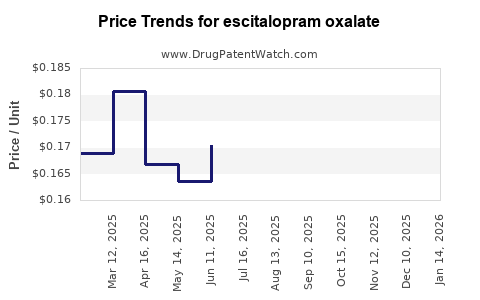
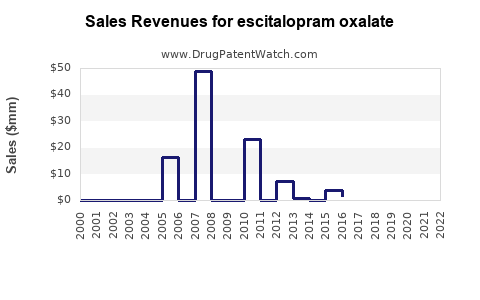
Last updated: September 4, 2026
Escitalopram oxalate is a mature, high-volume selective serotonin reuptake inhibitor sold primarily as generic escitalopram and historically marketed in the United States as Lexapro by Forest Laboratories, later acquired by Actavis and Allergan. U.S. composition-of-matter and exclusivity protection expired in 2012, eliminating branded pricing power and shifting the market toward low-cost generic supply. The product remains commercially relevant because of broad use in major depressive disorder and generalized anxiety disorder, established prescribing familiarity, and low manufacturing complexity.
What is escitalopram oxalate and how is it marketed?
Escitalopram oxalate is the oxalate salt of escitalopram, the pharmacologically active S-enantiomer of citalopram. It is an oral small-molecule antidepressant in the SSRI class.
The main U.S. indications are:
- Major depressive disorder in adults and adolescents aged 12 to 17.
- Generalized anxiety disorder in adults.
The product is sold in tablets, oral solution, and, in some markets, orally disintegrating or equivalent solid oral presentations. Common tablet strengths are 5 mg, 10 mg and 20 mg, expressed as escitalopram base equivalent under product labeling.
The original branded product was Lexapro. Generic manufacturers use names such as escitalopram tablets, escitalopram oral solution, or escitalopram oxalate, depending on the dosage form and regulatory filing.
Which companies commercialize escitalopram?
The market includes a large number of generic suppliers. Major U.S. participants have included:
- Teva Pharmaceutical Industries
- Viatris, formerly Mylan
- Sandoz
- Dr. Reddy's Laboratories
- Lupin
- Zydus Lifesciences
- Taro Pharmaceutical Industries
- Amneal Pharmaceuticals
- Hikma Pharmaceuticals
- Solco Healthcare
- Rising Pharmaceuticals and other contract and specialty suppliers
The supplier base is wider than for many recently launched products. This reduces dependence on a single manufacturer but increases price competition and limits the economic value of individual abbreviated new drug applications.
When did Lexapro lose exclusivity?
Lexapro lost practical U.S. market exclusivity in 2012 when generic escitalopram products entered following patent litigation and settlement arrangements. The brand's pediatric exclusivity period provided additional protection after the original patent term.
Forest Laboratories reported that Lexapro U.S. patent protection expired in March 2012. Generic competition then produced a rapid decline in branded sales and average selling prices. The product's principal commercial patent was U.S. Patent No. RE34,712, which covered the citalopram racemate and related technology. Escitalopram-specific protection was also associated with U.S. Patent No. 6,916,941, covering escitalopram oxalate and related crystalline forms. Patent and exclusivity treatment depended on the applicable patent, dosage form, pediatric extension and litigation settlement terms. [1][2]
Escitalopram exclusivity timeline
| Event |
Date |
Commercial effect |
| FDA approval of Lexapro NDA 021323 |
August 14, 2002 |
U.S. branded launch |
| Initial FDA-approved indications |
2002 onward |
Depression, later generalized anxiety disorder |
| Pediatric depression indication |
2005 |
Expanded eligible population |
| Pediatric exclusivity period |
2009 |
Extended regulatory protection |
| Generic ANDA approvals |
2012 |
Entry preparation and price pressure |
| Broad U.S. generic launch |
March 2012 |
Loss of branded market exclusivity |
| Patent estate after 2012 |
Limited practical value |
No meaningful branded barrier for standard tablets |
| Current status |
Mature generic market |
Volume remains; price and margins are compressed |
The exact legal effect of each patent depended on the dosage form and the claims asserted in litigation. For commercial forecasting, the central fact is that standard escitalopram tablets have been exposed to generic competition for more than a decade.
What patents protect escitalopram oxalate?
Escitalopram's historical patent estate included composition, stereochemical, salt, crystalline-form and formulation claims. Its current commercial strength is low for standard tablets because the key market protections have expired.
Principal historical patent categories
| Patent category |
Covered subject matter |
Current commercial relevance |
| Racemate and citalopram patents |
Citalopram chemistry and pharmaceutical use |
Expired |
| Escitalopram composition patents |
S-enantiomer and oxalate salt |
Expired or commercially exhausted |
| Crystalline-form patents |
Solid-state forms and manufacturing characteristics |
Limited after generic entry |
| Formulation patents |
Tablets, oral solutions and dosage characteristics |
Product-specific and generally weak for standard products |
| Method-of-use patents |
Depression, anxiety and related treatment methods |
Usually difficult to enforce against ordinary generic prescribing |
| Manufacturing patents |
Resolution, purification and crystallization processes |
May remain relevant to particular processes, but rarely blocks ordinary generic supply |
U.S. Patent No. 6,916,941 is commonly associated with escitalopram oxalate and was listed with an expiration date in 2022 before any applicable patent-term adjustment or pediatric extension. Any extension did not restore branded exclusivity in the standard U.S. tablet market after the 2012 generic launch. [2][3]
How strong is the escitalopram patent estate?
The estate is commercially weak for three reasons:
- The core molecule and principal salt protection are expired.
- Multiple manufacturers have demonstrated noninfringing routes and formulations.
- Standard tablets are readily substitutable under state pharmacy laws and payer formularies.
Residual patent value may exist for specialized formulations, manufacturing processes or geographic markets where local protection differs. That value is unlikely to support a new branded franchise without a differentiated delivery system, combination product or clinically meaningful indication.
What is the FDA and Orange Book status of escitalopram?
Lexapro was approved by the FDA under NDA 021323. Generic escitalopram products are approved through ANDAs demonstrating pharmaceutical equivalence and bioequivalence to the relevant reference product. The Orange Book identifies reference-listed drugs, therapeutic equivalents and applicable patent or exclusivity information. [4]
Orange Book status
Escitalopram tablets and oral solution are established generic products. Lexapro is no longer protected by meaningful, active U.S. market exclusivity for its principal dosage forms. Orange Book listings can change as patents expire, delist, or become legally irrelevant to commercial entry.
The regulatory pathway is favorable for new generic entrants when:
- The applicant can demonstrate bioequivalence.
- The dosage form matches an approved reference product.
- The applicant avoids active patent claims or prevails in Paragraph IV litigation.
- Manufacturing capacity meets FDA requirements.
Which companies challenged Lexapro patents?
Forest Laboratories faced generic challenges before the 2012 loss of exclusivity. Teva and other generic companies filed patent challenges or prepared abbreviated applications that triggered the Hatch-Waxman framework. Forest and generic manufacturers entered settlement arrangements that governed launch timing and commercial rights.
Public reporting indicated that Forest settled patent litigation with several generic companies, including Teva, with launch terms preceding or coinciding with the 2012 patent expiry period. The agreements helped establish a controlled transition but did not prevent broad generic erosion after launch. [1][5]
What did Paragraph IV litigation mean for escitalopram?
A Paragraph IV certification asserts that a listed patent is invalid, unenforceable or not infringed. The filing can trigger patent litigation and a 30-month stay of FDA approval for the challenged ANDA, subject to statutory conditions.
For Lexapro, Paragraph IV activity affected the timing and structure of generic entry. The commercial outcome was a limited period of negotiated entry followed by broad competition. Unlike products with a single first-filer and extended 180-day exclusivity, escitalopram ultimately developed into a multi-supplier market.
What was the financial impact of generic escitalopram entry?
Lexapro was one of Forest Laboratories' largest products before generic entry. Its revenue trajectory illustrates the typical small-molecule loss-of-exclusivity curve: high branded revenue before entry, an initial transition period, then rapid collapse as pharmacy substitution and payer pressure take effect.
Lexapro revenue trajectory
| Period |
Approximate commercial position |
Financial interpretation |
| 2008-2010 |
Peak branded maturity |
High prescription volume and premium pricing |
| Fiscal 2011 |
About $2.2 billion in Lexapro net sales reported by Forest |
Major contributor to Forest revenue |
| Fiscal 2012 |
About $2.1 billion reported, with generic entry late in the period |
Limited annual impact because entry occurred near year-end |
| Fiscal 2013 |
Sharp decline |
Full-year generic substitution materially reduced sales |
| 2014 onward |
Residual brand sales |
Brand became a smaller, lower-growth asset |
Forest Laboratories reported Lexapro net sales of approximately $2.2 billion in fiscal 2011 and approximately $2.1 billion in fiscal 2012. The financial effect of generic entry became much clearer in the subsequent fiscal year, when full-year generic substitution reduced both branded volume and net price. [1]
The decline was driven by more than unit displacement. Generic entry also caused:
- Rebates and discounts on remaining brand prescriptions.
- Lower pharmacy and payer willingness to stock the brand.
- Reduced promotional return on investment.
- Lower physician sensitivity to brand differentiation.
- Inventory and channel adjustments around launch.
What happened to brand revenue after loss of exclusivity?
Branded revenue typically falls in stages. Initial erosion may be moderated by authorized generics, supply contracts, patient loyalty and prescriber inertia. Once pharmacy substitution becomes routine, the remaining brand demand is concentrated in patients or plans with specific brand preferences.
For escitalopram, the long-term revenue pool shifted from one originator company to a distributed generic market. Total prescription volume remained substantial, but economic value per tablet declined sharply.
How large is the current escitalopram market?
Market estimates vary because analysts use different definitions. Some count only branded and generic escitalopram. Others combine escitalopram with citalopram, antidepressants, or the broader SSRI category. Reported global market estimates therefore should not be compared without reviewing product scope, geographic coverage and channel assumptions.
The current market is best characterized as:
- High-volume.
- Low-price.
- Generic dominated.
- Stable to modestly growing in unit demand.
- Limited in manufacturer-level profitability.
- Supported by chronic treatment duration and broad primary-care use.
Growth is more likely to come from prescription volume, diagnosis rates, treatment persistence and expansion in emerging markets than from price increases.
What drives escitalopram demand?
Demand is supported by:
- Continued prevalence of depression and anxiety disorders.
- Primary-care prescribing.
- Familiarity among physicians and patients.
- Low generic acquisition cost.
- Availability in multiple strengths and dosage forms.
- Use across public and private reimbursement systems.
Demand is constrained by:
- Competition from sertraline, fluoxetine, paroxetine and other SSRIs.
- Competition from serotonin-norepinephrine reuptake inhibitors and newer antidepressants.
- Treatment discontinuation and nonadherence.
- Generic price deflation.
- Safety monitoring and prescribing restrictions in younger patients.
How does escitalopram compare with competing antidepressants?
| Drug |
Class |
U.S. exclusivity position |
Commercial profile |
| Escitalopram |
SSRI |
Mature generic |
High volume, low unit economics |
| Citalopram |
SSRI |
Mature generic |
Older low-cost substitute |
| Sertraline |
SSRI |
Mature generic |
Strong institutional and primary-care use |
| Fluoxetine |
SSRI |
Mature generic |
Very low cost, long half-life |
| Paroxetine |
SSRI |
Mature generic |
Generic, with tolerability and withdrawal considerations |
| Venlafaxine |
SNRI |
Mature generic |
Broader mechanism, multiple dosage forms |
| Duloxetine |
SNRI |
Generic after major patent expiry |
Higher-value historical market, now price competitive |
| Vortioxetine |
Multimodal antidepressant |
Branded protection |
Higher price and differentiated positioning |
Escitalopram competes effectively on tolerability, simplicity, physician familiarity and generic price. It has limited protection against therapeutic substitution because prescribers can switch among several low-cost antidepressants.
Are biosimilar risks relevant to escitalopram?
No. Escitalopram oxalate is a synthetic small molecule, not a biologic. Biosimilar regulation does not apply.
The relevant competitive risks are:
- ANDA-based generic entry.
- Authorized generic supply.
- Contract manufacturing competition.
- API price changes.
- FDA inspection or supply interruptions.
- Pharmacy benefit manager substitution.
- Therapeutic switching to other antidepressants.
This distinction matters for valuation. Escitalopram does not require a biologics-style interchangeability analysis, complex comparability package or reference-product exclusivity strategy.
What formulation and manufacturing barriers remain?
Standard escitalopram tablets have low technical barriers. The most important manufacturing requirements are control of:
- Enantiomeric purity.
- Oxalate salt formation.
- Crystalline form and particle characteristics.
- Dissolution performance.
- Impurity profile.
- Content uniformity.
- Stability and packaging.
Escitalopram is the active S-enantiomer, so stereochemical control is central to API production. A manufacturer that can reliably produce high-purity API and maintain validated tablet dissolution can compete without accessing the originator's process.
Specialized oral solutions may create greater formulation and supply-chain complexity than ordinary tablets. They still do not generally create a durable market barrier unless supported by enforceable, unexpired patents, regulatory exclusivity or a meaningful distribution advantage.
What generic launch scenarios exist for escitalopram?
The principal launch scenarios are:
Low-price, high-volume supply
A large manufacturer competes on scale, tenders and wholesale distribution. Margins are thin, but volume can support acceptable returns.
Specialty dosage-form supply
A supplier focuses on oral solution or less crowded strengths. The opportunity is smaller but may provide better pricing than standard 10 mg and 20 mg tablets.
Contract and private-label supply
Manufacturers supply wholesalers, pharmacy chains or government programs under private labels. This model emphasizes manufacturing efficiency and reliable delivery.
Geographic expansion
Companies may target markets where generic penetration is incomplete, local registration is required, or branded products retain higher shares. Patent expiry in the United States does not establish freedom to operate in every jurisdiction.
What licensing deals affect escitalopram?
Escitalopram's commercial history was shaped more by patent settlements, generic supply arrangements and corporate acquisitions than by major current licensing transactions.
Key corporate events included:
- Forest Laboratories' development and commercialization of Lexapro.
- Actavis' acquisition of Forest Laboratories in 2014.
- Allergan's later corporate restructuring and divestiture activity.
- Generic manufacturer settlements and market-entry agreements around the U.S. patent disputes.
Because the principal product is now generic, licensing value is more likely to relate to manufacturing rights, regional registrations, API supply, authorized-generic arrangements or specialized dosage forms than to a global brand license.
What patent litigation affects escitalopram today?
The major U.S. patent litigation cycle occurred before and around generic entry in 2012. Current litigation risk is more likely to involve:
- Product liability.
- Manufacturing quality.
- FDA warning or recall matters.
- ANDA disputes over a specialized formulation.
- Patent claims covering a new combination, delivery system or indication.
- Regulatory exclusivity for a reformulated product.
A new entrant should not assume that all escitalopram-related claims are expired solely because Lexapro's core exclusivity ended. Freedom-to-operate analysis must review the specific formulation, manufacturing route, indication and jurisdiction. For ordinary escitalopram tablets, however, the risk of a blocking patent is low.
What is the geographic coverage of escitalopram patents?
Patent expiry is jurisdiction-specific. The United States, European Union, Japan, Canada, China, India and other markets applied different filing dates, prosecution histories, patent-term rules and supplementary protection mechanisms.
Commercial exposure depends on:
- Local patent status.
- National marketing authorization.
- Reference-product requirements.
- Government procurement.
- Local manufacturing rules.
- API import restrictions.
- Reimbursement and substitution policies.
U.S. expiry created the most visible financial event because the United States historically generated a large share of Lexapro's branded value. In other markets, generic entry timing varied.
What is the investment outlook for escitalopram?
Escitalopram is a defensive generic product rather than a high-growth branded opportunity. Its investment profile depends on operating scale, manufacturing cost, geographic reach and portfolio fit.
Positive factors include:
- Persistent demand.
- Broad physician familiarity.
- Low clinical switching barriers.
- Multiple dosage forms.
- Relatively straightforward solid-oral manufacturing.
Negative factors include:
- Severe price competition.
- Limited patent protection.
- Low differentiation.
- Exposure to pharmacy purchasing power.
- Possible product consolidation and supply interruptions.
- Substitution by other generic antidepressants.
Revenue exposure is most attractive for manufacturers with low-cost API access, efficient plants and large distribution networks. It is less attractive for companies dependent on premium branded pricing or a single product.
Key Takeaways
- Escitalopram oxalate is a mature, generic-dominated SSRI market.
- Lexapro's practical U.S. exclusivity ended in 2012 after patent litigation and generic entry.
- Forest Laboratories generated roughly $2.1 billion to $2.2 billion in annual Lexapro sales immediately before full generic erosion.
- Standard escitalopram tablets have low current patent strength and limited litigation risk.
- The product is not subject to biosimilar competition because it is a small molecule.
- Current value comes from volume, manufacturing efficiency, dosage-form coverage and geographic execution.
- Generic price deflation, not demand erosion, is the main financial pressure.
- New commercial opportunities are more likely in specialized formulations, contract supply and underpenetrated geographic markets than in branded U.S. tablets.
FAQs
Is escitalopram oxalate the same as Lexapro?
Lexapro is the former branded product containing escitalopram oxalate. Generic escitalopram products contain the same active pharmaceutical ingredient and are approved as therapeutically equivalent where designated by the FDA.
Can a new company still patent escitalopram?
A company generally cannot obtain a new composition-of-matter patent on the known escitalopram molecule. It may seek patents on genuinely novel formulations, combinations, manufacturing processes or therapeutic uses.
Does escitalopram have 180-day generic exclusivity remaining?
No. Any historical first-filer exclusivity associated with the original generic entry has long expired. The market now has multiple generic suppliers.
Why are escitalopram prices low despite continued demand?
Generic substitution, multiple approved manufacturers, payer negotiations and pharmacy purchasing concentration reduce prices. High prescription volume does not preserve the originator's premium after patent expiry.
Is escitalopram a suitable target for an authorized generic strategy?
It can support a high-volume authorized-generic strategy where supply reliability, manufacturing cost and distribution access are competitive. The opportunity is operational rather than patent-driven.
References
-
Forest Laboratories, Inc. (2013). Annual report pursuant to Section 13 or 15(d) of the Securities Exchange Act of 1934 for the fiscal year ended March 31, 2013. U.S. Securities and Exchange Commission.
-
U.S. Patent and Trademark Office. (2002). U.S. Patent No. 6,916,941: Escitalopram oxalate. Washington, DC: U.S. Department of Commerce.
-
U.S. Patent and Trademark Office. (1994). U.S. Patent No. RE34,712: Citalopram. Washington, DC: U.S. Department of Commerce.
-
U.S. Food and Drug Administration. (2024). Approved drug products with therapeutic equivalence evaluations: The Orange Book. Silver Spring, MD.
-
Federal Trade Commission. (2013). Authorized generic drugs: Short-term effects and long-term impact. Washington, DC: Federal Trade Commission.