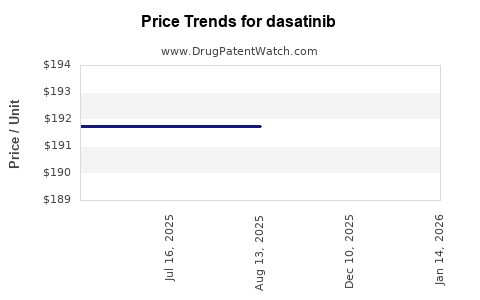
Last updated: September 4, 2026
Dasatinib is a mature oral tyrosine kinase inhibitor marketed primarily as Sprycel by Bristol Myers Squibb. Its commercial trajectory is defined by chronic use in chronic myeloid leukemia (CML), patent expiry in the United States, rapid generic entry, and declining branded revenue. The drug remains clinically important, but its economic profile has shifted from an innovative oncology asset to a high-volume, price-sensitive generic product.
What is the current market position of dasatinib?
Dasatinib is a second-generation BCR-ABL tyrosine kinase inhibitor approved for Philadelphia chromosome-positive CML and Philadelphia chromosome-positive acute lymphoblastic leukemia (Ph+ ALL). It inhibits BCR-ABL, SRC-family kinases, and related signaling pathways.
| Attribute |
Dasatinib |
| Brand |
Sprycel |
| Active ingredient |
Dasatinib |
| Originator |
Bristol Myers Squibb |
| Initial U.S. approval |
June 28, 2006 |
| Main indications |
Ph+ CML and Ph+ ALL |
| Dosage form |
Oral tablets |
| U.S. regulatory pathway |
New drug application, followed by abbreviated new drug applications |
| Primary competitors |
Imatinib, nilotinib, bosutinib, ponatinib, asciminib |
| Patent status |
Core U.S. patent protection expired in 2020, with pediatric exclusivity affecting timing |
| Current commercial phase |
Branded decline and generic substitution |
The drug gained share in CML because of its activity in patients resistant or intolerant to imatinib. Its position has since faced pressure from other second-generation TKIs, newer agents such as asciminib, and generic dasatinib.
How much revenue does Sprycel generate?
Bristol Myers Squibb's Sprycel revenue has declined substantially since generic entry. Reported revenue was approximately:
| Fiscal year |
Sprycel revenue, approximately |
Year-over-year direction |
| 2019 |
$2.1 billion |
Stable to modest decline |
| 2020 |
$2.0 billion |
Declining as generic entry approached |
| 2021 |
$1.9 billion |
Down |
| 2022 |
$1.7 billion |
Down |
| 2023 |
$1.4 billion |
Down sharply |
| 2024 |
Approximately $1.0 billion |
Continued erosion |
The figures reflect Bristol Myers Squibb product sales and should not be treated as total global dasatinib market revenue. Generic sales, distributor discounts, regional products, and hospital procurement are not fully captured in the branded figure. Bristol Myers Squibb has reported continuing erosion from generic competition in its annual filings (Bristol Myers Squibb, 2020-2024).
The financial trajectory is likely to remain negative for Sprycel. Brand revenue can persist after patent expiry through physician familiarity, supply reliability, payer formulary position, and use in patients stabilized on treatment. Those advantages weaken as multiple generic suppliers enter and payers increase substitution.
When did dasatinib lose U.S. patent exclusivity?
The principal U.S. compound patent for dasatinib was U.S. Patent No. 6,596,746, assigned to Bristol-Myers Squibb Company. The patent covered dasatinib and related compounds and had an expiration date in 2020, subject to applicable patent-term adjustment and pediatric exclusivity.
| Protection category |
Key date or status |
| U.S. patent covering the active compound |
U.S. Patent No. 6,596,746 |
| Original U.S. approval |
June 2006 |
| Core patent expiry |
2020 |
| Pediatric exclusivity |
Added six months to applicable exclusivity periods |
| Generic launch window |
2020 onward |
| Current status |
Generic competition established |
The FDA Orange Book listed patents and associated exclusivity information for Sprycel. Core compound protection did not extend into the late 2020s. Any remaining protection was more limited and product-specific, including pediatric exclusivity, method-of-use claims, or formulation-related rights (FDA, Orange Book).
What generic competition affects dasatinib?
Generic dasatinib is approved in the United States through the ANDA pathway. Generic manufacturers have included companies such as Teva, Apotex, Sun Pharmaceutical Industries, Zydus, Dr. Reddy's Laboratories, and other regional suppliers, depending on product strength and market period.
The competitive structure has several effects:
- Multiple ANDA approvals reduce the probability that one supplier can maintain premium pricing.
- Generic entry expands access for CML patients and reduces pharmacy acquisition costs.
- Supply interruptions or limited manufacturing capacity can temporarily support branded or secondary generic demand.
- Specialty-pharmacy distribution and oncology reimbursement can slow substitution compared with conventional primary-care medicines.
- The large number of approved strengths and dose adjustments increases manufacturing and inventory complexity.
The main commercial risk to BMS is not the existence of one generic competitor. It is the cumulative effect of several suppliers competing on price across 20 mg, 50 mg, 70 mg, 80 mg, 100 mg, and 140 mg tablet strengths.
Which companies challenged Sprycel patents under Paragraph IV?
Generic applicants seeking approval before expiry of listed patents could file Paragraph IV certifications alleging that patents were invalid, unenforceable, or not infringed. Dasatinib litigation and settlement activity involved multiple ANDA applicants over the years.
Publicly visible generic participants have included Teva Pharmaceuticals, Apotex, Sun Pharmaceutical Industries, Zydus, Dr. Reddy's Laboratories, and other ANDA sponsors. The exact commercial entry date for each company depended on litigation outcomes, settlement provisions, regulatory approval, and supply decisions.
Paragraph IV activity was commercially important because an early generic entrant could obtain a 180-day period of marketing exclusivity if it qualified as the first filer. The practical value of that exclusivity depended on the number of first filers, settlement terms, patent outcomes, and the timing of FDA approval.
What is the Orange Book status of Sprycel?
The Orange Book is the principal U.S. reference for approved products, listed patents, and therapeutic-equivalence information. Sprycel's core patent protection has expired, and generic dasatinib products have entered the U.S. market.
Orange Book analysis should distinguish among:
- Patents covering the active ingredient.
- Patents covering specific methods of treatment.
- Patents covering formulations or dosage forms.
- Regulatory exclusivity separate from patent protection.
- Listed patents that may no longer create a meaningful commercial barrier because of expiry or litigation outcomes.
For mature oral oncology products, Orange Book listings can affect ANDA timing even when the commercial value of the patent estate is declining. A patent with narrow claims may remain legally relevant without preventing generic substitution for the principal indications.
What formulations are protected by dasatinib patents?
Sprycel is supplied as immediate-release tablets. The commercial formulation contains dasatinib monohydrate and inactive ingredients used to provide tablet stability, dissolution, and manufacturability.
Potential formulation-related protection can cover:
- Dasatinib salt or hydrate forms.
- Crystal morphology.
- Tablet composition.
- Dissolution characteristics.
- Stability under storage conditions.
- Specific dose strengths.
- Methods of administering the drug with or without food.
- Treatment regimens for CML or Ph+ ALL.
Formulation patents generally provide narrower protection than a compound patent. Their commercial effect depends on whether an ANDA product can avoid the claim through a different excipient system, manufacturing process, solid form, or labeling strategy.
Dasatinib also has clinically relevant food and pH considerations. The drug's solubility can be affected by gastric pH, which creates technical and labeling considerations for generic development. Those issues can increase development complexity but have not prevented broad generic entry.
Does dasatinib have biosimilar risk?
Dasatinib has no biosimilar risk because it is a chemically synthesized small-molecule drug. Biosimilar approval under the Biologics Price Competition and Innovation Act applies to biologic products, not conventional small-molecule tablets.
The applicable competitive pathway is the ANDA system. Generic manufacturers must demonstrate pharmaceutical equivalence and bioequivalence rather than biosimilarity.
This distinction matters commercially:
| Issue |
Dasatinib |
Biologic product |
| Competitive pathway |
ANDA |
351(k) biosimilar application |
| Substitution framework |
State pharmacy laws and therapeutic equivalence |
Interchangeability and biologic substitution rules |
| Manufacturing complexity |
Solid-dose pharmaceutical manufacturing |
Biologic process and analytical comparability |
| Primary price pressure |
Generic substitution |
Biosimilar contracting and formulary competition |
How strong is the dasatinib patent estate?
The patent estate is commercially weak for maintaining branded exclusivity in the United States because the broad compound patent expired and multiple generic products are available.
| Patent-estate factor |
Assessment |
| Core compound protection |
Expired |
| U.S. generic barrier |
Low |
| Formulation protection |
Potentially narrow and product-dependent |
| Method-of-use protection |
Limited by label scope and claim breadth |
| Manufacturing protection |
Relevant to process economics, less effective against finished-dose competition |
| International protection |
Variable by country |
| Litigation leverage |
Reduced after generic launches |
| Long-term brand defense |
Limited |
The remaining intellectual-property value is more likely to arise from manufacturing know-how, supply reliability, brand recognition, and regulatory history than from broad exclusionary patent rights.
What patent litigation and settlements affect generic entry?
Dasatinib litigation centered on ANDA filings and challenges to listed patents. As with other high-value oncology drugs, settlement agreements may have determined the date on which individual generic companies could launch, subject to regulatory approval and other conditions.
The public commercial outcome is clear: generic entry occurred in the United States after the core exclusivity period, and Sprycel revenue subsequently declined. The economic impact of any individual settlement is less important now than the aggregate number of approved suppliers and the level of generic penetration.
Settlements can still affect:
- The first date of authorized or independent generic launch.
- The number of launch competitors.
- Allocation of generic supply rights.
- Potential damages exposure.
- The timing of price erosion.
- Distribution arrangements with specialty pharmacies.
How does dasatinib compare with competing CML drugs?
Dasatinib competes in a treatment market with several BCR-ABL inhibitors. The most relevant comparison is clinical positioning, resistance coverage, tolerability, and price.
| Drug |
Company or originator |
Generation or class |
Key commercial issue |
| Imatinib |
Novartis originator |
First-generation TKI |
Broad generic competition and low price |
| Dasatinib |
Bristol Myers Squibb |
Second-generation TKI |
Generic entry and declining brand sales |
| Nilotinib |
Novartis |
Second-generation TKI |
Generic competition and cardiovascular safety considerations |
| Bosutinib |
Pfizer |
Second-generation TKI |
Smaller commercial base and generic pressure |
| Ponatinib |
Takeda |
Later-generation TKI |
Reserved for resistant disease; safety restrictions |
| Asciminib |
Novartis |
STAMP inhibitor |
Newer mechanism and premium pricing |
Asciminib is the most significant newer branded competitor in patients who have failed prior TKIs or require a different mechanism. It is not a direct generic substitute for dasatinib, but it can reduce future dasatinib use in selected treatment lines.
What generic launch scenarios exist for dasatinib?
The U.S. market has already moved beyond the first generic-launch phase. The most likely commercial scenarios are:
High generic penetration
Multiple suppliers compete across all major strengths. Payers impose automatic or near-automatic substitution, and Sprycel becomes a limited-volume product used when physicians or payers require the branded product.
Moderate generic penetration
The brand retains share in specialty channels, government programs, or patients with stable treatment histories. Net pricing falls, but BMS preserves a residual revenue stream.
Supply-constrained generic market
Manufacturing problems, shortages, or withdrawals reduce the number of active suppliers. The brand may recover temporary share, especially for less common strengths such as 20 mg or 140 mg.
The high-penetration scenario is the baseline for a mature oral oncology product with an expired core patent and multiple approved ANDAs.
What geographic coverage and manufacturing barriers matter?
Patent and market outcomes differ by country. European, Canadian, Japanese, and emerging-market exclusivity periods may not align with U.S. dates. Local patent term adjustments, supplementary protection certificates, regulatory data protection, and national litigation can shift generic entry.
Manufacturing barriers are moderate rather than prohibitive. Dasatinib is a potent active pharmaceutical ingredient requiring controlled handling, validated containment, and consistent solid-state and dissolution performance. Finished-dose production is less complex than biologic manufacturing, but quality failures can create supply shortages.
The most meaningful barriers are:
- Controlled handling of a potent oncology compound.
- Reliable production of multiple strengths.
- Consistent dissolution and bioequivalence.
- Global regulatory compliance.
- Sufficient scale to compete after price erosion.
- Stable supply-chain access to active ingredient.
These barriers can reduce the number of commercially active suppliers without restoring the original branded pricing structure.
What is the investment and licensing outlook for dasatinib?
Dasatinib is unlikely to attract major originator-style licensing premiums as a standalone asset. Its value is concentrated in:
- Generic manufacturing portfolios.
- Regional distribution rights.
- Authorized-generic arrangements.
- Oncology hospital contracts.
- Combination-treatment research.
- Lifecycle opportunities involving novel delivery systems or new indications.
Licensing interest may arise where a manufacturer has low-cost API access, strong regulatory infrastructure, or distribution control in markets with delayed generic penetration. The economics are more likely to favor volume and operational efficiency than royalty-heavy brand licensing.
Key Takeaways
- Dasatinib is a mature oral oncology drug with established generic competition.
- Sprycel's core U.S. patent, U.S. Patent No. 6,596,746, expired in 2020, subject to applicable exclusivity adjustments.
- Bristol Myers Squibb's Sprycel revenue has fallen from roughly $2 billion annually before widespread generic erosion to approximately $1 billion or less in the latest period.
- The relevant competitive pathway is ANDA-based generic entry, not biosimilar substitution.
- Formulation, method-of-use, and manufacturing patents may provide narrower protection but do not recreate broad compound exclusivity.
- Asciminib and other TKIs create clinical competition, while generic dasatinib creates the dominant pricing threat.
- The likely long-term market is high-volume, low-margin, and divided among multiple generic suppliers.
FAQs About Dasatinib Patent Expiry and Market Competition
Is Sprycel still commercially viable after generic entry?
Yes, but its revenue base is materially smaller. Brand persistence depends on payer policy, supply reliability, specialty-pharmacy access, and physician preference.
Can a generic company launch a different dasatinib formulation?
Potentially. A manufacturer may develop a formulation that satisfies bioequivalence requirements while avoiding certain formulation claims, subject to FDA approval and applicable patent certifications.
Will dasatinib prices continue to decline?
The most likely direction is continued price pressure as additional suppliers compete. Shortages or supplier withdrawals can cause temporary reversals.
Is dasatinib protected by a composition-of-matter patent outside the United States?
Protection varies by country. National patent terms, supplementary protection certificates, and local litigation determine the effective exclusivity date in each market.
Is dasatinib still used as first-line therapy for CML?
Yes. It remains an approved and clinically used option, although treatment selection depends on disease phase, cardiovascular and pulmonary risk, resistance profile, physician preference, and the availability of newer TKIs.
References
-
Bristol Myers Squibb. (2020). 2020 annual report. Bristol Myers Squibb Company.
-
Bristol Myers Squibb. (2021). 2021 annual report. Bristol Myers Squibb Company.
-
Bristol Myers Squibb. (2022). 2022 annual report. Bristol Myers Squibb Company.
-
Bristol Myers Squibb. (2023). 2023 annual report. Bristol Myers Squibb Company.
-
Bristol Myers Squibb. (2024). 2024 annual report. Bristol Myers Squibb Company.
-
U.S. Food and Drug Administration. (2006). FDA approves Sprycel for chronic myeloid leukemia. U.S. Department of Health and Human Services.
-
U.S. Food and Drug Administration. (n.d.). Approved drug products with therapeutic equivalence evaluations: Orange Book. U.S. Department of Health and Human Services.
-
U.S. Patent and Trademark Office. (2003). U.S. Patent No. 6,596,746: Hydroxyethyl piperazine derivatives as protein tyrosine kinase inhibitors. United States Patent and Trademark Office.