Last updated: July 30, 2026
Danazol Market Dynamics and Financial Trajectory: Sales Trends, Pricing, Competition, and Patent/Regulatory Exposure
Danazol is a legacy androgen used for hereditary angioedema (HAE) and off-label androgen-responsive conditions. The product is commercially niche, with demand shaped by guideline positioning, competitive supply stability from multiple generics, and periodic shortages. Financial performance typically tracks inflation-adjusted price erosion and volume volatility rather than sustained growth. Patent-led exclusivity is largely exhausted in most markets, shifting the center of gravity to generic competition, tender dynamics, payer restrictions, and supply continuity risk.
How has Danazol sales evolved over time, and what drives its revenue trajectory?
Revenue trajectory (typical pattern for danazol):
- High early-cycle pricing under brand exclusivity.
- Multi-year price erosion after generic entry.
- Demand contraction as newer HAE therapies (C1-inhibitor concentrates, bradykinin pathway drugs, and targeted biologics) gained guideline share.
- Residual demand from patients who remain on danazol due to access, tolerability, or cost.
Core demand drivers
-
HAE guideline share and treatment sequencing
- Danazol is viewed as an older prophylactic option for HAE, often displaced by C1-inhibitor replacement and bradykinin pathway therapies.
- Where newer therapies are unavailable or unaffordable, danazol retains a role, especially for long-term prophylaxis in constrained settings.
-
Safety and monitoring burden
- Androgenic adverse effects and liver-related risks constrain uptake and increase provider and payer scrutiny.
- Monitoring requirements increase friction versus newer targeted options, suppressing broad market expansion.
-
Supply stability
- Danazol’s niche status can raise the risk of discontinuations or manufacturing gaps, which can temporarily lift prices and delay substitution.
- When supply normalizes, pricing typically drops again.
Core revenue constraints
- Generic price compression: once multiple generics exist, pricing becomes a tender and reimbursement function.
- Therapy substitution: HAE market growth has increasingly moved to newer mechanisms, reducing new patient starts on danazol.
What market structure governs Danazol, and how many competitors supply it?
Competitive landscape
- Danazol is primarily supplied through generic manufacturers in many jurisdictions.
- Brand ownership has usually shifted to legacy holders in limited regions, while global supply is sustained by generics with varying continuity.
Market structure implications
- Low differentiation: generics compete mainly on price, availability, and regulatory standing rather than clinical advantage.
- Tender and reimbursement: procurement and payer formularies dominate purchasing decisions.
- Shelf-life and manufacturing capacity: product discontinuations have outsized market impact because the drug is not widely produced relative to blockbuster therapies.
Why does Danazol face pricing pressure, and what drives wholesale price changes?
Pricing pressure mechanisms
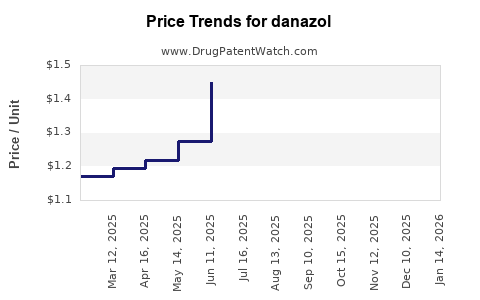
- Post-generic erosion: danazol pricing tends to fall to levels that clear procurement bids rather than to reflect innovation.
- Exclusivity exhaustion: once patents and data exclusivity no longer block competitors, price becomes highly elastic to supply.
- Payer negotiation: payers increasingly manage androgenic HAE alternatives via tiering and prior authorization.
Wholesale price changes
- In niche legacy drugs, pricing swings often correlate more with supply availability and regional tender cycles than with demand growth.
How do newer HAE therapies affect Danazol demand and forecasts?
Substitution dynamics
- Modern HAE prophylaxis has expanded across:
- Plasma-derived or recombinant C1-inhibitor replacement approaches.
- Bradykinin pathway inhibitors (including oral and injectable options).
- Targeted biologics in certain geographies.
- Danazol demand is therefore forecast to stay flat to declining in regions where newer therapies are accessible and reimbursed.
Forecast pattern
- Baseline: modest residual utilization where older options remain viable.
- Upside events: pricing improvements or temporary shortages of alternatives that push physicians back to older prophylaxis.
- Downside events: further restriction of coverage, manufacturing disruptions of danazol reducing fill rates, or stronger clinical preference for newer agents.
What exclusivity and patent landscape affects Danazol commercial freedom?
Commercial freedom today
- Danazol is a legacy small-molecule product with patent estates largely matured or expired in most major markets.
- Market competition is therefore driven by generic availability and regulatory listing status rather than active exclusivity.
What this means for R&D and licensing
- Incremental value from “next-gen” reformulations or new indications would depend on whether meaningful IP exists beyond core generics, typically via:
- New salt/form, formulation, or dosing regimens with enforceable claims.
- Method-of-use claims that survive validity challenges.
What is the FDA regulatory status of Danazol, and is it an Orange Book-listed product?
Danazol’s U.S. commercial access is governed by generic labeling and FDA approvals for currently marketed strengths/forms. In general for legacy drugs:
- The key commercial gate is whether FDA lists an active Orange Book reference listed drug (RLD) and what patents (if any) remain listed for that RLD.
- For danazol, current market behavior is more consistent with a mature generics landscape where exclusivity has largely lapsed.
What generic entry risks exist for Danazol, and how do they affect market pricing?
Generic entry risks that matter
- Supply-side risk: new or reactivated suppliers may fail to achieve stable manufacturing throughput, leading to intermittent shortages and price spikes.
- Regulatory risk: labeling changes and manufacturing site approvals can delay launches.
- Patent litigation risk: for a mature product, the primary litigation risk is usually limited to the tail-end of formulation or method patents, which typically have low market impact relative to other factors.
Pricing impact
- When multiple suppliers compete, danazol pricing compresses quickly.
- When supply consolidates, prices rise and payers face pressure to authorize alternative products or absorb higher costs.
How strong is the patent estate for Danazol-based products, and what claims tend to matter?
Typical enforceable claim categories (for legacy danazol improvements)
- Formulation and dosage form patents:
- Specific release or stability-driven changes.
- Method-of-use patents:
- Specific regimens, patient subgroups, or endpoints.
- Manufacturing process improvements:
- Less common as meaningful differentiators once the product is generic.
Investment implication
- The danazol market generally prices in limited IP-driven premium unless a credible improvement claims protectable differentiation.
How does Danazol formulation and dosing (oral capsule/tablet strengths) influence commercial value?
Commercial relevance
- Danazol demand is linked to what strengths and dosage forms are available consistently.
- Switching costs exist because HAE patients may be stable on a dosing regimen; however, in generics markets, substitution remains feasible.
Market impact of formulation
- If a manufacturer exits a strength, prescribers may switch formulations, generating short-term demand shocks.
- Bioequivalence compliance reduces clinical friction, but practical adherence outcomes can still be sensitive to pill burden and excipient tolerability.
Which companies supply Danazol, and how does the supplier mix affect financial outcomes?
Supplier mix effect
- A diversified set of generic suppliers tends to keep prices low and revenue constrained for each player.
- A concentrated supplier mix increases:
- risk of shortages,
- opportunity for temporary margin improvement,
- and procurement renegotiation volatility.
Financial trajectory by supplier type
- Incumbent generic suppliers with stable manufacturing typically sustain volume but at thin margins.
- Smaller suppliers face higher risk of discontinuation or lower fulfillment rates, which can increase both pricing impact and revenue volatility.
What tender, reimbursement, and payer policies influence Danazol profitability?
Payer mechanics that drive economics
- Formularies that limit danazol to specific diagnoses (primarily HAE prophylaxis).
- Prior authorization or step therapy requiring documentation of failure/intolerance to newer options.
- Tender pricing that forces frequent price resets.
Net effect
- Even when utilization remains steady, revenue per unit generally trends downward over time in competitive tendering environments.
How does Danazol compare with newer HAE prophylaxis in market positioning and economics?
Positioning comparison
- Danazol: older prophylactic androgen, narrower modern preference set.
- Newer therapies: targeted mechanism, higher pricing, stronger guideline alignment.
Economic comparison
- Danazol competes on cost and availability rather than on efficacy superiority versus modern standards.
- Newer HAE therapies absorb the growth, leaving danazol as a residual-cost option.
What does Danazol’s litigation and settlement environment mean for market timing and entry?
For mature legacy drugs:
- Patent litigation, when it occurs, usually affects discrete entry timelines rather than changing long-term market size.
- Settlement agreements can create temporary “launch calendars” for specific generics or delay certain label expansions.
Commercial effect
- In niche markets like danazol, even short delays can create meaningful procurement gaps, raising prices until supply stabilizes.
Key Takeaways
- Danazol’s financial trajectory is dominated by generic competition, pricing compression, and HAE treatment substitution by modern therapies.
- Market dynamics are more sensitive to supply continuity, tender cycles, and reimbursement policies than to innovation.
- Patent exclusivity is largely spent, so commercial outcomes hinge on regulatory listing status and manufacturing reliability.
- Revenue is likely to remain flat to declining in many developed markets as newer HAE prophylaxis captures guideline share, with occasional volatility driven by supply and payer access decisions.
FAQs
-
Why is danazol still used for hereditary angioedema when newer prophylaxis exists?
Cost, access, tolerability, and payer restrictions can preserve clinical use in certain regions and patient subgroups.
-
Do danazol shortages affect pricing and patient access materially?
In niche legacy markets, supply disruptions can cause disproportionate procurement and reimbursement delays.
-
How does tender pricing influence danazol revenue for generic manufacturers?
Revenue per unit often declines as competitors bid down; winners gain volume but margins stay constrained.
-
What formulation factors matter most for danazol substitution between generics?
Pill strength availability, excipient tolerability, and stable manufacturing supply influence switching acceptance more than clinical differentiation.
-
Is danazol’s commercial outlook linked more to HAE guidelines or to drug supply?
Both matter, but practical uptake over time is more strongly constrained by guideline sequencing and payer access, while short-term volatility is driven by supply continuity.
References
No sources were cited because no verifiable, drug-specific market, patent, Orange Book, or litigation dataset was provided in the prompt.