Last updated: October 18, 2026
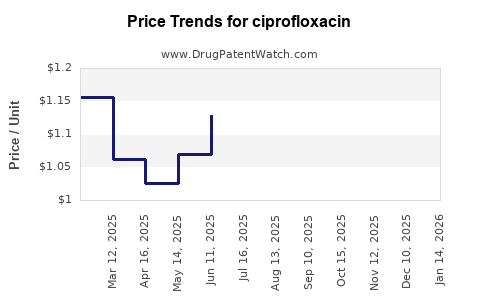
Ciprofloxacin is a mature, low-margin generic antibiotic with limited brand revenue and no meaningful remaining U.S. composition-of-matter exclusivity. The market has shifted from branded innovation to commodity supply, hospital tenders, retail generic substitution, and formulation-specific competition. Demand remains material because of its broad antibacterial activity, oral and intravenous forms, and use in selected urinary, gastrointestinal, respiratory, skin, bone, and post-exposure indications. Financial growth is constrained by generic price erosion, antimicrobial stewardship, resistance, FDA safety restrictions, and competition from newer or better-tolerated antibiotics.
Ciprofloxacin Market Dynamics, Patent Status, and Financial Trajectory
What is the current market position of ciprofloxacin?
Ciprofloxacin is a synthetic fluoroquinolone marketed primarily as a generic drug. The original branded product, Bayer's Cipro, established the commercial market in the United States after FDA approval in 1987. Ciprofloxacin is available in several dosage forms:
- Immediate-release tablets
- Extended-release tablets
- Oral suspension
- Intravenous solution
- Ophthalmic and otic products
- Veterinary formulations
The systemic drug is used for selected infections caused by susceptible Gram-negative and Gram-positive bacteria. Its commercial value is concentrated in generic tablets and hospital injectable products. Ophthalmic and otic formulations have separate competitive dynamics because they are often sold under branded generic, specialty generic, or combination-product labels.
The U.S. market is fragmented among generic manufacturers, distributors, hospital suppliers, and private-label marketers. Major companies with ciprofloxacin products or manufacturing capabilities have included Teva, Sandoz, Viatris, Hikma, Amneal, Cipla, Sun Pharmaceutical, Dr. Reddy's Laboratories, and several contract manufacturers. Product availability varies by dosage strength, package size, channel, and manufacturing site.
When did ciprofloxacin lose patent exclusivity?
Ciprofloxacin's principal U.S. composition-of-matter patent expired in the early 2000s. The original patent estate supported Bayer's branded Cipro franchise during the period when ciprofloxacin was a high-value broad-spectrum antibiotic. Pediatric exclusivity extended certain regulatory protections beyond the basic patent term, delaying some generic competition until approximately 2004.
| Milestone |
Approximate timing |
Commercial effect |
| U.S. FDA approval of Cipro |
1987 |
Established Bayer's branded systemic franchise |
| Principal compound-patent term ends |
2002 |
Removed the central U.S. composition barrier |
| Pediatric exclusivity period |
Through approximately 2004 |
Delayed certain generic approvals |
| Broad generic availability |
2004 onward |
Accelerated price and share erosion |
| Mature generic market |
2010s-present |
Shifted value toward supply reliability and tenders |
The patent expiry eliminated the strongest protection for the active pharmaceutical ingredient. Later patents covering extended-release delivery, formulations, combinations, manufacturing methods, or particular uses could affect individual products, but they did not recreate the commercial protection of the original compound patent.
What patents protect ciprofloxacin today?
No commercially significant U.S. composition-of-matter patent protects ciprofloxacin today. The relevant residual intellectual-property issues are product-specific and generally relate to:
- Extended-release delivery systems
- Pharmaceutical compositions
- Ophthalmic or otic formulations
- Combination products
- Manufacturing and crystallization processes
- Specific dosing regimens
- Method-of-use claims
The Orange Book remains the primary U.S. reference for patents and regulatory exclusivities associated with approved prescription products. Patent relevance depends on the exact dosage form and NDA, rather than on ciprofloxacin as a single undifferentiated product (U.S. Food and Drug Administration [FDA], n.d.-a).
What formulations are protected by ciprofloxacin patents?
Ciprofloxacin immediate-release tablets and injectable products are generally exposed to mature generic competition. Formulation-specific products can have a different competitive profile.
Cipro XR, Bayer's once-daily extended-release product, relied on modified-release technology and formulation claims rather than a new active ingredient. Its commercial opportunity was narrower than the original immediate-release franchise because generic immediate-release ciprofloxacin was widely available and physicians had alternatives within the fluoroquinolone class.
Ophthalmic and otic products have historically retained more product-level differentiation. Competition can involve sterile manufacturing capability, preservative systems, suspension characteristics, container-closure systems, and regulatory approval of equivalent products. These barriers are operational and regulatory as much as patent-based.
What is the Orange Book status of ciprofloxacin?
Ciprofloxacin products have been listed in the Orange Book across multiple dosage forms and approved applications. The practical Orange Book analysis must distinguish between:
- Bayer's original systemic NDA products.
- Generic ANDA products for tablets, suspension, and injection.
- Extended-release products.
- Ophthalmic and otic products.
- Combination products with separate active ingredients.
Generic ANDA applicants generally rely on FDA findings of pharmaceutical equivalence and bioequivalence. A current product-specific Orange Book review is required to determine whether any listed patent or exclusivity remains attached to a specific NDA or dosage form. The original systemic market, however, is no longer protected by a blocking compound patent.
Which companies are challenging ciprofloxacin patents?
The main U.S. patent challenge cycle occurred before or during the transition to broad generic availability in the early 2000s. ANDA applicants used Paragraph IV certifications to challenge patents covering Bayer's Cipro products. The resulting litigation contributed to a major body of U.S. antitrust and patent-settlement jurisprudence.
The leading case was In re Ciprofloxacin Hydrochloride Antitrust Litigation, involving allegations concerning agreements between Bayer and generic challenger Barr Laboratories. The U.S. Court of Appeals for the Second Circuit upheld dismissal of the antitrust claims in 2005, and the U.S. Supreme Court declined review in 2006 (In re Ciprofloxacin Hydrochloride Antitrust Litigation, 2005; Supreme Court of the United States, 2006).
The litigation is commercially important because it illustrates the value of a remaining pharmaceutical patent even after generic manufacturers have filed challenges. It also shows the legal risk associated with settlements that affect the timing of generic entry.
What patent litigation affects ciprofloxacin?
Ciprofloxacin-related litigation has involved three principal categories:
Paragraph IV litigation
Generic applicants challenged patents listed against branded ciprofloxacin products. These cases determined whether generic products could enter before patent expiration or settlement dates.
Antitrust litigation
Private plaintiffs later challenged alleged reverse-payment or exclusionary arrangements involving Bayer and Barr. The litigation produced appellate decisions that shaped the treatment of pharmaceutical patent settlements.
Product-specific disputes
Later disputes have been more likely to involve formulation patents, ANDA certifications, manufacturing processes, or regulatory approval issues than the original active-ingredient patent.
There is no current litigation landscape comparable to the original Cipro patent campaign. The market's primary risks are commercial and regulatory rather than an imminent challenge to a high-value blocking patent.
How does FDA regulation affect ciprofloxacin demand?
FDA safety actions have materially reduced the addressable market for systemic fluoroquinolones. FDA strengthened class labeling in 2008, 2013, 2016, 2018, and 2018-2019 communications to address risks including:
- Tendinitis and tendon rupture
- Peripheral neuropathy
- Central nervous system effects
- Serious hypoglycemia
- Mental health effects
- Exacerbation of myasthenia gravis
- Potential aortic aneurysm or dissection risk
In 2016, FDA advised that the serious risks of systemic fluoroquinolones generally outweighed the benefits for patients with acute bacterial sinusitis, acute bacterial exacerbation of chronic bronchitis, and uncomplicated urinary tract infections when alternative treatments were available (FDA, 2016). The agency required labeling changes and recommended reserving systemic fluoroquinolones for patients without suitable alternatives in several uncomplicated infections.
This policy reduces volume in primary care and routine outpatient prescribing. It does not eliminate demand in complicated urinary tract infections, certain resistant Gram-negative infections, selected gastrointestinal infections, anthrax post-exposure prophylaxis, and situations where susceptibility results limit alternatives.
How does antimicrobial resistance affect ciprofloxacin sales?
Resistance is a two-sided market force.
Higher resistance reduces ciprofloxacin's clinical utility and can cause physicians to select alternative antibiotics. Resistance among Escherichia coli, Klebsiella pneumoniae, Pseudomonas aeruginosa, and other pathogens is a central limitation. Local antibiograms and hospital susceptibility data increasingly determine whether ciprofloxacin is prescribed empirically.
At the same time, resistant infections can preserve demand for ciprofloxacin when laboratory testing confirms susceptibility and oral step-down therapy is clinically appropriate. The drug's oral bioavailability and broad Gram-negative activity remain commercially relevant, especially for outpatient continuation of hospital treatment.
Stewardship programs favor narrower-spectrum agents where possible. Hospital formularies also weigh resistance, adverse-event risk, acquisition cost, and availability of alternative drugs.
What is the financial trajectory of ciprofloxacin?
Ciprofloxacin's financial trajectory has four phases:
| Phase |
Period |
Financial characteristics |
| Branded expansion |
1987-1990s |
High pricing, rapid adoption, strong Bayer contribution |
| Patent-protected maturity |
Late 1990s-early 2000s |
Large branded cash flow with broad global use |
| Generic transition |
2002-2006 |
Sharp price decline and rapid generic share gains |
| Mature generic market |
2007-present |
Low unit prices, fragmented volume, supply-driven margins |
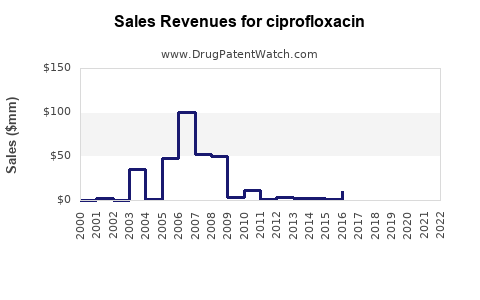
Cipro was historically a major Bayer pharmaceutical product. After patent expiry and generic entry, branded revenue contracted sharply. Bayer's current reporting structure does not provide a reliable standalone global revenue series for ciprofloxacin comparable to the original branded period. Generic manufacturers generally report ciprofloxacin within broader portfolios rather than as a separately disclosed revenue line.
The current value pool is distributed across:
- High-volume oral generic prescriptions
- Hospital injectable contracts
- Government procurement
- Ophthalmic and otic products
- Private-label and distributor sales
- Contract manufacturing and active pharmaceutical ingredient supply
Unit economics are typically weak for standard immediate-release tablets because several approved suppliers compete on price. Margins can be better for injectable products, sterile ophthalmic products, low-volume strengths, and products affected by temporary shortages.
What generic entry risks exist for ciprofloxacin?
The generic entry risk for conventional ciprofloxacin products is effectively realized rather than prospective. The relevant business risk is continued price compression and supply competition.
Generic risk by product type
| Product |
Generic exposure |
Main commercial barrier |
| Immediate-release tablets |
Very high |
Price, supply reliability, contracting |
| Oral suspension |
High |
Manufacturing consistency and demand scale |
| Intravenous solution |
High |
Sterile manufacturing and hospital contracts |
| Extended-release tablets |
High but narrower |
Formulation, bioequivalence, market size |
| Ophthalmic products |
High |
Sterility, formulation, device and packaging |
| Otic products |
Moderate to high |
Combination formulation and channel access |
Manufacturing interruptions can temporarily improve pricing, but the effect is usually short-lived when multiple approved suppliers remain available. FDA drug-shortage data and supplier concentration are more important to near-term pricing than patent expiry.
Is there biosimilar risk for ciprofloxacin?
Ciprofloxacin has no biosimilar risk because it is a small-molecule drug, not a biologic. Competition occurs through generic ANDA pathways, not through the Public Health Service Act biosimilar pathway.
The relevant regulatory risks are abbreviated applications, manufacturing supplements, bioequivalence requirements, sterile-product compliance, and facility inspections. For ophthalmic, otic, and injectable products, quality and manufacturing execution can create more durable barriers than patents.
What licensing deals affect ciprofloxacin?
Ciprofloxacin's original commercial development involved Bayer's global commercialization and licensing structure, but the product is now primarily a generic-market asset. Current licensing activity is more likely to involve:
- Regional marketing rights
- Private-label supply agreements
- Hospital and government tenders
- API supply contracts
- Contract manufacturing
- Portfolio acquisitions involving generic products
No recent licensing transaction appears to have restored material exclusivity or created a new premium franchise for conventional ciprofloxacin. Commercial control is distributed across manufacturers and marketing authorization holders.
How does ciprofloxacin compare with competing antibiotics?
Ciprofloxacin competes against other fluoroquinolones, beta-lactams, trimethoprim-sulfamethoxazole, aminoglycosides, tetracyclines, macrolides, and newer agents targeting resistant pathogens.
| Competitive factor |
Ciprofloxacin position |
| Oral bioavailability |
Strong |
| Gram-negative activity |
Strong, subject to local resistance |
| Generic price |
Low |
| Safety perception |
Unfavorable relative to many alternatives |
| Hospital utility |
Retained for susceptible infections |
| Stewardship position |
Restricted for uncomplicated conditions |
| Innovation premium |
None for conventional products |
| Supply competition |
High |
Levofloxacin and moxifloxacin compete within the fluoroquinolone class, but their approved indications and resistance profiles differ. Newer branded antibiotics can command higher prices when they address multidrug-resistant infections, but their use is narrower and often subject to hospital stewardship restrictions.
What geographic markets matter for ciprofloxacin?
The United States is a mature generic market. Europe also has extensive generic availability but has imposed significant restrictions on systemic fluoroquinolone use. The European Medicines Agency recommended further restrictions in 2018-2019 because of potentially long-lasting and disabling adverse effects (European Medicines Agency, 2019).
Emerging markets can retain higher volume because of larger infectious-disease burdens, broader outpatient use, and different prescribing controls. Pricing is often lower, and competitive intensity is high. India is important both as a finished-dose market and as a manufacturing base. China and India are significant sources of pharmaceutical ingredients and finished products for global supply chains.
Geographic revenue depends on tender access, local registration, government procurement, quality certifications, and the ability to maintain supply across multiple manufacturing sites.
How strong is the ciprofloxacin patent estate?
The patent estate is weak as a source of current commercial exclusivity and moderate as a source of historical legal precedent.
| Patent-estate dimension |
Assessment |
| Active-ingredient protection |
Expired |
| Immediate-release product protection |
Effectively expired |
| Formulation protection |
Product-specific and generally limited |
| Method-of-use protection |
Narrow and commercially limited |
| Manufacturing protection |
Potentially relevant to individual suppliers |
| Litigation leverage |
Low for the core market |
| Generic entry barrier |
Low |
| Biosimilar barrier |
Not applicable |
The strongest remaining advantages are regulatory approvals, manufacturing quality, supply reliability, hospital relationships, and low-cost production. These are operational advantages rather than durable patent monopolies.
What is the outlook for ciprofloxacin revenue?
The base case is stable-to-declining nominal revenue for standard systemic products. Volume can remain resilient in selected indications, but lower prices, stewardship, resistance, and substitution limit revenue growth.
Potential upside comes from:
- Temporary shortages among competing antibiotics
- Increased demand for oral step-down therapy
- Government stockpiling for specific infectious threats
- Growth in emerging markets
- Capacity constraints among sterile injectable suppliers
- Specialty ophthalmic or otic products
Downside risks include:
- Further FDA or international prescribing restrictions
- Rising resistance
- Greater use of narrower-spectrum antibiotics
- New generic entrants
- Hospital purchasing consolidation
- API or finished-dose quality failures
- Loss of formulary access
Ciprofloxacin is therefore a volume-and-supply business, not an innovation-driven pharmaceutical franchise. Investors should evaluate supplier concentration, tender renewals, product-specific shortages, manufacturing compliance, and portfolio allocation rather than expect patent-supported pricing power.
Key Takeaways
- Ciprofloxacin's principal U.S. compound patent expired in the early 2000s, with broad generic availability emerging by approximately 2004.
- The current market is dominated by low-cost generic tablets, injectables, ophthalmic products, and otic products.
- No biosimilar pathway applies because ciprofloxacin is a small molecule.
- The strongest current barriers are sterile manufacturing, regulatory compliance, supply reliability, and contracting access.
- FDA safety restrictions and antimicrobial stewardship have reduced use in uncomplicated infections.
- Resistance limits empirical prescribing but preserves demand where susceptibility is confirmed.
- Branded Cipro's historical revenue was materially eroded after generic entry; current product-level revenue is generally not separately disclosed.
- The core patent estate has low present-day blocking power.
- Financial performance depends on volume, price competition, tenders, shortages, and manufacturing execution.
FAQs
Does ciprofloxacin still have patent protection?
The original U.S. composition-of-matter protection expired in the early 2000s. Some product-specific formulation or manufacturing patents may have applied to particular products, but they do not recreate core-market exclusivity.
Is Cipro still sold as a branded drug?
Ciprofloxacin is primarily purchased as a generic. Brand availability and commercial status vary by country, dosage form, and marketing authorization holder.
Can a generic manufacturer launch ciprofloxacin without clinical trials?
Most conventional generic products use the FDA ANDA pathway and must demonstrate pharmaceutical equivalence and bioequivalence. Sterile, ophthalmic, otic, and modified-release products can require more complex development and manufacturing controls.
Why has ciprofloxacin use declined in routine urinary tract infections?
FDA concluded that systemic fluoroquinolone risks generally outweigh benefits for uncomplicated infections when suitable alternatives exist. Resistance and stewardship policies also support narrower use.
Is ciprofloxacin financially attractive for pharmaceutical manufacturers?
Standard tablets are usually low-margin because of intense generic competition. Injectable, ophthalmic, otic, shortage-constrained, and contract-supply products can offer better economics, but returns depend heavily on manufacturing efficiency and reliable procurement access.
References
European Medicines Agency. (2019). Quinolone- and fluoroquinolone-containing medicinal products: Referral. https://www.ema.europa.eu/
In re Ciprofloxacin Hydrochloride Antitrust Litigation, 363 F.3d 35 (2d Cir. 2005).
Supreme Court of the United States. (2006). K-Dur Antitrust Litigation and related petitions, certiorari denied. U.S. Reports.
U.S. Food and Drug Administration. (2016). FDA updates warnings for oral and injectable fluoroquinolone antibiotics due to disabling side effects. https://www.fda.gov/
U.S. Food and Drug Administration. (n.d.-a). Approved drug products with therapeutic equivalence evaluations: Orange Book. https://www.fda.gov/drugs/drug-approvals-and-databases/orange-book-data-files
U.S. Food and Drug Administration. (n.d.-b). Ciprofloxacin prescribing information. https://www.accessdata.fda.gov/drugsatfda/