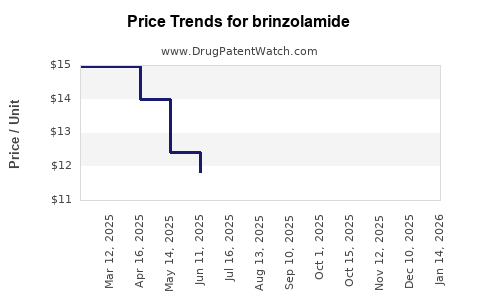
Last updated: October 14, 2026
Brinzolamide is a mature ophthalmic carbonic anhydrase inhibitor used primarily to reduce elevated intraocular pressure in open-angle glaucoma and ocular hypertension. The reference product, Azopt 1% ophthalmic suspension, was developed by Alcon and first approved by the FDA in 1998. Its core product exclusivity has expired, generic brinzolamide is available in the United States, and long-term commercial value has shifted from branded monotherapy to generic volume, combination products, and international markets.
Public filings do not separately disclose global revenue for Azopt or brinzolamide. The product’s financial trajectory is therefore best assessed through FDA approvals, patent status, generic entry, Alcon portfolio disclosures, and the economics of chronic glaucoma treatment.
What is brinzolamide and how does it work?
Brinzolamide is a topical carbonic anhydrase inhibitor supplied as a 1% ophthalmic suspension. It inhibits carbonic anhydrase II in the ciliary processes, reducing aqueous humor production and lowering intraocular pressure. The FDA-approved indication is the treatment of elevated intraocular pressure in patients with ocular hypertension or open-angle glaucoma.[1]
| Attribute |
Brinzolamide |
| Reference brand |
Azopt |
| Active ingredient |
Brinzolamide |
| Strength |
1% ophthalmic suspension |
| Therapeutic class |
Ophthalmic carbonic anhydrase inhibitor |
| Primary indications |
Open-angle glaucoma; ocular hypertension |
| Route |
Topical ophthalmic |
| Original sponsor |
Alcon |
| U.S. approval |
1998 |
| Prescription status |
Prescription drug |
| Primary competitors |
Dorzolamide, timolol, latanoprost, bimatoprost, travoprost, brimonidine |
| Combination product |
Simbrinza, brinzolamide 1%/brimonidine 0.2% |
Brinzolamide is typically administered three times daily as monotherapy. It can also be used with other intraocular-pressure-lowering drugs. Its suspension formulation differentiates it from dorzolamide, another topical carbonic anhydrase inhibitor.
When did brinzolamide lose exclusivity?
Brinzolamide lost effective U.S. market exclusivity after the expiration of its original regulatory and patent protections. FDA approval of generic brinzolamide ophthalmic suspension established that the core product could be commercialized without authorization from the Azopt sponsor.
The relevant exclusivity sequence was:
| Milestone |
Approximate timing |
Commercial effect |
| FDA approval of Azopt |
1998 |
Branded market entry |
| New chemical entity exclusivity |
Early 2000s |
Blocked abbreviated approval for the statutory exclusivity period |
| Core patent protection |
Expired before broad generic adoption |
Removed principal composition and product barriers |
| Generic brinzolamide approvals |
2010s |
Introduced direct price competition |
| Current market |
Mature generic market |
Volume remains, but branded pricing power is limited |
The FDA Orange Book, rather than the original launch date, controls the legal assessment of listed patents and regulatory exclusivity.[2] Patent term adjustments, pediatric extensions, and patent listing changes can affect the precise date applicable to a particular generic applicant.
What patents protect brinzolamide and Azopt?
The original brinzolamide patent estate covered the active compound and related pharmaceutical uses. Later protection focused on the ophthalmic suspension, vehicle, particle characteristics, and product formulation.
The commercial significance of those patents has declined because the principal U.S. exclusivity period has ended. Brinzolamide is no longer protected by an effective composition-of-matter monopoly comparable to that available at launch.
What formulations were protected?
Azopt was developed as a suspension rather than a conventional aqueous solution. The formulation challenge involved dispersing brinzolamide, maintaining dose uniformity, controlling particle size, and preserving ocular tolerability.
Potentially relevant formulation features included:
- Brinzolamide concentration and suspension stability.
- Viscosity and particle-size control.
- pH and ophthalmic vehicle composition.
- Preservative systems.
- Container and drop-delivery performance.
- Storage and redispersion characteristics.
Formulation patents can delay or complicate generic entry when they are listed in the Orange Book and remain enforceable. In the current brinzolamide market, formulation differentiation is more relevant to product quality, procurement, and substitution than to sustained monopoly pricing.
What is the FDA regulatory status of brinzolamide?
Brinzolamide remains an FDA-approved prescription ophthalmic product. Azopt is approved as a 1% ophthalmic suspension for reducing elevated intraocular pressure. Generic versions may be approved through abbreviated new drug applications if they demonstrate pharmaceutical equivalence and bioequivalence under the applicable FDA standards.[1][3]
The FDA regulatory structure has four commercial consequences:
- Generic applicants can rely on the reference product’s established safety and efficacy record.
- Products must satisfy ophthalmic manufacturing and quality requirements.
- Suspension performance creates technical requirements beyond simple active-ingredient matching.
- Approved generics can be substituted under state pharmacy laws, subject to local rules and payer formularies.
Brinzolamide is not a biologic. Biosimilar approval pathways do not apply. The competitive threat comes from conventional generic manufacturers, not biosimilar developers.
How many patents cover brinzolamide today?
The legally relevant number is the number of unexpired, Orange Book-listed patents associated with the applicable reference product. That number can change as FDA listings are added, delisted, or expire.
For the core brinzolamide monotherapy market, the commercial evidence indicates that original patent barriers no longer prevent generic competition. Any remaining patent risk is more likely to involve a specific formulation, combination product, delivery system, or method of use than the brinzolamide molecule itself.
A generic applicant may pursue:
- Paragraph I certification if no relevant patent is listed.
- Paragraph II certification if a listed patent has expired.
- Paragraph III certification if the applicant will wait for patent expiry.
- Paragraph IV certification if it alleges that a listed patent is invalid, unenforceable, or not infringed.
Publicly available evidence does not support treating brinzolamide monotherapy as an active, high-value patent-blocked market.
Which companies compete with brinzolamide?
Brinzolamide competes within a crowded glaucoma market rather than operating as a standalone therapeutic franchise.
| Product or class |
Representative products |
Competitive position |
| Prostaglandin analogs |
Latanoprost, bimatoprost, travoprost |
Often preferred for once-daily dosing |
| Beta blockers |
Timolol |
Low-cost, established generic option |
| Alpha agonists |
Brimonidine |
Generic and widely used |
| Carbonic anhydrase inhibitors |
Brinzolamide, dorzolamide |
Useful as monotherapy or adjunctive therapy |
| Fixed combinations |
Brinzolamide/brimonidine; dorzolamide/timolol |
Reduce drop burden and improve regimen consolidation |
| Rho kinase inhibitors |
Netarsudil |
Newer mechanism with differentiated commercial positioning |
Latanoprost and timolol exert substantial price pressure because they are inexpensive, familiar, and broadly available. Brinzolamide can retain demand where clinicians prefer its suspension formulation, where patients do not tolerate alternatives, or where it is used as part of multi-drug therapy.
What is the commercial role of Simbrinza?
Simbrinza combines brinzolamide 1% and brimonidine 0.2% in a single ophthalmic suspension. The FDA approved Simbrinza in 2013 for reducing elevated intraocular pressure in patients with open-angle glaucoma or ocular hypertension.[4]
The combination improves regimen convenience by replacing two separate products with one bottle. Its commercial protection has been more dependent on product-specific formulation, combination-product patents, regulatory exclusivity, and brand positioning than on the original brinzolamide molecule.
Simbrinza faces two forms of pressure:
- Generic substitution for its individual components.
- Generic or authorized-generic competition for the fixed-dose combination, where available.
Fixed combinations can maintain higher average selling prices than single-ingredient generics because they offer convenience and may reduce administration complexity. That advantage weakens when payers favor separate low-cost generic components.
What patent litigation and Paragraph IV challenges affect brinzolamide?
Brinzolamide monotherapy is a mature generic market, and there is no widely recognized current patent dispute that materially blocks generic access in the United States. Historical Paragraph IV activity would have been most relevant before or during generic entry, when an ANDA applicant challenged any unexpired Orange Book-listed patents covering Azopt.
The main litigation risks in this category are:
- Patent litigation over suspension formulation claims.
- Disputes over whether a generic label induces infringement of a method-of-use patent.
- Patent challenges involving fixed-dose brinzolamide combinations.
- Regulatory litigation concerning product-specific bioequivalence or substitution.
No current litigation record should be assumed to create a material barrier without confirmation from the FDA Orange Book and federal court dockets.
What generic entry risks exist for Azopt?
Generic entry risk is high because:
- The product has been on the market for more than two decades.
- Brinzolamide is a small molecule.
- The dosage form is established.
- Generic ophthalmic manufacturers have experience with suspension products.
- Payers can substitute or prefer lower-cost alternatives.
- Glaucoma treatment is chronic, creating stable but price-sensitive demand.
The main residual barriers are manufacturing rather than molecule-level intellectual property. A generic manufacturer must control suspension uniformity, particle size, sterility, preservative performance, container closure integrity, and drop delivery. These requirements can limit the number of reliable suppliers, but they do not restore branded exclusivity.
How strong is the brinzolamide patent estate?
The patent estate is weak for long-term monopoly protection and moderate for technical manufacturing protection.
| Patent dimension |
Assessment |
| Active ingredient |
Weak; mature generic status |
| Original composition patent |
Expired or commercially exhausted |
| Ophthalmic suspension |
Moderate technical relevance |
| Method of use |
Limited value unless tied to an enforceable, non-expired claim |
| Combination products |
Stronger than monotherapy, depending on listing and expiry |
| Manufacturing know-how |
Moderate barrier to consistent commercial supply |
| Biosimilar protection |
Not applicable |
| U.S. pricing protection |
Low |
The distinction between patent strength and manufacturing difficulty is important. A suspension may be difficult to make consistently while remaining legally open to generic competition.
What is the financial trajectory for brinzolamide?
Brinzolamide’s financial trajectory follows the standard lifecycle of a mature branded ophthalmic drug:
- Initial growth after Azopt launch.
- Expansion through chronic glaucoma use and ophthalmology promotion.
- Stabilization as a recognized alternative to dorzolamide.
- Revenue erosion after generic entry.
- Ongoing unit demand at lower prices.
- Portfolio value shifting toward combinations, supply contracts, and international markets.
Alcon reports revenue at business and product-category levels, but public annual reports do not consistently disclose a standalone global Azopt revenue line. The financial exposure is therefore smaller than the product’s historical clinical footprint suggests.
For the originator, revenue risk comes from:
- Generic substitution.
- Payer formulary pressure.
- Low-cost alternatives such as timolol and latanoprost.
- Reduced ophthalmologist promotion of mature brands.
- Declining average selling prices.
For generic manufacturers, the opportunity is volume-based. Margins depend on manufacturing efficiency, market concentration, supply reliability, and reimbursement status. Ophthalmic suspensions can offer more technical differentiation than simple oral tablets, but competition remains intense once several approved suppliers enter.
How does brinzolamide compare with dorzolamide?
Brinzolamide and dorzolamide are both topical carbonic anhydrase inhibitors, but they differ in formulation, dosing, tolerability, and market history.
| Attribute |
Brinzolamide |
Dorzolamide |
| Concentration |
1% suspension |
Commonly 2% solution |
| Class |
Carbonic anhydrase inhibitor |
Carbonic anhydrase inhibitor |
| Original brand |
Azopt |
Trusopt |
| Generic status |
Generic available |
Generic available |
| Typical dosing |
Three times daily |
Three times daily |
| Formulation issue |
Suspension handling and redispersion |
Solution tolerability and formulation |
| Combination use |
Brimonidine combination marketed as Simbrinza |
Timolol combination marketed as Cosopt |
| Commercial position |
Mature, lower-priced market |
Mature, highly competitive market |
Neither product has strong molecule-level pricing power. Clinical selection often depends on tolerability, formulary status, prior response, and whether the physician prefers a fixed-dose combination.
What geographic markets remain commercially relevant?
The United States is a mature generic market. Commercial opportunity remains in:
- Markets with slower generic penetration.
- Countries where Azopt retains brand recognition.
- Regions with fragmented pharmacy distribution.
- Public health systems that procure ophthalmic products through tenders.
- Markets where suspension manufacturing capacity is limited.
International patent status is jurisdiction-specific. U.S. expiry does not establish freedom to operate in Europe, Japan, China, or emerging markets. Local patent registers, regulatory exclusivity rules, and procurement systems determine launch timing.
What generic launch scenarios are most likely?
The base case is continued generic erosion of Azopt pricing with stable or slowly declining aggregate unit demand. The most likely scenarios are:
| Scenario |
Market outcome |
| Multiple generic suppliers |
Rapid price erosion and fragmented volume |
| Limited reliable suppliers |
Moderate pricing stability due to supply constraints |
| Greater fixed-combination uptake |
Brinzolamide volume shifts toward combination products |
| Increased use of prostaglandin analogs |
Lower demand for carbonic anhydrase inhibitor monotherapy |
| Manufacturing disruption |
Temporary shortages and improved short-term pricing |
| New delivery technologies |
Potential premium products, but limited effect on legacy brinzolamide |
Key Takeaways
- Brinzolamide is a mature glaucoma drug with FDA approval dating to 1998.
- Azopt is the original branded product; generic brinzolamide is available in the United States.
- Core molecule-level patent protection no longer provides meaningful U.S. monopoly protection.
- The principal residual barriers involve ophthalmic suspension manufacturing, quality control, and product-specific formulations.
- Brinzolamide competes with low-cost dorzolamide, timolol, latanoprost, brimonidine, and fixed-dose combinations.
- Simbrinza provides greater formulation and combination-product differentiation than brinzolamide monotherapy.
- Brinzolamide is not subject to biosimilar competition because it is a small-molecule drug.
- Public company filings do not provide a dependable standalone global revenue series for Azopt.
- The commercial market is volume-driven, payer-sensitive, and exposed to continued generic price erosion.
- Geographic opportunities depend on country-specific patent, regulatory, reimbursement, and procurement conditions.
FAQs
Is brinzolamide still commercially protected by patents?
The core brinzolamide product no longer has effective patent protection that prevents ordinary generic competition in the U.S. market. Product-specific formulation or combination patents must be reviewed separately.
Is Azopt still sold in the United States?
Azopt is an FDA-approved reference product, but commercial availability and marketing status can vary by manufacturer, distributor, and market channel. Generic brinzolamide is the main source of competitive supply.
Can brinzolamide be substituted with dorzolamide?
Both drugs belong to the topical carbonic anhydrase inhibitor class, but substitution depends on the prescription, state law, payer policy, formulation, and clinician judgment. They are not automatically identical products.
Does brinzolamide have a biosimilar competitor?
No. Brinzolamide is a small-molecule drug. Its competitors are conventional generic ophthalmic products, not biosimilars.
Does Simbrinza have stronger commercial protection than Azopt?
Simbrinza can have greater product differentiation because it is a fixed-dose brinzolamide/brimonidine combination. Its actual protection depends on current patents, regulatory exclusivity, generic approvals, and payer substitution rules.
References
-
U.S. Food and Drug Administration. (2017). Azopt (brinzolamide ophthalmic suspension) prescribing information. FDA.
-
U.S. Food and Drug Administration. (2024). Approved drug products with therapeutic equivalence evaluations: Orange Book. FDA.
-
U.S. Food and Drug Administration. (2024). Abbreviated new drug application approvals and generic drug guidance. FDA.
-
U.S. Food and Drug Administration. (2013). Simbrinza (brinzolamide and brimonidine tartrate ophthalmic suspension) prescribing information. FDA.
-
Alcon Inc. (2024). Annual report. Alcon Inc.
-
DailyMed. (2024). Brinzolamide ophthalmic suspension labeling. National Library of Medicine.