Last updated: September 7, 2026
Benzonatate is a mature, prescription cough suppressant sold in the United States primarily as a generic capsule. Its original product exclusivity has expired, no meaningful active U.S. patent estate protects the molecule, and no biosimilar pathway applies. Market economics are driven by manufacturing capacity, contract supply, wholesaler pricing, pediatric-safety controls, and intermittent shortages rather than by patent-protected pricing.
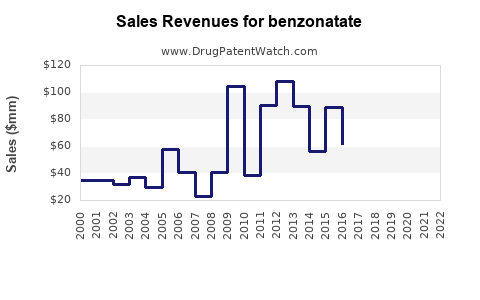
Public companies do not generally report benzontate revenue as a separate line item. The product’s financial trajectory is therefore best assessed through generic competition, supplier concentration, FDA regulatory events, prescription volume, and price volatility rather than disclosed brand sales.
What is benzonatate and how is it used?
Benzonatate is a non-opioid antitussive marketed in the United States under the former Tessalon brand and under numerous generic labels. It is available primarily in 100-mg and 200-mg oral capsules. The product is indicated for symptomatic relief of cough in patients older than 10 years under U.S. labeling.[1]
The drug suppresses cough by anesthetizing stretch receptors in the respiratory passages, lungs, and pleura. The capsule must be swallowed whole. Chewing or dissolving it can produce oropharyngeal anesthesia, choking, laryngospasm, and other serious reactions.[1]
Key product characteristics
| Attribute |
Benzonatate |
| Therapeutic class |
Non-opioid antitussive |
| Common strengths |
100 mg and 200 mg capsules |
| U.S. route |
Oral |
| U.S. prescription status |
Prescription drug |
| U.S. controlled-substance status |
Not federally scheduled |
| Pediatric labeling |
Not established for children younger than 10 years |
| Primary competitors |
Dextromethorphan, codeine-containing products, guaifenesin combinations |
| Main commercial form |
Generic soft or liquid-filled capsule |
| Biosimilar relevance |
None |
What is the FDA regulatory status of benzonatate?
Benzonatate has been marketed in the United States for decades. The branded Tessalon product was approved through NDA 018731, while current commercial supply is primarily distributed through abbreviated new drug applications and generic labels listed in FDA databases.[2][3]
The drug remains FDA-approved for cough relief, but regulatory risk is concentrated in labeling compliance, capsule integrity, manufacturing controls, and accidental pediatric exposure.
FDA safety actions and labeling risk
In 2010, FDA warned that accidental ingestion of benzonatate by children younger than 10 years could cause death. The agency cited rapid onset of symptoms, including restlessness, tremors, seizures, coma, and cardiac arrest. FDA required stronger safety communication and emphasized child-resistant storage.[4]
The safety profile affects the market in four ways:
- It limits pediatric promotional claims.
- It increases packaging and pharmacovigilance requirements.
- It creates recall exposure if capsules are improperly packaged or labeled.
- It favors established manufacturers with stronger quality systems.
Benzonatate is not an opioid and is not subject to opioid-specific federal controls. It remains prescription-only in the United States, which distinguishes it from several over-the-counter cough products.
What patents protect benzonatate?
No commercially important U.S. patent appears to provide current exclusivity for the benzonatate active ingredient or its standard capsule formulation. The original Tessalon-era composition and product protection expired decades ago.
Patent and exclusivity position
| Protection category |
Current position |
| Original compound patent |
Expired |
| Original brand-product protection |
Expired |
| Active ingredient exclusivity |
None identified |
| Current formulation patents |
No dominant enforceable estate identified for standard capsules |
| Method-of-use patents |
No commercially significant blocking patent identified |
| Pediatric exclusivity |
None identified |
| Orphan exclusivity |
None |
| U.S. market exclusivity |
None of commercial significance |
| Biosimilar exclusivity |
Not applicable |
The principal commercial barrier is not patent law. It is the ability to manufacture compliant capsules consistently, qualify suppliers, obtain FDA approval, and maintain distribution through wholesalers and pharmacies.
When did benzonatate lose exclusivity?
Benzonatate lost practical exclusivity many years before the modern generic-drug framework became the main commercial model. The original branded product has no current protection comparable to the patent life of newer small-molecule medicines.
Generic entry has therefore been possible through ANDA filings supported by bioequivalence and chemistry, manufacturing, and controls data. Generic applicants do not need to repeat the full clinical program supporting the original NDA.
The absence of current exclusivity means that a new entrant generally competes on:
- Wholesale acquisition cost
- Supply reliability
- Approved strengths and package sizes
- Wholesaler relationships
- Manufacturing yield
- Product quality and defect history
- Ability to avoid recalls and shortages
How many companies manufacture benzonatate?
The U.S. market has historically included multiple generic suppliers and repackagers. FDA DailyMed listings have included products associated with manufacturers such as Amneal Pharmaceuticals, ANI Pharmaceuticals, Ascend Laboratories, Camber, Hikma, Major Pharmaceuticals, Rising Pharma, Teva, and other labelers or distributors, depending on the period reviewed.[3]
The number of companies with a current listing can differ from the number of active manufacturers. A labeler may source product from a contract manufacturer, while a wholesaler or repackager may appear separately in commercial databases.
Competitive structure
Benzonatate is a fragmented generic market, but effective competition can narrow during supply interruptions. Capsule manufacturing is more technically demanding than a simple compressed tablet because the dosage form requires controlled encapsulation, liquid-fill or soft-gel processing, sealing, inspection, and packaging.
This creates a gap between nominal supplier count and dependable supply capacity. A market with many approved suppliers can still experience price increases if several manufacturers simultaneously encounter raw-material, equipment, quality, or packaging constraints.
What formulation patents protect benzonatate capsules?
No dominant active formulation patent has been identified for the standard 100-mg and 200-mg benzonatate capsules currently sold in the United States.
The relevant intellectual-property risks are more likely to involve:
- Capsule shell composition
- Liquid-fill processing
- Manufacturing equipment
- Packaging configurations
- Trade secrets
- Supplier specifications
- Quality-control methods
- Private-label distribution agreements
These rights may affect manufacturing economics without creating market exclusivity. A competitor can generally design around process or packaging claims if those claims exist and can qualify an alternative manufacturing route.
Are there Paragraph IV challenges or benzonatate patent lawsuits?
Benzonatate does not present the typical current Paragraph IV litigation profile associated with high-value branded drugs. Because the original compound and product protections expired long ago, generic applicants generally have no important active patent barrier to challenge.
No active, commercially material Orange Book patent dispute is identified as controlling U.S. generic entry for standard benzonatate capsules. The principal litigation risks are instead likely to arise from:
- Product liability claims
- Pediatric accidental-ingestion cases
- Manufacturing-defect allegations
- False-labeling or packaging disputes
- Contract and supply disagreements
- FDA recall-related claims
Orange Book status
The Orange Book is relevant because it identifies FDA-approved products and any listed patents or exclusivity. For benzonatate, the practical market position is that generic applicants are not blocked by a live branded patent estate of meaningful commercial duration.[2]
What is the geographic coverage of benzonatate patents?
Geographic patent protection is effectively exhausted in the major commercial jurisdictions for the legacy molecule. Any historical U.S. or foreign patent rights associated with the original product have expired.
Current geographic differentiation is regulatory rather than patent-based:
| Market |
Commercial position |
| United States |
Prescription generic market; no meaningful current exclusivity |
| European Union |
National or centralized regulatory requirements differ; product availability is more variable |
| Canada |
Generic or branded availability depends on provincial and federal authorization |
| Emerging markets |
Local registration, manufacturing quality, and distribution determine access |
| Global |
No global patent barrier controls the mature molecule |
A company expanding internationally must manage country-specific registrations, pharmacopoeial standards, labeling, serialization, and local distribution. Those requirements can delay entry even when patent rights are expired.
What is the financial trajectory for benzonatate?
Benzonatate has the financial profile of a mature, low-cost generic rather than a branded growth asset.
Revenue trajectory
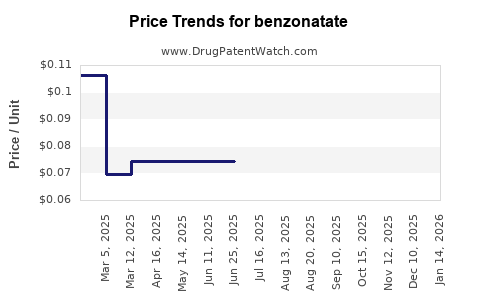
Public disclosures generally do not isolate benzonatate revenue. The product is usually included within broader generic-pharmaceutical sales, and many suppliers distribute it through portfolios containing hundreds of products. As a result, there is no reliable public revenue series for the total benzonatate market or for most individual suppliers.
The financial trajectory can be summarized as follows:
| Period |
Market dynamic |
Financial effect |
| Branded era |
Tessalon and related branded products held the market |
Higher unit margins and brand pricing |
| Generic-entry era |
Multiple ANDA-approved suppliers entered |
Price erosion and share fragmentation |
| Mature generic era |
Low-cost supply became the norm |
Lower margins, high volume sensitivity |
| Shortage periods |
Supplier interruptions reduced available supply |
Temporary price and margin expansion |
| Post-shortage normalization |
Additional supply returned |
Price compression and inventory correction |
Benzonatate can produce attractive short-term margins when competitors are out of stock, but those margins are difficult to sustain. Entry by a new supplier, wholesaler inventory normalization, or restoration of a major manufacturer’s capacity can rapidly reduce pricing.
Revenue exposure for manufacturers
For diversified generic companies, benzonatate is unlikely to be a material standalone earnings driver. Its value is more likely to come from:
- Filling production capacity
- Supporting a respiratory portfolio
- Maintaining pharmacy and wholesaler relationships
- Capturing seasonal cough demand
- Generating incremental revenue from an established ANDA
The largest financial risk is operational. A quality failure or recall can eliminate a product’s contribution and impose remediation costs, while a shortage can create regulatory scrutiny and customer penalties.
What generic entry risks exist for benzonatate?
Generic entry risk is high because the drug has no meaningful current exclusivity. A new entrant does not need to overcome a blocking patent, but it must overcome several practical hurdles.
Manufacturing and IP barriers
The major barriers include:
- FDA approval of the proposed capsule.
- Demonstration of bioequivalence.
- Control of fill weight and active-ingredient uniformity.
- Consistent capsule sealing and dissolution performance.
- Reliable sourcing of benzonatate active pharmaceutical ingredient.
- Compliance with current good manufacturing practice.
- Packaging that reduces pediatric access.
- Stable wholesaler and pharmacy distribution.
Trade secrets and process know-how can protect manufacturing efficiency, but they do not usually prevent lawful generic entry. The best-positioned suppliers are those with validated capsule capacity and a strong inspection history.
How does benzonatate compare with competing cough medicines?
Benzonatate competes with both prescription and over-the-counter products.
| Product |
Regulatory status |
Commercial advantage |
Main limitation |
| Benzonatate |
Prescription |
Non-opioid; established generic supply |
Pediatric toxicity risk; capsule must be swallowed whole |
| Dextromethorphan |
OTC |
Broad consumer access and brand support |
Misuse potential; variable consumer response |
| Guaifenesin |
OTC |
Expectorant positioning and combination products |
Does not directly suppress cough |
| Codeine combinations |
Prescription in relevant jurisdictions |
Strong antitussive effect |
Opioid controls, dependence and safety concerns |
| Honey and non-drug remedies |
OTC or nonprescription |
Low cost and easy access |
Limited applicability and variable evidence |
Benzonatate’s competitive position depends on physician prescribing, seasonal respiratory illness, patient preference, and payer substitution. It is most exposed to low-cost over-the-counter alternatives when cough symptoms are mild.
What licensing deals affect benzonatate?
No major recent licensing transaction appears to control the U.S. benzonatate market. Commercial arrangements are more likely to involve private-label supply, contract manufacturing, distribution, or portfolio acquisitions than molecule-level licensing.
A company evaluating a transaction should focus on:
- Ownership of the ANDA
- Manufacturing-site status
- Product-specific FDA inspection history
- Supply and API contracts
- Recall obligations
- Customer concentration
- Historical shortage performance
- Liability allocation for pediatric exposure
What generic launch scenarios are likely?
The most plausible U.S. launch scenarios are:
Low-price portfolio launch
A diversified generic company launches benzonatate as part of a respiratory portfolio. Pricing is competitive from the start, and the product provides incremental volume rather than a standalone growth platform.
Shortage-driven launch
A supplier enters after competitors experience manufacturing or quality problems. The entrant may obtain temporary pricing power, but margins decline when normal supply returns.
Contract-manufactured private-label launch
A distributor or pharmacy supplier markets the product under its own label while relying on a third-party manufacturer. Commercial success depends on supply reliability and contract terms rather than differentiated IP.
Reformulated or alternative dosage-form launch
A company develops a different delivery format or packaging configuration. This route may create regulatory and branding differentiation, but it does not automatically create durable market exclusivity.
Key Takeaways
- Benzonatate is a mature prescription generic cough suppressant with no meaningful current U.S. patent exclusivity.
- The original branded product and legacy patent protection expired decades ago.
- Standard 100-mg and 200-mg capsules are supplied by multiple generic manufacturers and labelers.
- Paragraph IV patent litigation is not a central current risk.
- The main barriers are capsule manufacturing, FDA compliance, supply reliability, packaging, and pediatric safety.
- Public companies generally do not disclose benzontate revenue separately.
- Financial performance is volume-driven and vulnerable to price erosion.
- Temporary margin expansion can occur during shortages but is unlikely to persist.
- Biosimilar risk is irrelevant because benzonatate is a small-molecule drug.
- The commercial opportunity is best viewed as a portfolio product or shortage-exposed generic, not as a patent-protected growth asset.
FAQs About Benzonatate Market Exclusivity and Commercial Risk
Is benzonatate still patented?
No commercially important active U.S. patent is identified as blocking standard generic benzonatate capsules. Historical compound and branded-product protection expired long ago.
Is benzonatate a branded or generic drug?
Both forms have existed, but current U.S. supply is predominantly generic. Tessalon is the legacy branded product name.
Can a company launch generic benzonatate without a Paragraph IV certification?
Yes. If no relevant unexpired Orange Book patent blocks the product, an ANDA applicant can avoid a Paragraph IV patent challenge and rely on the applicable certification pathway.
Why can benzonatate prices rise if there are many manufacturers?
Approved supplier count does not equal dependable production capacity. A small number of manufacturers may control most effective supply, and capsule-quality problems or API shortages can produce temporary price increases.
Is benzonatate a good pharmaceutical licensing target?
It is generally more suitable for a generic portfolio, contract-manufacturing agreement, or shortage-recovery strategy than for a conventional molecule-license transaction. Its value depends on supply execution rather than patent exclusivity.
References
- U.S. Food and Drug Administration. (2023). Benzonatate prescribing information. DailyMed.
- U.S. Food and Drug Administration. (n.d.). Approved drug products with therapeutic equivalence evaluations. Orange Book.
- National Library of Medicine. (n.d.). DailyMed: Benzonatate drug labels.
- U.S. Food and Drug Administration. (2010). Benzonatate: Risks and accidental ingestion in children younger than 10 years. FDA Drug Safety Communication.