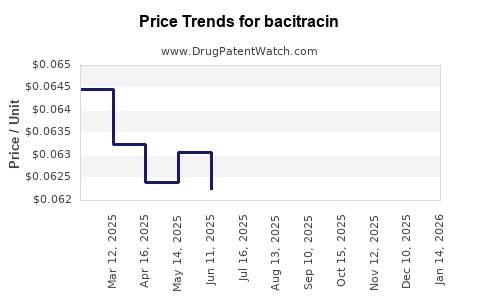
Last updated: September 8, 2026
Bacitracin is a mature, low-cost topical antibiotic with limited standalone revenue visibility and little meaningful patent protection. The U.S. market is split between over-the-counter bacitracin and bacitracin-zinc ointments, prescription ophthalmic products, and the former injectable product. FDA’s withdrawal of bacitracin for injection removed the highest-risk regulatory segment, while topical demand remains exposed to generic price competition, allergy concerns, clinical substitution, and declining use of routine topical antibiotics.
No public company reports bacitracin revenue as a standalone product line. Financial exposure is therefore best assessed through product category, channel, market share, and regulatory developments rather than reported brand revenue.
What products contain bacitracin and who sells them?
Bacitracin is sold primarily as bacitracin, bacitracin zinc, or a component of combination topical antibiotic products.
| Product category |
Typical formulation |
Market status |
Principal commercial dynamics |
| OTC topical ointment |
Bacitracin or bacitracin zinc in petrolatum |
Marketed in the U.S. under the OTC topical antimicrobial framework |
Low-price generic competition |
| Combination OTC antibiotic |
Bacitracin zinc with polymyxin B, with or without neomycin |
Marketed under brands including Neosporin and generic equivalents |
Brand recognition but substantial substitution |
| Prescription ophthalmic ointment |
Bacitracin or bacitracin zinc ophthalmic ointment |
Generic prescription market |
Limited product differentiation |
| Injectable bacitracin |
Bacitracin for injection |
Withdrawn from U.S. commercial use after FDA safety concerns |
No meaningful current U.S. growth opportunity |
| Veterinary products |
Bacitracin-containing feed or veterinary formulations |
Jurisdiction-specific |
Regulatory restrictions and antimicrobial-use controls |
Kenvue markets Neosporin, which includes bacitracin zinc in certain formulations. The Neosporin franchise is part of Kenvue’s broader self-care portfolio, and Kenvue does not separately disclose revenue for bacitracin-containing products. Generic manufacturers and private-label retailers supply much of the remaining market.
What is the FDA regulatory status of bacitracin?
FDA regulates bacitracin differently according to dosage form and route of administration.
OTC topical bacitracin
Topical bacitracin products are generally marketed under the FDA OTC topical antimicrobial drug framework, including the conditions in 21 C.F.R. Part 333. Products must comply with permitted active ingredients, concentrations, labeling, indications, and manufacturing requirements [1].
OTC topical products are typically labeled for minor cuts, scrapes, and burns. They are not positioned as broad treatments for serious skin infections. The market does not require a new drug application for each compliant monograph product, which lowers entry barriers and increases price competition.
Prescription ophthalmic bacitracin
Bacitracin ophthalmic ointment remains a prescription product category. The commercial market is primarily generic and depends on abbreviated new drug applications, manufacturing capacity, supply continuity, and pharmacy contracts.
Ophthalmic products have higher technical barriers than ordinary skin ointments because manufacturers must meet sterility, particulate, container-closure, and ophthalmic quality requirements. Those barriers can support temporary supply advantages, but they do not create durable molecule-level exclusivity.
Bacitracin for injection
FDA requested withdrawal of bacitracin for injection after concluding that its risks outweighed its limited benefits. Serious nephrotoxicity and the availability of alternative antibiotics were central concerns. Manufacturers discontinued the product in the United States, eliminating injectable bacitracin as a current U.S. commercial growth driver [2].
When does bacitracin lose exclusivity?
Bacitracin lost meaningful molecule-level exclusivity decades ago. The active ingredient is an established antibiotic with extensive prior art and a long history of generic use.
The commercial exclusivity profile is as follows:
| Exclusivity type |
Current position |
| New chemical entity exclusivity |
Expired |
| Original composition patents |
Expired |
| Basic topical formulation patents |
Expired or commercially immaterial |
| Prescription generic entry |
Generally available subject to product-specific FDA requirements |
| OTC monograph protection |
Regulatory compliance, not patent exclusivity |
| Biosimilar exclusivity |
Not applicable |
| Brand protection |
Trademark and packaging protection may remain |
| Product-specific formulation protection |
Possible in isolated cases, but not a broad bacitracin barrier |
For most bacitracin products, the relevant business question is not when patent exclusivity expires. It is whether a manufacturer can produce a compliant, stable, sterile product at a cost that supports distribution and retailer access.
What patents protect bacitracin products?
The core bacitracin molecule is not protected by enforceable U.S. exclusivity of commercial significance. Current protection, where it exists, would generally relate to a particular formulation, container, delivery system, manufacturing process, or combination product rather than bacitracin itself.
Orange Book status
The Orange Book is most relevant to approved prescription bacitracin products, particularly ophthalmic formulations. OTC monograph products are not protected through the same Orange Book patent-certification structure as branded prescription products.
There is no widely recognized, commercially significant Orange Book patent estate that blocks ordinary U.S. entry into topical bacitracin ointment. Any ANDA applicant would still need to evaluate the specific reference-listed drug, listed patents, regulatory exclusivities, and product formulation requirements.
Formulation patents
Potential formulation issues include:
- Ophthalmic ointment consistency and drug distribution
- Sterility and preservative systems
- Tube and container-closure design
- Stability in petrolatum or other semisolid bases
- Combination products containing polymyxin B or neomycin
- Manufacturing processes for maintaining potency and uniformity
These issues can create technical or operational barriers. They do not generally provide a durable monopoly across all bacitracin dosage forms.
Are there Paragraph IV challenges for bacitracin?
Bacitracin has limited Paragraph IV litigation exposure because its principal commercial products are old generics and OTC monograph products rather than recently approved branded drugs with valuable patent cliffs.
A Paragraph IV filing could arise for a prescription ophthalmic product if an ANDA applicant certified that an Orange Book-listed patent was invalid, unenforceable, or not infringed. The economic incentive would depend on the size of the remaining market and the number of existing suppliers.
The more likely competitive events are:
- A new ANDA entrant seeking to take share from existing ophthalmic suppliers.
- A manufacturing transfer or site approval that improves supply reliability.
- A retailer or wholesaler switching to a lower-cost private-label product.
- A shortage-driven price increase followed by rapid generic normalization.
- A branded combination product losing share to single-ingredient or generic alternatives.
Bacitracin is not a conventional patent-cliff opportunity. The market is mature, fragmented, and generally unattractive for high-cost patent litigation.
How strong is the bacitracin patent estate?
The bacitracin patent estate is weak from a product-specific investment perspective.
| Patent-estate factor |
Assessment |
| Core molecule |
Very weak; historical protection expired |
| Topical monotherapy |
Weak |
| Combination antibiotic products |
Weak at the active-ingredient level; possible product-specific claims |
| Ophthalmic delivery |
Moderate technical complexity, weak broad exclusivity |
| Injectable product |
Commercially irrelevant in the United States after withdrawal |
| Manufacturing know-how |
Potentially relevant but difficult to monetize as a monopoly |
| Trademark protection |
Relevant for branded products such as Neosporin |
| Trade secrets |
Possible process value, but limited public visibility |
The strongest practical defenses are brand recognition, retailer placement, manufacturing quality, and supply reliability. Patent litigation is unlikely to be the primary competitive tool.
What is the competitive landscape for bacitracin?
Bacitracin competes against both other topical antibiotics and non-antibiotic wound-care products.
Direct antibiotic competitors
- Polymyxin B
- Neomycin
- Triple-antibiotic combinations
- Mupirocin
- Retapamulin
- Fusidic acid in markets where available
Mupirocin has a stronger role in treating defined bacterial skin infections, particularly when prescribed for suspected or confirmed staphylococcal disease. Bacitracin is used more often in low-acuity topical settings.
Non-antibiotic competitors
- Petrolatum
- Silicone-based wound dressings
- Antiseptic products
- Hydrocolloid dressings
- Moist wound-healing products
Clinical guidance has reduced the need for routine topical antibiotics for uncomplicated minor wounds. The American Academy of Dermatology recommends petrolatum for many clean minor wounds and notes the risk of allergic contact dermatitis from topical antibiotics [3]. This trend places pressure on unit volume even when population-level wound-care demand remains stable.
What is the financial trajectory for bacitracin?
Bacitracin is a low-growth, low-price pharmaceutical category. Public financial reporting does not isolate bacitracin sales, so no reliable standalone revenue series exists for the active ingredient.
The financial trajectory has four phases:
| Period |
Financial profile |
| Historical branded period |
Higher pricing and limited competition |
| Generic expansion |
Rapid price compression and supplier proliferation |
| Mature OTC period |
Stable but low-value volume, supported by household recognition |
| Current market |
Low growth, retailer-driven pricing, and substitution toward non-antibiotic wound care |
The largest commercial value is likely concentrated in branded combination products, especially where a recognized brand retains shelf presence. The active ingredient itself has limited pricing power.
Revenue exposure by business model
| Business model |
Bacitracin exposure |
Financial sensitivity |
| Branded consumer-health company |
Combination products and brand franchises |
Brand equity, advertising, retailer margins |
| Generic prescription manufacturer |
Ophthalmic ointment |
FDA compliance, supply reliability, contract pricing |
| OTC private-label supplier |
Single-ingredient and combination ointments |
Lowest price and manufacturing cost |
| API manufacturer |
Bacitracin raw material |
Volume, quality, sourcing, international demand |
| Hospital supplier |
Historical injectable product |
U.S. exposure largely eliminated |
| Retail pharmacy |
OTC and ophthalmic dispensing |
Category turnover and reimbursement |
Kenvue’s public reporting groups products within broader self-care categories rather than disclosing Neosporin or bacitracin revenue separately [4]. Generic manufacturers also typically report revenues at segment or portfolio level. This limits company-specific valuation analysis.
What generic entry risks exist for bacitracin?
Generic entry risk is high for prescription bacitracin products and effectively structural for OTC products.
The principal risks are:
- Permanent price erosion from multiple suppliers
- Retailer substitution to private-label ointments
- Contract loss at wholesalers and pharmacy chains
- Product discontinuation after manufacturing deviations
- FDA inspection findings
- Shortages caused by limited sterile manufacturing capacity
- Consumer movement toward petrolatum and non-antibiotic products
- Allergy concerns involving bacitracin and other topical antibiotics
The main constraint on new entrants is not patent protection. It is the ability to establish compliant manufacturing, maintain supply, and secure distribution at acceptable margins.
What patent litigation and licensing deals affect bacitracin?
No major current U.S. patent litigation campaign or high-value licensing transaction is broadly associated with bacitracin as an active ingredient.
Commercial arrangements are more likely to involve:
- Contract manufacturing
- Private-label supply
- Brand licensing
- Distribution agreements
- Acquisition of consumer-health portfolios
- API supply arrangements
These transactions are usually negotiated at the portfolio or manufacturing level. Bacitracin revenue is rarely disclosed as a separate consideration item.
The lack of major licensing activity reflects the product’s maturity and low patent leverage. Strategic value is more likely to arise from manufacturing capacity, retail access, or inclusion in a broader consumer-health portfolio.
Does bacitracin face biosimilar risk?
No. Bacitracin is a small-molecule antibiotic and is not a biologic. Biosimilar competition does not apply.
The relevant competitors are generic drugs, OTC monograph products, branded combination products, and non-antibiotic wound-care products. Regulatory and commercial analysis should therefore use the generic-drug framework rather than the biosimilar framework.
How does bacitracin compare with mupirocin and Neosporin?
| Factor |
Bacitracin monotherapy |
Mupirocin |
Neosporin-type combination |
| Primary use |
Minor wounds and topical protection |
Treatment of selected bacterial skin infections |
Consumer wound care |
| Prescription status |
OTC or prescription depending on dosage form |
Prescription in the U.S. |
OTC |
| Patent strength |
Weak |
Historical product-specific protection largely matured |
Trademark and brand protection |
| Price level |
Low |
Higher than commodity OTC ointments |
Brand-dependent |
| Clinical differentiation |
Limited |
Greater clinical specificity |
Convenience and brand recognition |
| Allergy concern |
Material |
Also present, but different profile |
Multiple active ingredients increase exposure |
| Generic competition |
High |
High |
High, with strong private-label pressure |
| Growth outlook |
Flat to declining |
More defensible clinical niche |
Dependent on brand and consumer-health demand |
Bacitracin has the weakest clinical and pricing differentiation of the three categories. Neosporin can command a consumer premium through branding, while mupirocin retains prescription value because physicians use it for defined infections and decolonization-related indications.
What geographic markets are relevant?
The United States is the most commercially visible market for OTC bacitracin and branded combination products. International markets differ in dosage-form availability, prescription controls, antimicrobial stewardship rules, and consumer preferences.
Key geographic variables include:
- Whether bacitracin is OTC or prescription-only
- Availability of bacitracin-containing combination products
- Local generic-manufacturer concentration
- National reimbursement rules
- Restrictions on topical antibiotic advertising
- Veterinary and agricultural use controls
- Import dependence for API and finished dosage forms
The U.S. injectable market has effectively closed, but topical and ophthalmic markets remain active in selected jurisdictions. Manufacturing disruptions can affect multiple regions because API and finished-product supply chains are concentrated.
What are the likely generic launch scenarios?
Base case
The market remains mature. Existing suppliers compete on price, shelf placement, and supply continuity. Revenue is broadly flat to declining in real terms.
Upside case
A competitor experiences a shortage, recall, or manufacturing interruption. A supplier with approved capacity captures temporary volume and improves pricing. The benefit is likely short-lived because new supply can enter once the disruption ends.
Downside case
Routine topical antibiotic use declines faster because of clinical guidance, allergic-contact-dermatitis concerns, or consumer substitution toward petrolatum and advanced wound dressings. Brand and private-label volume fall, while prescription ophthalmic demand remains limited.
Injectable scenario
A U.S. commercial return of bacitracin for injection is unlikely to be a normal generic launch opportunity because FDA previously identified serious safety concerns and limited therapeutic need [2].
Key Takeaways
- Bacitracin is a mature, low-growth antibiotic with minimal molecule-level patent protection.
- OTC topical products are governed mainly by FDA monograph compliance, branding, distribution, and manufacturing economics.
- Prescription ophthalmic bacitracin remains a generic market with technical sterility and quality barriers but limited patent leverage.
- Bacitracin for injection was withdrawn from the U.S. market following FDA safety concerns.
- No biosimilar pathway applies because bacitracin is a small-molecule antibiotic.
- Public companies do not separately disclose bacitracin revenue, preventing a reliable standalone market-size or revenue-growth calculation.
- The principal commercial threats are generic price erosion, retailer substitution, allergy concerns, and migration toward petrolatum or other non-antibiotic wound-care products.
- The strongest remaining commercial assets are brand recognition, supply reliability, manufacturing approvals, and retail distribution, not patents.
FAQs About Bacitracin Market and Patent Risk
Is bacitracin still profitable for pharmaceutical manufacturers?
It can generate incremental portfolio revenue, particularly in branded OTC combinations and efficient private-label manufacturing. It is unlikely to support premium pricing or high standalone margins because generic competition is extensive.
Can a company launch a new bacitracin ointment without a patent license?
A compliant OTC product generally does not require a license to expired molecule patents. The manufacturer must comply with FDA monograph requirements, labeling rules, current good manufacturing practices, and applicable trademark restrictions.
Is bacitracin included in Neosporin?
Certain Neosporin formulations contain bacitracin zinc, usually in combination with polymyxin B and, in some products, neomycin. Product composition varies by formulation and market.
Why was injectable bacitracin discontinued?
FDA identified serious kidney toxicity risks and concluded that the product had limited benefit compared with available alternatives. Manufacturers discontinued U.S. injectable supply following FDA action.
Does bacitracin have a future in hospital medicine?
Its U.S. hospital role is limited. Topical and ophthalmic products remain commercially relevant, but the injectable product’s withdrawal and antimicrobial-stewardship pressures constrain broader hospital use.
References
-
U.S. Food and Drug Administration. (n.d.). 21 C.F.R. Part 333: Topical antimicrobial drug products for over-the-counter human use. Electronic Code of Federal Regulations.
-
U.S. Food and Drug Administration. (2020). FDA requests withdrawal of bacitracin for injection from the market. FDA Drug Safety Communications.
-
American Academy of Dermatology Association. (n.d.). How to treat minor cuts and scrapes. American Academy of Dermatology.
-
Kenvue Inc. (2024). Annual report for fiscal year 2023. U.S. Securities and Exchange Commission.