Last updated: August 1, 2026
Armodafinil is a mature, predominantly generic wakefulness-promoting drug marketed in the United States under the brand name Nuvigil and by multiple generic manufacturers. Its commercial trajectory has moved from branded growth before 2012 to price-driven generic competition after U.S. patent and regulatory exclusivity ended. Current market value is concentrated in generic prescription volume rather than branded revenue, while the drug remains clinically relevant for narcolepsy, obstructive sleep apnea-related residual sleepiness, and shift-work sleep disorder.
What is armodafinil and how is it marketed?
Armodafinil is the R-enantiomer of modafinil. It has a longer terminal half-life than the racemic modafinil mixture and is supplied as immediate-release oral tablets in 50 mg, 150 mg, 200 mg, and 250 mg strengths. The reference product is Nuvigil, originally developed by Cephalon and later commercialized by Teva after its acquisition of Cephalon in 2011. [1,2]
| Product |
Active ingredient |
Original developer |
Current commercial structure |
| Nuvigil |
Armodafinil |
Cephalon |
Teva reference brand, limited branded role |
| Generic armodafinil |
Armodafinil |
Multiple manufacturers |
Main U.S. supply source |
| Provigil |
Modafinil |
Cephalon |
Competing racemic product and generic market |
Armodafinil is a Schedule IV controlled substance in the United States because of abuse, misuse, and dependence risks. The controlled-substance designation increases compliance and distribution requirements but does not prevent generic substitution. [1]
What conditions does armodafinil treat?
The FDA-approved indications are excessive sleepiness associated with:
- Narcolepsy
- Obstructive sleep apnea, as an adjunct to treatment of the airway obstruction
- Shift-work sleep disorder
Armodafinil does not treat the underlying airway obstruction in obstructive sleep apnea. The FDA label positions it as a wakefulness treatment for residual sleepiness after evaluation and treatment of the airway disorder. [1]
The drug competes with modafinil, solriamfetol, and pitolisant. Its main commercial advantage over modafinil is the differentiated pharmacokinetic profile associated with the R-enantiomer. Its main disadvantages are generic pricing, controlled-substance restrictions, and competition from newer branded wakefulness products.
When did armodafinil lose exclusivity?
U.S. branded exclusivity ended after generic armodafinil approvals began in 2016. Mylan received FDA approval for generic Nuvigil tablets in 2016, followed by other manufacturers. [3]
The reference product's principal composition patent, U.S. Patent No. 7,132,570, covered armodafinil and had an expiration date in the early 2020s after applicable patent-term adjustments and pediatric exclusivity. The Orange Book also listed later patents associated with Nuvigil, including formulation or crystal-form claims. Generic approvals and litigation outcomes reduced the practical ability of those patents to preserve a high-price branded market. [4,5]
Armodafinil exclusivity timeline
| Milestone |
Date or period |
Commercial effect |
| Nuvigil U.S. launch |
2007 |
Established a differentiated successor to Provigil |
| Cephalon acquired by Teva |
2011 |
Shifted Nuvigil ownership to Teva |
| Principal patent protection |
Early 2020s |
Delayed full generic erosion |
| First FDA generic approvals |
2016 |
Began U.S. price and share erosion |
| Post-launch generic market |
2016 onward |
Moved value from brand revenue to volume and low-cost supply |
The practical loss of exclusivity occurred before the final nominal expiration of every listed patent because authorized and paragraph IV-approved generics can enter after regulatory and litigation settlements.
What patents protect armodafinil and Nuvigil?
The principal U.S. patent historically associated with Nuvigil was U.S. Patent No. 7,132,570, assigned to Cephalon. The patent covered armodafinil compositions and related pharmaceutical uses. Later Nuvigil listings included patents directed to specific solid-state forms, formulations, and dosage characteristics. [4]
| Patent category |
Representative protection |
Business relevance |
| Active pharmaceutical ingredient |
Armodafinil and related composition claims |
Core exclusivity for the molecule |
| Solid-state or crystal form |
Specific armodafinil form |
Potential manufacturing and formulation barrier |
| Tablet formulation |
Oral dosage composition |
Can support later Orange Book listings |
| Method of use |
Treatment of excessive sleepiness |
May create narrower litigation exposure |
| Manufacturing process |
Process or intermediate claims |
May affect API sourcing and freedom to operate |
Patent strength for armodafinil is now limited by the drug's age, broad generic availability, and the expiration or erosion of the principal U.S. claims. Formulation and manufacturing patents can still create jurisdiction-specific risk, but they generally do not support the commercial premium once multiple approved tablet suppliers exist.
What is the Orange Book status of Nuvigil?
Nuvigil has been listed in the FDA Orange Book as the reference product for armodafinil tablets. Orange Book listings historically included patents covering the active drug and later product characteristics. Generic applicants could challenge listed patents through paragraph IV certifications or defer entry until patent expiration. [4]
The present commercial significance of the Orange Book is lower than during the pre-generic period. Generic armodafinil is established, and the market no longer depends on a single patent-protected supplier. The remaining legal issues concern individual products, patent scope, settlement obligations, and potential state-specific or formulation-specific claims.
Which companies challenged Nuvigil patents?
Generic manufacturers that entered or pursued approval for armodafinil included Mylan and other large generic companies. The challenges followed the standard abbreviated new drug application pathway, with paragraph IV certifications used where applicants alleged that listed patents were invalid, unenforceable, or not infringed. [3,5]
Generic competition developed through a combination of:
- Paragraph IV patent challenges
- Patent expiration
- Settlement agreements
- FDA approval of abbreviated new drug applications
- Commercial entry by multiple suppliers
The generic market is less concentrated than the former Nuvigil market, although actual supply can vary by pharmacy benefit manager contracts, wholesaler inventories, manufacturing capacity, and controlled-substance distribution controls.
What patent litigation affected armodafinil?
Nuvigil patent litigation was part of Cephalon's broader strategy to extend the commercial life of its wakefulness franchise after Provigil faced generic pressure. Patent disputes involved generic applicants seeking approval before the full expiration of listed Nuvigil patents.
The key litigation issues included:
- Whether generic armodafinil infringed composition or formulation claims.
- Whether later-filed patents were valid and enforceable.
- Whether generic applicants could launch under a paragraph IV certification.
- Whether settlement terms delayed entry or allowed an agreed launch date.
By 2016, FDA-approved generic entry had materially changed the litigation balance. The relevant business question shifted from whether generics could enter to how many suppliers would remain commercially active and at what price.
How did armodafinil revenue change after generic entry?
Teva does not report Nuvigil as an independent current operating segment in a way that provides a clean, ongoing public revenue series. Historical Teva disclosures identified Nuvigil as a branded product, but later reporting combined products into broader North American branded or specialty categories. [2]
The financial trajectory can be divided into four phases:
| Phase |
Period |
Revenue dynamics |
| Launch and adoption |
2007-2010 |
Nuvigil expanded the Cephalon wakefulness franchise |
| Branded peak |
2011-2015 |
Revenue benefited from limited direct generic armodafinil competition |
| Generic transition |
2016-2018 |
Volume shifted to generics and branded pricing weakened |
| Mature generic market |
2019-present |
Value is driven by low-cost prescriptions, supplier share, and reimbursement |
Nuvigil benefited from the commercial infrastructure created for Provigil, including prescriber familiarity, sleep-disorder specialists, and payer recognition. Its growth was constrained by overlap with modafinil and by the ability of patients and prescribers to substitute between the two products.
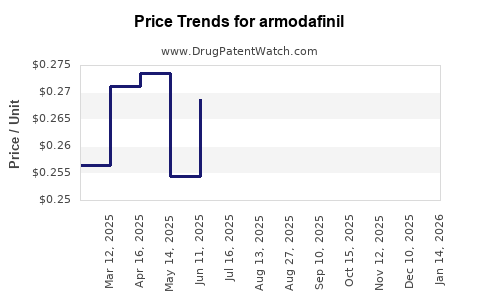
After generic entry, the reference brand faced the standard erosion pattern: lower prescription share, reimbursement pressure, formulary exclusion, and reduced ability to sustain premium pricing. Generic manufacturers captured most unit demand, but per-tablet revenue declined sharply.
How large is the current armodafinil market?
Public company filings do not provide a reliable standalone global revenue figure for all armodafinil products. The market is fragmented across generic manufacturers, wholesalers, retail pharmacies, hospital systems, and private-label distributors.
The main value pools are:
- U.S. generic retail prescriptions
- Branded or authorized-brand prescriptions with continuity-of-care demand
- Specialty pharmacy dispensing
- International modafinil and armodafinil markets
- Contract manufacturing and API supply
The United States remains the most commercially transparent market because FDA approvals, Orange Book listings, controlled-substance rules, and prescription data are available. International markets vary substantially in approval status, reimbursement, scheduling, and availability.
Armodafinil has a lower revenue ceiling than newer branded wakefulness products because it is an established generic. Its commercial importance is more closely linked to prescription volume and manufacturing efficiency than to patent-based pricing power.
How does armodafinil compare with modafinil and newer wakefulness drugs?
| Attribute |
Armodafinil |
Modafinil |
Solriamfetol |
Pitolisant |
| Market status |
Mature generic |
Mature generic |
Branded and newer |
Branded and newer |
| Mechanism |
R-enantiomer of modafinil |
Racemic compound |
Dopamine and norepinephrine reuptake inhibitor |
Histamine H3 antagonist/inverse agonist |
| Main approved sleepiness indications |
Narcolepsy, OSA, shift work |
Narcolepsy, OSA, shift work |
Narcolepsy, OSA |
Narcolepsy; other approved uses vary by jurisdiction |
| Pricing power |
Low |
Low |
Higher |
Higher |
| Patent value |
Largely expired or eroded |
Largely expired or eroded |
More material |
More material |
| Generic substitution |
Extensive |
Extensive |
Limited compared with armodafinil |
Limited compared with armodafinil |
Armodafinil remains relevant when prescribers seek a lower-cost wakefulness agent or when patients prefer its dosing profile. Solriamfetol and pitolisant compete for patients requiring branded alternatives, particularly when response to modafinil-class products is inadequate or adverse effects limit use.
What generic entry risks exist for armodafinil?
The principal risk is not future generic entry. It is continued generic price compression and supply instability.
Key risks include:
- Additional suppliers entering after approval
- Pharmacy benefit manager reimbursement reductions
- API shortages or manufacturing interruptions
- Controlled-substance quota and distribution constraints
- Product recalls
- Substitution by modafinil or newer agents
- Low-margin economics reducing supplier participation
Generic prices can fall to levels that make the product unattractive to manufacturers despite stable clinical demand. This creates a tension between low acquisition cost and occasional supply disruption.
What manufacturing and intellectual-property barriers remain?
Armodafinil manufacturing requires control of stereochemistry, impurity profiles, polymorphic form, tablet uniformity, and controlled-substance compliance. These requirements create operational barriers even after core composition patents expire.
Potential barriers include:
- Reliable production of the R-enantiomer
- Consistent API purity and particle characteristics
- FDA-compliant analytical methods
- Schedule IV handling and distribution controls
- ANDA approval and post-approval supplement requirements
- Supplier qualification for international markets
Process patents can remain relevant in selected jurisdictions, but they generally do not recreate the market exclusivity associated with the original molecule patent. A manufacturer with low-cost API access, validated production, and stable regulatory compliance has a stronger position than a company relying on residual patent protection.
What is the outlook for armodafinil financial performance?
Armodafinil is a mature, low-growth pharmaceutical market. Unit demand should remain supported by established diagnoses and clinical familiarity, but revenue growth is unlikely without a new delivery system, a differentiated formulation, or a new approved indication.
The most likely financial pattern is:
- Stable or modestly declining prescription volume.
- Continued erosion in average selling price.
- Concentration of revenue among efficient generic manufacturers.
- Limited contribution from Nuvigil as a premium branded product.
- Greater importance of supply reliability and contract volume.
A meaningful commercial upside case would require a new formulation, an expanded indication, strong international penetration, or a branded strategy that avoids direct generic substitution. The existing immediate-release tablet market does not offer the patent leverage that supported Nuvigil's earlier revenue profile.
Key Takeaways
- Armodafinil is a mature generic wakefulness drug marketed originally as Nuvigil.
- Teva owns the historical reference-product franchise after acquiring Cephalon.
- FDA-approved generic entry began in 2016 and shifted market value from branded pricing to generic volume.
- The principal Nuvigil patent estate included U.S. Patent No. 7,132,570 and later formulation or solid-state listings.
- Current commercial risk centers on price compression, supplier concentration, recalls, and API or distribution disruptions.
- Modafinil remains the closest generic competitor, while solriamfetol and pitolisant provide newer branded alternatives.
- Long-term revenue growth is limited unless a differentiated formulation, new indication, or international expansion creates additional value.
FAQs
Is armodafinil still patent-protected?
Core U.S. exclusivity has expired or been commercially neutralized by generic entry. Individual formulation, process, or jurisdiction-specific claims may still require separate review.
Is Nuvigil still sold in the United States?
Nuvigil remains the reference brand for armodafinil, but generic tablets supply most U.S. prescriptions and have substantially reduced the brand's commercial role.
Can a generic manufacturer launch a new armodafinil product?
A manufacturer generally needs an FDA-approved ANDA, compliant controlled-substance handling, validated manufacturing, and resolution of applicable Orange Book patent certifications.
Does armodafinil have biosimilar competition?
No. Armodafinil is a small-molecule drug, so competition proceeds through generic-drug pathways rather than the FDA biosimilar pathway.
What would increase the value of an armodafinil product?
A controlled-release formulation, improved tolerability profile, new approved indication, differentiated delivery system, or reliable international reimbursement could increase value. Core tablet-market patent protection is no longer the primary commercial driver.
References
- U.S. Food and Drug Administration. (2023). Nuvigil (armodafinil) tablets prescribing information.
- Teva Pharmaceutical Industries Ltd. (2011-2018). Annual reports and Form 20-F filings.
- U.S. Food and Drug Administration. (2016). FDA approves first generic versions of Nuvigil.
- U.S. Food and Drug Administration. (2024). Approved drug products with therapeutic equivalence evaluations: Orange Book.
- U.S. Patent and Trademark Office. (2006). U.S. Patent No. 7,132,570: Methods and compositions comprising R-modafinil.