Last Updated: June 9, 2026

Aprepitant - Generic Drug Details


✉ Email this page to a colleague

« Back to Dashboard


What are the generic drug sources for aprepitant and what is the scope of freedom to operate?

Aprepitant is the generic ingredient in four branded drugs marketed by Glenmark Speclt, Sandoz, Torrent, MSD, Heron Theraps Inc, Mylan, and Msd Merck Co, and is included in eight NDAs. There are fifteen patents protecting this compound and four Paragraph IV challenges. Additional information is available in the individual branded drug profile pages.

Aprepitant has fifty-seven patent family members in thirty-seven countries.

There are twenty-six drug master file entries for aprepitant. Seven suppliers are listed for this compound. There are two tentative approvals for this compound.

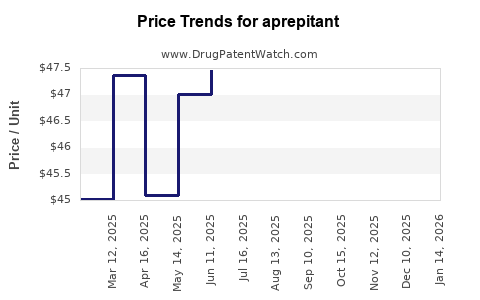
Drug Prices for aprepitant

See drug prices for aprepitant

Recent Clinical Trials for aprepitant

Identify potential brand extensions & 505(b)(2) entrants

SponsorPhase
Montefiore Medical CenterPHASE4
Centre hospitalier de l'Universit de Montral (CHUM)PHASE3
Rabin Medical CenterPHASE1

See all aprepitant clinical trials

Generic filers with tentative approvals for APREPITANT
Applicant Application No. Strength Dosage Form
⤷  Start Trial⤷  Start Trial130MG/18MLINJECTION, EMULSION
⤷  Start Trial⤷  Start Trial130MG/18ML (7.2MG/ML)INJECTABLE;INTRAVENOUS

The 'tentative' approval signifies that the product meets all FDA standards for marketing, and, but for the patents / regulatory protections, it would approved.

Paragraph IV (Patent) Challenges for APREPITANT
Tradename Dosage Ingredient Strength NDA ANDAs Submitted Submissiondate
APONVIE Intravenous Emulsion aprepitant 32 mg/4.4 mL 216457 1 2023-11-07
CINVANTI Intravenous Emulsion aprepitant 130 mg/18 mL 209296 1 2022-04-29
EMEND for Oral Suspension aprepitant 125 mg/Kit 207865 1 2016-11-23
EMEND Capsule aprepitant 40 mg, 80 mg and 125 mg 021549 1 2008-11-03

US Patents and Regulatory Information for aprepitant

Applicant Tradename Generic Name Dosage NDA Approval Date TE Type RLD RS Patent No. Patent Expiration Product Substance Delist Req. Exclusivity Expiration
Msd EMEND aprepitant CAPSULE;ORAL 021549-003 Jun 30, 2006 DISCN Yes No ⤷  Start Trial ⤷  Start Trial Y ⤷  Start Trial
Heron Theraps Inc CINVANTI aprepitant EMULSION;INTRAVENOUS 209296-001 Nov 9, 2017 RX Yes Yes ⤷  Start Trial ⤷  Start Trial Y ⤷  Start Trial
Sandoz APREPITANT aprepitant CAPSULE;ORAL 090999-003 Sep 24, 2012 AB RX No No ⤷  Start Trial ⤷  Start Trial ⤷  Start Trial
>Applicant >Tradename >Generic Name >Dosage >NDA >Approval Date >TE >Type >RLD >RS >Patent No. >Patent Expiration >Product >Substance >Delist Req. >Exclusivity Expiration

Expired US Patents for aprepitant

Applicant Tradename Generic Name Dosage NDA Approval Date Patent No. Patent Expiration
Msd EMEND aprepitant CAPSULE;ORAL 021549-002 Mar 26, 2003 ⤷  Start Trial ⤷  Start Trial
Msd EMEND aprepitant CAPSULE;ORAL 021549-001 Mar 26, 2003 ⤷  Start Trial ⤷  Start Trial
>Applicant >Tradename >Generic Name >Dosage >NDA >Approval Date >Patent No. >Patent Expiration

EU/EMA Drug Approvals for aprepitant

Company Drugname Inn Product Number / Indication Status Generic Biosimilar Orphan Marketing Authorisation Marketing Refusal
Merck Sharp & Dohme B.V. Emend aprepitant EMEA/H/C/000527Emend 40 mg hard capsules is indicated for the prevention of postoperative nausea and vomiting (PONV) in adults.Emend is also available as 80 mg and 125 mg hard capsules for the prevention of nausea and vomiting associated with highly and moderately emetogenic cancer chemotherapy in adults and adolescents from the age of 12 (see separate Summary of Product Characteristics).Emend is also available as 165 mg hard capsules for the prevention of acute and delayed nausea and vomiting associated with highly emetogenic cisplatin based cancer chemotherapy in adults and the prevention of nausea and vomiting associated with moderately emetogenic cancer chemotherapy in adults.Emend is also available as powder for oral suspension for the prevention of nausea and vomiting associated with highly and moderately emetogenic cancer chemotherapy in children, toddlers and infants from the age of 6 months to less than 12 years.Emend 80 mg, 125 mg, 165 mg hard capsules and Emend powder for oral suspension are given as part of combination therapy. Authorised no no no 2003-11-11
>Company >Drugname >Inn >Product Number / Indication >Status >Generic >Biosimilar >Orphan >Marketing Authorisation >Marketing Refusal

International Patents for aprepitant

Country Patent Number Title Estimated Expiration
China 1617712 ⤷  Start Trial
South Korea 20170056575 아프레피탄트의 에멀젼 제형 (EMULSION FORMULATIONS OF APREPITANT) ⤷  Start Trial
Canada 2469315 COMPOSITION PHARMACEUTIQUE NANOPARTICULAIRE A BASE D'UN ANTAGONISTE DU RECEPTEUR DE LA TACHYKININE (PHARMACEUTICAL NANOPARTICULATE COMPOSITION OF A TACHYKININ RECEPTOR ANTAGONIST) ⤷  Start Trial
>Country >Patent Number >Title >Estimated Expiration

Supplementary Protection Certificates for aprepitant

Patent Number Supplementary Protection Certificate SPC Country SPC Expiration SPC Description
0748320 SPC/GB08/021 United Kingdom ⤷  Start Trial PRODUCT NAME: FOSAPREPITANT AND PHARMACEUTICALLY ACCEPTABLE SALTS THEREOF, IN PARTICULAR THE BIS(N-METHYL-D-GLUCAMINE)SALT; REGISTERED: UK EU/1/07/437/001 20080111; UK EU/1/07/437/002 20080111
0734381 04C0010 France ⤷  Start Trial PRODUCT NAME: APREPITANT; REGISTRATION NO/DATE: EU/1/03/262/001 20031111
0734381 SPC/GB04/011 United Kingdom ⤷  Start Trial PRODUCT NAME: APREPITANT, OPTIONALLY IN THE FORM OF A PHARMACEUTICALLY ACCEPTABLE SALT; REGISTERED: UK EU/1/03/262/001 20031113; UK EU/1/03/262/002 20031113; UK EU/1/03/262/003 20031113; UK EU/1/03/262/004 20031113; UK EU/1/03/262/005 20031113; UK EU/1/03/262/006 20031113
>Patent Number >Supplementary Protection Certificate >SPC Country >SPC Expiration >SPC Description
Last updated: May 21, 2026

Aprepitant market dynamics and financial trajectory (revenue, pricing, exclusivity, and competitive risk)

Aprepitant is an antiemetic NK1 receptor antagonist used with corticosteroids and 5‑HT3 antagonists to prevent chemotherapy-induced nausea and vomiting (CINV) and to control postoperative nausea and vomiting (PONV). The category’s revenue profile is shaped by (1) patent/exclusivity timelines, (2) the breadth of branded label coverage versus narrower generic labeling, (3) payer contracting and site-of-care shifts, and (4) competition from generic aprepitant and NK1 alternatives. Financial trajectory since the branded era has largely depended on loss of exclusivity and the speed and depth of generic uptake, offset partially by continued guideline-based use in CINV regimens.


What is aprepitant’s current market position and revenue trajectory?

Featured answer: Aprepitant’s long-run revenue has trended down from branded peaks due to generic entry, with stabilization driven by continued CINV standard-of-care positioning, payer contracting, and seasonality in chemotherapy volumes.

Core use and demand drivers

Aprepitant is typically used in:

  • Highly emetogenic chemotherapy (HEC) CINV prophylaxis regimens
  • Moderately emetogenic chemotherapy (MEC) regimens where guideline pathways support NK1 inclusion
  • PONV prevention in adult populations (where NK1 antagonists are used)

Key demand drivers

  • Steady chemotherapy patient volumes
  • Emetogenicity mix (HEC share supports higher NK1 penetration)
  • Guideline adherence and pathway standardization at oncology centers
  • Formulary behavior: shift from branded to contracted generics after exclusivity loss

Revenue trajectory mechanics

Branded revenue typically declines in three phases:

  1. Pre-generic run-rate: branded unit growth tied to guideline adoption
  2. First generic discount cycle: price erosion and volume share shift
  3. Post-generic normalization: consolidation of supply and payer rebates stabilize net pricing

Aprepitant’s net revenue path is therefore more sensitive to rebate intensity, ASP compression, and channel mix than to changes in clinical demand.


When does aprepitant lose exclusivity and how does that affect sales?

Featured answer: Loss of branded exclusivity is the dominant inflection point for aprepitant’s financial trajectory, driving sustained ASP erosion and margin compression.

Exclusivity-driven sales impact

When exclusivity ends for a branded NK1 antagonist product, sales usually follow:

  • Rapid substitution to authorized generics and/or first challengers
  • Delayed penetration in hospital formularies that wait for contracting cycles
  • Persistent residual use for prescriber preference, patient history, or specific regimen protocols

What to expect in generic erosion

For CINV supportive care drugs, generic erosion tends to be:

  • Faster than chronic specialty drugs because prescribing is protocol-driven
  • Less complete than some generics because oncology pathways maintain structured CINV prophylaxis where NK1 inclusion persists, even if the specific agent switches to the lowest-cost equivalent

How do generics change aprepitant pricing, ASP, and margin?

Featured answer: Generic entry shifts aprepitant from branded premium pricing to competitive net pricing, with profitability increasingly determined by contracting volume, manufacturing scale, and supply continuity.

Pricing dynamics

  • ASP declines after generic launch, driven by wholesale pricing and rebate changes
  • Hospital procurement converts to tender-driven pricing over time
  • Commercial pharmacy (where applicable) also re-prices through plan formularies and pharmacy benefit manager (PBM) dynamics

Margin and manufacturing scale

Aprepitant’s margin profile is influenced by:

  • Batch economics and yield
  • Filings for additional strengths or package sizes
  • Ability to maintain supply during peak demand periods

Net financial impact often looks like:

  • Lower revenue per unit after generics
  • Higher unit volumes if pathway adherence stays stable
  • Compressed gross margin due to lower price and increased competitive spend

What patent estate strength does aprepitant have and how does it map to financial risk?

Featured answer: Financial risk post-generic entry is typically driven by whether follow-on patents delay generic substitution or restrict specific formulations, methods, or dosing regimens.

Where patent barriers usually matter

For supportive care drugs like aprepitant, the economically important constraints are typically:

  • Formulation patents covering dosage forms or specific release characteristics
  • Method-of-use patents tied to dosing regimens or emetogenic risk stratification
  • Manufacturing process patents that can raise regulatory/CMC barriers

Commercial risk linkage

  • If follow-on patents are meaningful and enforced, generic entry can be delayed or partial.
  • If the estate is thin or not enforceable, generic uptake accelerates and net pricing falls sooner.

What generic entry risks exist for aprepitant and how fast can erosion occur?

Featured answer: Erosion can occur quickly once first authorized generics or Paragraph IV ANDA filers launch, but the depth of erosion depends on contracting speed and whether the brand’s label breadth is fully replicated in competing products.

Risk factors that speed substitution

  • Multiproduct therapeutic class coverage: many CINV pathways tolerate NK1 substitution
  • Hospital formulary conversion timelines
  • Product availability and multiple-source supply

Risk factors that slow substitution

  • If a generic’s label coverage is narrower (for example, specific PONV indications or regimen details)
  • Institutional preference for a single supplier due to historical outcomes or supply assurances
  • Pack size or administration workflow constraints

What is the FDA regulatory status of aprepitant (Orange Book implications)?

Featured answer: The FDA regulatory status for aprepitant in the U.S. typically determines whether multiple generic products can be marketed immediately and whether listed patents constrain additional launches.

How Orange Book status affects market structure

  • Orange Book-listed patents tied to approved drug products can generate Paragraph IV litigation and delay generic approval or launch.
  • When those patents expire or are deemed non-infringing, competitive supply expands and prices fall.

Manufacturing and CMC consequences

For supportive care injectables or capsules, CMC and stability data can be practical gating items, but the market effect is usually secondary to exclusivity.


Which companies supply aprepitant and how competitive is the landscape?

Featured answer: The competitive landscape shifts from a single branded supplier to a multi-generic market; dominance usually flows to manufacturers with stable supply and strong distribution contracting.

What drives market share allocation after exclusivity

  • Number of ANDA approvals and commercial launches
  • Contracting with major hospital systems and group purchasing organizations (GPOs)
  • Wholesale distribution reach
  • Pricing aggressiveness and rebate positioning

Class competition

Aprepitant competes within NK1 antagonists used for CINV/PONV prophylaxis:

  • Other NK1 agents can redirect some NK1 usage if they have competitive pricing or different dosing convenience.
  • Where payers prefer a single NK1 on formulary, class-level substitution can reduce erosion intensity for one agent while increasing it for another.

How does aprepitant compare with other NK1 antagonists on market dynamics?

Featured answer: Market outcomes across NK1 antagonists tend to be driven by launch timing (generic vs branded), dosing convenience, and payer formulary preference more than by efficacy differences.

Comparison dimensions

  • Dosing convenience (cycle-day administration)
  • Switching flexibility within clinical pathways
  • Payer formulary depth for generic equivalents
  • Historical formulary position in oncology and perioperative settings

Implications for aprepitant

If another NK1 agent has broader payer uptake or better contracting terms, aprepitant’s unit share can decline faster even after generic entry. If aprepitant becomes the lowest-cost NK1 in a given tender region, it can retain demand and cushion revenue decline.


What litigation and Paragraph IV challenges affect aprepitant’s financial timeline?

Featured answer: Paragraph IV challenges can delay specific generic launches and produce “stair-step” market entry, affecting revenue timing more than ultimate long-run decline.

Typical financial effects of litigation

  • Temporary delay: brand retains higher share longer, lifting near-term revenue
  • Settlement-driven entry: generic arrives later but can be immediate upon settlement term expiry
  • Authorized generic: can reduce erosion magnitude even if branded exclusivity is lifted

What to track for investors and licensors

  • Trigger dates for settlement entry
  • Court rulings that end stays
  • Whether the generic was launched “at-risk” versus after final FDA approval clearance

How do settlement agreements and launch timing translate into annual revenue swings?

Featured answer: Settlement and launch timing typically create short windows where prices remain elevated relative to the eventual post-entry baseline.

Revenue swing pattern

  • Pre-launch: brand share holds due to delayed generic entry
  • Launch month: rapid ASP and share change after channel alignment
  • After 2 to 6 quarters: competitive equilibrium and normalized net pricing

For aprepitant, because prescribing is protocolized, the “shock” tends to be sharp once procurement changes and hospital formularies adopt the new lowest-cost option.


What commercial metrics best describe aprepitant’s financial trajectory?

Featured answer: The market can be monitored effectively with ASP, unit volume, and channel mix (hospital vs retail), with payer contracting indicators explaining the net-price variance.

Metrics to model

  • Net sales (gross-to-net driven by rebates)
  • ASP and WAC spread
  • Unit share in oncology and perioperative segments
  • Tender outcomes at major hospital systems
  • Generic number-of-suppliers count per NDC/strength
  • Inventory and supply continuity (affects substitution speed)

What is the financial outlook for aprepitant under different generic supply scenarios?

Featured answer: Financial upside is mainly a function of sustaining supply and retaining the lowest-cost position, while downside centers on additional entrants and deeper price competition.

Scenario framework

  1. Single-source consolidation: fewer suppliers tighten pricing power
  2. Multiple-source price competition: rapid net price declines
  3. Short supply interruptions: localized price spikes but usually temporary
  4. Class-level substitution by other NK1s: reduces unit demand for aprepitant even if ASP holds

Key Takeaways

  • Aprepitant’s financial trajectory is dominated by exclusivity loss and subsequent generic uptake, producing sustained ASP erosion after the branded-to-generic transition.
  • Market dynamics depend on protocol-driven demand in CINV regimens and payer contracting speed, leading to rapid substitution once competitive products are available.
  • Litigation and settlement can shift the timing of erosion into discrete steps, but the long-run direction usually tracks the competitive supply landscape.
  • Competitive positioning versus other NK1 antagonists and the lowest-cost tender outcome drive residual market share after generic entry.
  • For forecasting, monitor net price (ASP compression), unit volume share in hospital procurement, and supplier count per strength/NDC.

FAQs

1. How quickly can hospital formularies switch after generic aprepitant launches?
Switching typically follows contracting and tender cycles; the fastest conversions occur in systems with established pathway-based CINV protocols and active multi-source purchasing.

2. Does aprepitant face competition from other NK1 antagonists on formulary tiering?
Yes. Payers and GPOs may standardize a single NK1 for CINV prophylaxis, making class-level substitution a key share driver.

3. What supply risks most affect aprepitant revenue in a multi-generic market?
Manufacturing continuity and stability-driven production constraints can slow substitution or create temporary pricing rebounds, especially during peak chemotherapy scheduling periods.

4. Which market segments matter more for aprepitant’s post-exclusivity revenue: oncology infusions or perioperative care?
Oncology CINV prophylaxis usually drives the largest baseline demand; perioperative PONV use can materially affect quarterly variability but is often smaller.

5. What indicators best predict further price erosion for aprepitant?
Additional ANDA approvals/launches, increased supplier count, aggressive rebate changes, and tender outcomes that reset the lowest-cost option.


References (APA)

  1. FDA. Orange Book: Approved Drug Products with Therapeutic Equivalence Evaluations. U.S. Food and Drug Administration.
  2. FDA. Drug Approval Reports and labeling information for aprepitant-containing products. U.S. Food and Drug Administration.
  3. NCCN Guidelines. Antiemesis (Nausea/Vomiting) guidance for CINV prophylaxis. National Comprehensive Cancer Network.

More… ↓

⤷  Start Trial

Make Better Decisions: Try a trial or see plans & pricing

Drugs may be covered by multiple patents or regulatory protections. All trademarks and applicant names are the property of their respective owners or licensors. Although great care is taken in the proper and correct provision of this service, thinkBiotech LLC does not accept any responsibility for possible consequences of errors or omissions in the provided data. The data presented herein is for information purposes only. There is no warranty that the data contained herein is error free. We do not provide individual investment advice. This service is not registered with any financial regulatory agency. The information we publish is educational only and based on our opinions plus our models. By using DrugPatentWatch you acknowledge that we do not provide personalized recommendations or advice. thinkBiotech performs no independent verification of facts as provided by public sources nor are attempts made to provide legal or investing advice. Any reliance on data provided herein is done solely at the discretion of the user. Users of this service are advised to seek professional advice and independent confirmation before considering acting on any of the provided information. thinkBiotech LLC reserves the right to amend, extend or withdraw any part or all of the offered service without notice.