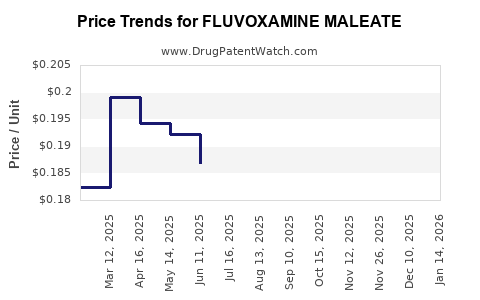
Last updated: June 12, 2026
Fluvoxamine maleate is an established, off-patent oral antidepressant. Near-term financial trajectory is driven by (1) conversion to low-cost generic volume, (2) scope and durability of demand linked to non-depression use claims, and (3) price compression across mature markets. In the US, trade-driving exposure remains tied to existing branded products (if any) versus generic-only supply. In most jurisdictions, the product’s economics track classic “mature generic” patterns: declining net price, stabilizing or slowly growing unit volume, and revenue reshuffling toward the lowest-cost suppliers.
What is the current market size and revenue trajectory for fluvoxamine maleate?
How does fluvoxamine maleate revenue typically evolve in mature generic markets?
A mature, molecule-level profile for fluvoxamine maleate follows three phases:
- Pre-main generic entry: brand-led revenue with higher net prices.
- Post-generic entry: rapid net price decline after the first wave of generics.
- Consolidation: unit growth continues while revenue mostly flattens due to sustained price pressure.
Key financial mechanics:
- Net revenue tracks ASP more than units once generic competition becomes multi-supplier.
- Revenue stability depends on volume resilience from adherence and prescriber familiarity, not on innovation cycles.
- Margin discipline shifts to manufacturing scale and sourcing rather than product differentiation.
What demand drivers affect unit growth for fluvoxamine maleate?
Primary demand is still anchored in psychiatric indications (major depressive disorder and related depressive disorders), with potential incremental demand drivers from off-label interest when clinical narratives change. Demand pull also comes from:
- Formulary placement of generics by large pharmacy benefit managers.
- Switching behavior at the pharmacy counter as payers enforce tiering and preferred generic lists.
- Regional prescribing guidelines and local reimbursement rules.
What is the risk to revenue growth for an established generic molecule?
- Ongoing price erosion from new generic entrants and pharmacy-driven substitution.
- Loss of insurer/formulary support for higher-cost suppliers if contracting dynamics shift.
- Indicator-specific demand volatility if non-core use narratives cool or face policy reversal.
Which companies sell fluvoxamine maleate and how do market shares shift under generic price competition?
Who are the major suppliers and how do they compete?
In most markets, fluvoxamine maleate becomes a generic commodity with competition among multiple manufacturers and labeled distributors. Market share typically concentrates among:
- Top generic manufacturers with large-scale supply chains.
- Wholesaler and pharmacy network preferred products with the lowest landed cost.
- Formulary “preferred” generics assigned via PBM rebates and contracting.
What determines which manufacturer wins volume?
- Net price vs. reference price in payer contracts
- Availability reliability during supply constraints
- Package/NDC-level execution (strength, dosage form, distribution reach)
- Manufacturing quality history affecting pharmacy willingness to switch
How does tendering and contracting change revenue?
When payers move to:
- auction or preferred list contracting, volume shifts fast.
- multi-source contracting, no single supplier captures durable premiums.
The result is typically sustained revenue pressure on non-leading suppliers and periodic share swings.
What are the key market dynamics shaping pricing for fluvoxamine maleate?
What drives ASP declines after generic entry?
- New generic listings increase supply elasticity and compress wholesale price.
- Payer-driven substitution eliminates brand premiums quickly.
- International benchmark pricing can compound downward pressure where regulators reference mature pricing.
How do formularies and PBM policies affect pricing velocity?
Once multiple generic SKUs exist:
- PBM preferred tiers can drop ASP suddenly at contract renewal.
- Pharmacy-level substitution can accelerate by reducing friction and maximizing rebate economics.
Does dosage strength or formulation change pricing?
Yes, but typically second-order:
- Different strengths can experience uneven competition intensity.
- Any differences in packaging, tablet vs. capsule, and excipient profiles can affect pricing outcomes slightly even within the same molecule.
How could new indication narratives affect fluvoxamine maleate sales without changing patent status?
What happens when off-label or adjunct interest rises for an old generic?
Even without exclusivity:
- Volume can rise if prescribers adopt the drug off-label.
- Payers respond with tiering policies that may initially support broader access and later revert to strict cost controls.
What are the economic limits of indication-driven demand for generics?
- If adoption spreads but is not tied to a distinct reimbursed pathway, volume growth may be partially absorbed by price erosion.
- Off-label uptake can attract more suppliers to the market, pulling price down faster.
What is the main upside lever?
The upside is durable payer-covered volume. Without reimbursement consistency, utilization spikes tend to fade as price competition intensifies.
How does regulatory status influence commercial trajectory for fluvoxamine maleate?
What FDA pathway considerations apply to generics?
In the US, fluvoxamine maleate is generally supported by ANDAs referencing the approved reference listed drug(s). Commercial trajectory is driven by:
- ANDA approval velocity and market entry timing
- Label parity (strengths, indications, dosing instructions)
- Litigation or regulatory stays if any exist around specific listed products (less common for a well-established molecule)
Orange Book mechanics: what matters financially
For mature drugs, the primary Orange Book impact is no longer innovation protection. It becomes:
- Whether a reference listed drug still has active exclusivity around listed patents
- Whether FDA lists method-of-use, formulation, or process claims for a specific RLD
- Which ANDA applicants can launch immediately versus being blocked
For fluvoxamine maleate specifically, the commercial outlook depends on whether any listed patents or exclusivity remain relevant to current RLDs. In the absence of active exclusivity, the economic outcome is dominated by generic price competition.
What generic entry risks exist for fluvoxamine maleate, and how fast can price drop?
What are the typical timelines for generic pricing compression?
For established generics, price compression can occur quickly after entry:
- Entry-to-ASP drop often accelerates in the first quarters after multiple ANDAs launch.
- Volume share redistribution can occur at pharmacy substitution speed and PBM contracting cycles.
- The net effect is a near-immediate revenue flattening followed by slow unit growth.
What manufacturing/IP barriers can delay generic launches?
Commercially relevant barriers include:
- Process or manufacturing compliance issues
- Quality system events leading to pauses
- Supply chain constraints
- Product-specific labeling or bioequivalence disputes if they affect approval timelines
For a mature molecule, these barriers tend to create short-lived disruptions rather than multi-year price sustainment.
What litigation or exclusivity events could still move the market price for fluvoxamine maleate?
How do Paragraph IV challenges affect financial trajectory?
Paragraph IV matters primarily when:
- there is still a protectable patent or exclusivity tied to the specific RLD.
For mature molecules, the probability of material Paragraph IV-driven delayed launches declines over time, but it can still occur around remaining listed patents for particular formulations or method-of-use claims tied to a specific labeled product.
What settlement dynamics matter economically?
Settlement outcomes affect:
- Launch timing of competing ANDAs
- Whether the market stays closer to a higher ASP for longer
- How many authorized generics or permitted launch SKUs appear
What if exclusivity extends only for specific dosage forms?
Then pricing effects can be localized:
- One strength or dosage form holds margin briefly.
- Revenue shifts to the protected strength until general competition spreads.
How does fluvoxamine maleate compare with other SSRIs on economics and competitive positioning?
Why do market dynamics differ across SSRIs?
Even among SSRIs, economics differ by:
- brand longevity and last exclusivity timing
- generic concentration
- strength availability and product-line breadth
- treatment guideline adoption and payer preferred status
What tends to be true for fluvoxamine versus newer SSRIs?
- If competitors include more recently commercialized products, their first generic entry can lag.
- For fluvoxamine itself, being mature means pricing is likely lower and less volatile, with competition concentrated in cost and supply execution.
What dosage forms and formulation factors influence adoption and profitability?
What products drive commercial utilization?
For fluvoxamine maleate, profitability typically hinges on:
- strength coverage (broad strength availability reduces prescriber friction)
- packaging aligned with dispensing workflows
- reliable supply at contracted net prices
Do formulation tweaks change patent risk or pricing?
Formulation modifications can create product-level exclusivity if new patents exist, but for mature fluvoxamine maleate the incremental economic impact is usually limited. The primary value is operational: ensuring bioequivalence parity and minimizing manufacturing cost.
Country and jurisdiction: where is the financial trajectory most likely to differ?
US
- Expect continued generic dominance.
- Financial path depends on PBM preferred pricing and generic supply concentration at the product level.
EU (selected member states)
- Price competition is typically more regulated and reference-price driven.
- Revenue may stabilize sooner but at lower ASP than the US due to faster regulatory price convergence.
Other regions
- Adoption depends on national formulary inclusion, reimbursement rules, and generic market maturity.
- Where generics enter later, initial revenue may persist longer before steep price declines.
Key financial indicators to track for fluvoxamine maleate in 2026+
Pricing and volume KPIs
- Net sales vs. unit volume trend (separates price erosion from true demand growth)
- ASP trajectory at the NDC/dosage strength level
- Share of prescriptions among preferred generics (PBM influence)
- Gross margin and manufacturing cost per unit (reflects supplier competitiveness)
Supply and execution KPIs
- Availability (fill rate, stockouts)
- Quality actions that can temporarily remove products
- Number of active suppliers for each strength
Policy KPIs
- Formulary tier changes at major PBMs
- Reimbursement changes if non-core indication demand is recognized or later restricted
Key Takeaways
- Fluvoxamine maleate’s commercial trajectory is that of a mature, off-patent generic: price erosion dominates and revenue largely tracks unit volume stability.
- Market share shifts are primarily contracting and preferred-list driven, not innovation driven.
- Any demand uplift from off-label or adjunct narratives is likely to be absorbed by further generic competition, unless reimbursement and payer coverage keep utilization durable.
- The practical financial battleground remains NDC-level net pricing, PBM contracting, and supplier availability rather than patent-driven delays.
FAQs
- How do PBM preferred-generic lists change fluvoxamine maleate net pricing?
- What drives unit growth for fluvoxamine maleate after generic entry: adherence, switching, or formulary inclusion?
- Does the economics of fluvoxamine maleate differ materially by dosage strength?
- How can off-label interest in an old generic translate into measurable revenue without exclusivity?
- What supply-chain events most commonly cause short-term price and availability swings for established generics like fluvoxamine maleate?
References (APA)
- FDA. Orange Book: Approved Drug Products with Therapeutic Equivalence Evaluations. https://www.accessdata.fda.gov/scripts/cder/daf/
- FDA. Drug Approval Reports and ANDA approvals (search portal). https://www.fda.gov/drugs/
- FDA. Labeling and prescribing information resources. https://www.accessdata.fda.gov/scripts/cder/daf/index.cfm