You're using a free limited version of DrugPatentWatch: Upgrade for Complete Access

Last Updated: December 17, 2025

ETRAVIRINE - Generic Drug Details


✉ Email this page to a colleague

« Back to Dashboard


What are the generic sources for etravirine and what is the scope of freedom to operate?

Etravirine is the generic ingredient in two branded drugs marketed by Amneal, Bionpharma, Carnegie, and Janssen R And D, and is included in four NDAs. Additional information is available in the individual branded drug profile pages.

There are five drug master file entries for etravirine. Six suppliers are listed for this compound.

Summary for ETRAVIRINE
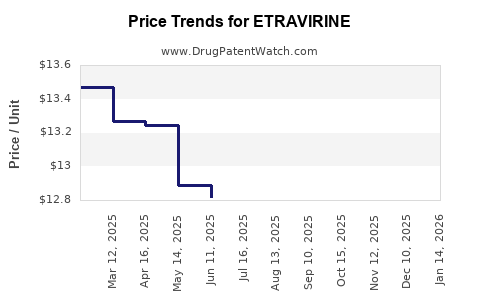
Drug Prices for ETRAVIRINE

See drug prices for ETRAVIRINE

Recent Clinical Trials for ETRAVIRINE

Identify potential brand extensions & 505(b)(2) entrants

SponsorPhase
Fundacion Clinic per a la Recerca BiomédicaPhase 4
Jean-Pierre RoutyN/A
Orlando Immunology CenterPhase 4

See all ETRAVIRINE clinical trials

US Patents and Regulatory Information for ETRAVIRINE

Applicant Tradename Generic Name Dosage NDA Approval Date TE Type RLD RS Patent No. Patent Expiration Product Substance Delist Req. Exclusivity Expiration
Janssen R And D INTELENCE etravirine TABLET;ORAL 022187-001 Jan 18, 2008 AB RX Yes No ⤷  Get Started Free ⤷  Get Started Free ⤷  Get Started Free
Carnegie ETRAVIRINE etravirine TABLET;ORAL 215402-001 Apr 13, 2022 AB RX No No ⤷  Get Started Free ⤷  Get Started Free ⤷  Get Started Free
Carnegie ETRAVIRINE etravirine TABLET;ORAL 215402-002 Apr 13, 2022 AB RX No No ⤷  Get Started Free ⤷  Get Started Free ⤷  Get Started Free
>Applicant >Tradename >Generic Name >Dosage >NDA >Approval Date >TE >Type >RLD >RS >Patent No. >Patent Expiration >Product >Substance >Delist Req. >Exclusivity Expiration

Expired US Patents for ETRAVIRINE

Applicant Tradename Generic Name Dosage NDA Approval Date Patent No. Patent Expiration
Janssen R And D INTELENCE etravirine TABLET;ORAL 022187-002 Dec 22, 2010 7,037,917*PED ⤷  Get Started Free
Janssen R And D INTELENCE etravirine TABLET;ORAL 022187-001 Jan 18, 2008 6,878,717*PED ⤷  Get Started Free
Janssen R And D INTELENCE etravirine TABLET;ORAL 022187-002 Dec 22, 2010 6,878,717*PED ⤷  Get Started Free
>Applicant >Tradename >Generic Name >Dosage >NDA >Approval Date >Patent No. >Patent Expiration

EU/EMA Drug Approvals for ETRAVIRINE

Company Drugname Inn Product Number / Indication Status Generic Biosimilar Orphan Marketing Authorisation Marketing Refusal
Janssen-Cilag International NV Intelence etravirine EMEA/H/C/000900Intelence, in combination with a boosted protease inhibitor and other antiretroviral medicinal products, is indicated for the treatment of human-immunodeficiency-virus-type-1 (HIV-1) infection in antiretroviral-treatment-experienced adult patients and in antiretroviral-treatment-experienced paediatric patients from six years of age.This indication is based on week-48 analyses from two phase-III trials in highly pretreated patients where Intelence was investigated in combination with an optimised background regimen (OBR) which included darunavir/ritonavir. The indication in paediatric patients is based on 48-week analyses of a single-arm, phase-II trial in antiretroviral-treatment-experienced paediatric patients. Authorised no no no 2008-08-28
>Company >Drugname >Inn >Product Number / Indication >Status >Generic >Biosimilar >Orphan >Marketing Authorisation >Marketing Refusal

Market Dynamics and Financial Trajectory for Etravirine

Last updated: September 4, 2025

Introduction

Etravirine, marketed under the brand name Intelence, is a non-nucleoside reverse transcriptase inhibitor (NNRTI) used in the treatment of HIV-1 infection. Approved by the U.S. Food and Drug Administration (FDA) in 2008, Etravirine has since established itself as a vital component in antiretroviral therapy (ART) regimens for HIV-positive patients. Understanding the drug's market dynamics and financial trajectory requires an analysis of its clinical positioning, competitive landscape, regulatory trends, manufacturing factors, and macroeconomic influences that shape its valuation and growth prospects.

1. Clinical Positioning and Market Demand

Etravirine's role as a second-line treatment option stems from its efficacy in patients who have developed resistance to first-generation NNRTIs such as efavirenz and nevirapine. Its unique mechanism of binding to multiple sites on the reverse transcriptase enzyme confers high resistance barriers, making it attractive in salvage therapy.

The global HIV treatment market continues to grow, driven by rising prevalence and expanded access programs. According to UNAIDS, approximately 38 million people worldwide live with HIV, with over 25 million on antiretroviral therapy as of 2021. The increasing adoption of Etravirine in low- and middle-income countries (LMICs), especially where resistance to first-line therapies is high, supports sustained demand.

However, the drug's market share has been challenged by newer agents in the NNRTI class, such as doravirine and the growing use of integrase strand transfer inhibitors (INSTIs) like dolutegravir, which are favored for their improved side effect profiles and simplified dosing regimens.

2. Competitive Landscape

Etravirine faces intense competition from multiple drug classes:

  • Integrase Inhibitors: Dolutegravir (DTG) and bictegravir have gained dominance as first-line therapies due to superior efficacy and tolerability.
  • Other NNRTIs: Rilpivirine remains a competitor in certain regimens, although resistance issues are a concern.
  • Protease Inhibitors (PIs): Used in salvage therapy but less preferred due to adverse effects and pill burdens.

In this context, Etravirine's positioning as a secondary or salvage therapy limits its market growth potential but sustains steady demand in treatment-resistant cases. Some studies indicate residual Off-label use and preference shifts in specific regions, especially where resistance testing informs personalized therapy choices.

3. Regulatory and Patent Landscape

Etravirine’s patent expiration timelines crucially influence its market trajectory. The original patents in the United States expired in 2020, opening avenues for generic manufacturing, which typically results in substantial price erosion—downward pressure on revenue in developed markets. In emerging markets, patent protections often persist longer, providing a temporary shield from generic competition.

Regulatory developments also impact the drug's landscape:

  • Approval of Generics: Several generics are approved in various jurisdictions, contributing to price competition.
  • New Indications or Formulations: Patent extensions via new formulations or fixed-dose combinations can temporarily bolster revenue.

4. Manufacturing and Supply Chain Considerations

Manufacturing Etravirine involves complex synthetic pathways, and shifts toward generic production have scaled up capacity, significantly lowering costs. This proliferation enhances access but compresses profit margins for originator companies. Supply chain stability, particularly amid global disruptions like COVID-19, sustains affordability and availability in resource-poor settings, which remains critical for demand continuity.

5. Pricing and Reimbursement Dynamics

Pricing strategies for Etravirine vary by region:

  • Developed Markets: Prices are higher, driven by patent exclusivity, with reimbursement flows through healthcare payers.
  • Emerging Markets: Lower prices due to generic competition and subsidy programs.

Reimbursement policies, especially in LMICs—funded through global initiatives like Gilead’s PEPFAR, the Clinton Foundation, and the Global Fund—affect access and revenue streams. Additionally, price negotiations and health policy shifts toward combination therapies influence Etravirine's market penetration.

6. Macro-Economic and Epidemiological Influences

The ongoing HIV epidemic in lower-income regions offers long-term demand for effective salvage therapies like Etravirine. However, several macro factors bear influence:

  • Funding Fluctuations: Changes in international aid impact procurement volumes.
  • Generic Market Dynamics: Entry of generics in key markets will depress prices and revenues.
  • Innovative Therapy Adoption: Transition toward novel drug classes may diminish Etravirine's market share over time.

7. Revenue and Financial Outlook

Initially, Etravirine recorded peak annual revenues of approximately $400–500 million in the late 2010s. Post-patent expiry in key markets and escalating generic competition have depressed sales significantly. As of 2022, global sales have declined by over 60%, with top pharmaceutical companies recalibrating their portfolios accordingly.

Despite declining revenues, Etravirine remains a relevant option within highly resistant HIV cases, especially in settings with limited access to newer agents. The drug's ongoing utility in salvage therapy sustains a niche market, albeit with diminishing financial returns.

8. Future Trajectory and Strategic Considerations

Looking ahead, the financial trajectory hinges on several factors:

  • Market Penetration in Low-Income Countries: Continued reliance on Etravirine in resistance management sustains some demand.
  • Emergence of New Resistance Patterns: Limited, but ongoing, resistance challenges necessitate alternative therapies.
  • Development of Fixed-Dose Combinations: Integration into multi-drug formulations may rejuvenate interest, prolonging lifecycle.

Pharmaceutical firms may also focus on lifecycle management strategies, such as new dosing regimens, formulation improvements, or expanded indications, to extend profitability.

Key Market Drivers and Barriers

Drivers Barriers
Rising global HIV prevalence Patent expiration and generic competition
High resistance prevalence necessitating salvage therapy Competition from newer, more tolerable agents
International aid funding for treatment access Limited penetration in developed markets post-patent expiry
Increasing use of fixed-dose combinations Stringent regulatory and reimbursement hurdles

Conclusion

Etravirine’s market dynamics are shaped by its clinical niche, the evolving HIV treatment landscape, patent protections, and macroeconomic factors. While its revenues face pressure from generics and emerging treatment options, the drug's role in managing resistant HIV cases sustains moderate demand. Companies and stakeholders must navigate patent cliffs, price competition, and treatment landscape shifts while leveraging opportunities in targeted markets.


Key Takeaways

  • Market Positioning: Etravirine remains vital for salvage therapy in resistant HIV cases, though its broader market share diminishes alongside newer agents.
  • Patent and Generic Impact: Patent expiries have precipitated significant revenue declines; generics dominate prices in many regions.
  • Regional Variability: Demand persists primarily in resource-limited settings where resistance testing guides therapy choices.
  • Strategic Opportunities: Lifecycle management via formulation innovations and regional partnerships can extend the drug's market viability.
  • Investment Implication: For stakeholders, understanding regional dynamics and resistance trends is essential for informed positioning.

FAQs

1. What factors have most contributed to the decline in Etravirine’s revenues?
Patent expirations leading to generic entry, competition from newer drug classes like INSTIs, and shifting treatment guidelines favoring simpler regimens have all contributed to revenue declines.

2. How does resistance impact the demand for Etravirine?
Etravirine’s efficacy as a salvage therapy makes it crucial for patients with resistance to other NNRTIs, sustaining demand in cases where resistance testing indicates its use.

3. Are there ongoing efforts to extend Etravirine’s patent life or develop new formulations?
While no recent patent extensions are reported, companies may explore fixed-dose combination formulations or new delivery methods to prolong lifecycle.

4. Which regions harbor the most significant market for Etravirine?
Sub-Saharan Africa and parts of Asia, where resource limitations restrict access to newer, more convenient drugs, rely more heavily on Etravirine.

5. What is the outlook for Etravirine’s role in future HIV treatment strategies?
Its role is expected to diminish in favor of first-line INSTIs and other novel agents, but it remains a crucial component for highly resistant cases in specific markets.


References

  1. UNAIDS. Global HIV & AIDS statistics—Fact sheet 2022.
  2. U.S. Food and Drug Administration. FDA approves Intelence for HIV treatment, 2008.
  3. MarketWatch. HIV antiretroviral drugs market analysis, 2022.
  4. Gilead Sciences. Global HIV treatment access programs overview, 2022.
  5. World Health Organization. Consolidated guidelines on HIV prevention, testing, treatment, service delivery, 2021.

More… ↓

⤷  Get Started Free

Make Better Decisions: Try a trial or see plans & pricing

Drugs may be covered by multiple patents or regulatory protections. All trademarks and applicant names are the property of their respective owners or licensors. Although great care is taken in the proper and correct provision of this service, thinkBiotech LLC does not accept any responsibility for possible consequences of errors or omissions in the provided data. The data presented herein is for information purposes only. There is no warranty that the data contained herein is error free. We do not provide individual investment advice. This service is not registered with any financial regulatory agency. The information we publish is educational only and based on our opinions plus our models. By using DrugPatentWatch you acknowledge that we do not provide personalized recommendations or advice. thinkBiotech performs no independent verification of facts as provided by public sources nor are attempts made to provide legal or investing advice. Any reliance on data provided herein is done solely at the discretion of the user. Users of this service are advised to seek professional advice and independent confirmation before considering acting on any of the provided information. thinkBiotech LLC reserves the right to amend, extend or withdraw any part or all of the offered service without notice.