Last updated: August 7, 2026
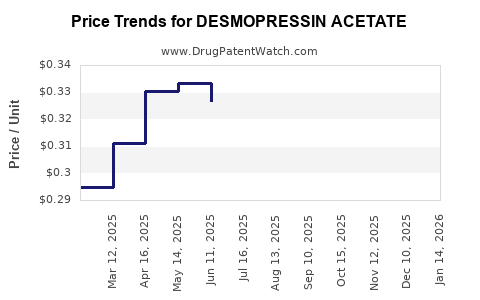
Desmopressin acetate is a mature, largely generic small-molecule market with value concentrated in branded formulations, specialty indications, and supply reliability rather than in the active ingredient itself. Generic tablets have compressed prices, while Ferring’s DDAVP and Nocdurna products retain commercial value through formulation, indication, and distribution advantages. The market’s principal constraints are hyponatremia risk, FDA labeling restrictions, product recalls, manufacturing interruptions, and limited public disclosure of product-level revenue.
What is the current market position of desmopressin acetate?
Desmopressin acetate is a synthetic vasopressin analog used in four principal settings:
| Market segment |
Typical dosage form |
Commercial position |
| Central diabetes insipidus |
Tablets, injection, nasal spray |
Established, largely generic |
| Primary nocturnal enuresis |
Tablets and nasal formulations |
Established, generic competition |
| Nocturia due to nocturnal polyuria |
Sublingual tablet |
Branded, differentiated formulation |
| Hemophilia A and von Willebrand disease |
Intravenous or subcutaneous injection, historically nasal spray |
Specialty and hospital market |
The molecule is marketed under DDAVP, Nocdurna, generic desmopressin tablets, and several injectable or nasal products. The FDA has approved products across multiple New Drug Applications and Abbreviated New Drug Applications, but commercial availability varies by formulation and manufacturer.[1]
The market is not a single homogeneous product category. Oral tablets compete primarily on price. Nocdurna competes on low-dose sublingual delivery and an FDA-approved nocturia indication. Injectable products compete through hospital access, institutional contracts, quality compliance, and supply continuity.
How large is the desmopressin acetate market?
No reliable public source reports a consolidated global revenue figure for all desmopressin acetate products. Ferring is privately held and does not disclose standalone revenue for DDAVP, Nocdurna, or the broader desmopressin franchise. Public company filings generally combine desmopressin sales with wider specialty portfolios or do not separately identify the product.
The market can be characterized financially as follows:
| Metric |
Assessment |
| Active pharmaceutical ingredient |
Mature and generic |
| U.S. oral tablet pricing |
Low to moderate, subject to generic substitution |
| Branded formulation pricing |
Higher, particularly for Nocdurna |
| Hospital injectable pricing |
Dependent on contracts and shortage conditions |
| Revenue concentration |
High among a small number of branded and specialty suppliers |
| Volume growth |
Limited in mature indications |
| Value growth |
Driven by formulation mix, price, and supply availability |
| Public revenue transparency |
Low |
Commercial estimates from prescription-data vendors should be treated as product-specific rather than market-wide. They may exclude hospital purchases, cash-pay prescriptions, international sales, and discontinued or intermittently unavailable formulations.
What products and manufacturers compete in desmopressin acetate?
Ferring products
Ferring is the principal branded commercial participant in the U.S. desmopressin market.
DDAVP has been marketed in tablet, nasal, and injectable forms for central diabetes insipidus, nocturnal enuresis, and bleeding-related indications. The specific approved uses vary by dosage form and label.
Nocdurna is a low-dose sublingual desmopressin acetate tablet approved in 2018 for the treatment of nocturia due to nocturnal polyuria in adults who awaken at least twice per night to urinate.[2] Its commercial differentiation rests on:
- A sublingual route;
- Low-dose administration;
- A dedicated adult nocturia indication;
- Gender-specific dosing;
- Risk-management requirements addressing hyponatremia.
Generic manufacturers
Generic desmopressin products have been approved in oral tablet and injectable categories. Manufacturers have included large generic companies and specialty suppliers, although individual product availability changes over time because of discontinuations, manufacturing issues, and FDA supply actions.
Generic competition is strongest in established tablet indications. It is weaker for branded low-dose sublingual products and for products requiring specialized manufacturing, sterile filling, or nasal delivery systems.
Competitive substitutes
Desmopressin competes indirectly with:
- Behavioral and fluid-management interventions for nocturia;
- Antimuscarinic therapies;
- Beta-3 adrenergic agonists;
- Other therapies for bleeding disorders;
- Long-acting factor concentrates;
- Von Willebrand factor replacement;
- Vasopressin or related agents in selected hospital settings.
These substitutes limit pricing power in some indications but do not fully replace desmopressin’s role in central diabetes insipidus or selected hemostatic applications.
When did desmopressin acetate lose exclusivity?
The original desmopressin acetate patents and regulatory exclusivities expired decades ago. The core molecule is therefore exposed to generic competition.
Later exclusivity has centered on formulation and indication patents rather than composition-of-matter protection for desmopressin itself. Nocdurna received FDA approval on June 21, 2018. Any three-year clinical-investigation exclusivity associated with the approval would have expired in 2021, subject to the scope of the protected change and the FDA’s regulatory records.[2]
The commercial implication is material: the core molecule does not provide a durable barrier, while newer formulations can retain protection only if their patents cover meaningful delivery, dosage, or use features and survive validity and infringement challenges.
What patents protect desmopressin acetate products?
The patent estate is formulation- and use-focused rather than molecule-focused.
Core molecule
The underlying desmopressin molecule is off patent. Generic manufacturers can seek approval for established dosage forms through the ANDA pathway, subject to applicable FDA requirements and listed patents.
Nocdurna and sublingual formulations
Nocdurna’s protection is expected to depend on patents covering one or more of the following:
- Sublingual dosage forms;
- Low-dose desmopressin compositions;
- Dosing regimens for nocturia;
- Sex-specific dose selection;
- Pharmacokinetic or safety characteristics;
- Methods for treating nocturnal polyuria.
The relevant Orange Book listing status can change through patent additions, expiration, delisting, litigation, or regulatory updates. A current Orange Book review is required to establish the operative patent numbers and expiration dates for a specific filing date.[3]
DDAVP and generic tablets
The principal barriers for generic DDAVP tablets are not likely to be long-lived molecule patents. They are more likely to involve:
- Product-specific formulation patents, where still listed;
- Labeling and indication strategy;
- Manufacturing approvals;
- Bioequivalence;
- Distribution agreements;
- Drug-shortage and supply conditions.
Nasal formulations
Nasal desmopressin has historically carried higher technical and safety risk than tablets. Dose uniformity, device performance, preservative systems, and systemic exposure affect both regulatory approval and product liability exposure.
What is the Orange Book status of desmopressin acetate?
FDA Orange Book entries distinguish among multiple desmopressin products and dosage forms. There is no single Orange Book status for the entire active ingredient.
The main Orange Book categories are:
- DDAVP tablets and related dosage forms;
- Nocdurna sublingual tablets;
- Injectable desmopressin products;
- Other approved formulations with different sponsors and application numbers.
For generic applicants, the relevant question is whether the reference product has listed patents or exclusivity that affects an ANDA filing. A Paragraph IV certification may trigger litigation under the Hatch-Waxman framework, while a Paragraph III certification can defer approval until patent expiration.
Publicly available core FDA records do not establish a broad, molecule-wide exclusivity barrier for desmopressin acetate. The practical risk is product-specific, particularly for Nocdurna and any later-generation delivery system.[3]
Which companies are challenging desmopressin acetate patents?
Desmopressin has a long generic history, but the principal competitive activity has been product-by-product rather than a single highly visible patent campaign.
Generic entrants can challenge listed patents through:
- Paragraph IV certifications;
- ANDA litigation;
- Design-around formulations;
- Approval limited to nonprotected indications;
- Separate applications for alternative dosage forms.
No single active Paragraph IV dispute defines the entire U.S. desmopressin market. Any litigation involving Nocdurna or another branded product should be evaluated through FDA Orange Book updates, federal court dockets, and the sponsor’s current patent listings.
What formulation patents protect desmopressin acetate?
Formulation protection is commercially more important than API protection.
Oral tablets
Tablet products have the lowest technical barrier. The principal generic requirements are pharmaceutical equivalence, bioequivalence, stability, content uniformity, and acceptable manufacturing controls.
Sublingual tablets
Nocdurna has a stronger commercial position because the sublingual dosage form is tied to a specific low-dose regimen and adult nocturia indication. This combination can support a higher price than conventional tablets even when the active ingredient is identical.
Nasal sprays
Nasal sprays require control over delivered dose, spray pattern, device compatibility, and stability. The formulation must also address the risk that intranasal administration produces excessive systemic exposure.
Injectable products
Sterile manufacturing, container closure integrity, particulate control, and institutional quality standards create a higher entry barrier. Injectable competition can remain limited even when the active ingredient is generic.
What FDA regulatory issues affect desmopressin acetate sales?
Hyponatremia is the central regulatory and commercial risk.
Desmopressin can cause water retention and reduced serum sodium. The FDA labeling for Nocdurna includes fluid-intake restrictions and sodium-monitoring requirements for certain patients. Risk is higher in older adults and in patients using medications that affect fluid balance or sodium concentration.[2]
The regulatory record has also affected the nasal segment. Stimate, a desmopressin nasal spray used for hemophilia A and von Willebrand disease, was recalled in 2020 after excessive drug concentrations were identified in some lots. The recall disrupted supply for patients and changed prescriber behavior toward injectable or alternative hemostatic products.[4]
A nasal product’s commercial recovery depends on validated manufacturing, reliable lot release, regulatory confidence, and the willingness of hematologists and treatment centers to return to the product.
What patent litigation and settlement agreements affect the market?
The mature DDAVP tablet market has limited evidence of a single settlement agreement controlling the broader category. Any settlement involving a branded formulation would likely be narrow and could include:
- A licensed generic launch date;
- Authorized-generic supply;
- Royalty terms;
- Non-assertion provisions;
- Restrictions on indications or dosage forms.
Settlement economics are more relevant to Nocdurna than to basic desmopressin tablets because a successful low-dose sublingual generic could materially reduce the branded product’s price and volume.
No broad biosimilar litigation exists because desmopressin acetate is a chemically synthesized small molecule, not a biologic.
How strong is the desmopressin acetate patent estate?
The patent estate is strong only in selected commercial niches.
| Estate component |
Relative strength |
| Core desmopressin molecule |
Weak or exhausted |
| Generic oral tablets |
Weak |
| Low-dose sublingual formulation |
Moderate, depending on live claims |
| Nocturia method-of-use claims |
Moderate, subject to label and validity issues |
| Nasal delivery technology |
Variable |
| Sterile injectable manufacturing |
Moderate operational barrier |
| Brand, distribution, and clinical familiarity |
Moderate commercial value |
Patent strength is not equivalent to revenue durability. A formulation patent may survive litigation but still face competition from a noninfringing alternative. Conversely, a weak patent estate can support substantial commercial value when manufacturing complexity or limited supplier capacity slows entry.
What is the financial trajectory for desmopressin acetate?
The most likely financial trajectory is mature-market stabilization with selective erosion.
Base case
The base case assumes:
- Continued generic erosion in tablets;
- Stable demand for central diabetes insipidus;
- Moderate specialty demand in bleeding disorders;
- Nocdurna retaining a differentiated position in adult nocturia;
- No major permanent shortage in injectable products;
- Gradual migration from branded tablets to generics.
Under this scenario, unit volume is relatively stable while branded revenue declines slowly as mix shifts toward generic products.
Downside case
The downside case includes a successful low-cost competitor to Nocdurna, renewed nasal-product safety concerns, or loss of supply continuity. Revenue would fall faster because the market has limited growth in the underlying patient population.
Upside case
The upside case depends on improved diagnosis of nocturnal polyuria, expanded use of differentiated low-dose delivery, sustained injectable shortages, or a new formulation with better safety or adherence. These factors could increase value per treated patient, but they would not create a high-growth market comparable with protected specialty drugs.
| Driver |
Revenue effect |
| Generic tablet entry |
Negative for branded revenue |
| Nocdurna differentiation |
Supports price and margin |
| Product recall |
Negative for volume and trust |
| Injectable shortages |
Can increase short-term supplier leverage |
| Hyponatremia warnings |
Limits patient selection and prescribing |
| Aging population |
Supports nocturia and diabetes-insipidus demand |
| Hospital contracting |
Compresses injectable margins |
| New delivery technology |
Potential positive if clinically differentiated |
What generic launch risks exist for desmopressin acetate?
Generic entrants face a low API barrier but uneven product-development barriers.
The main risks are:
- Selecting a reference product with commercially meaningful demand.
- Demonstrating bioequivalence for a low-dose or specialized formulation.
- Managing sodium-related safety labeling.
- Securing reliable API and finished-dose manufacturing.
- Avoiding listed patent claims for formulation or method of use.
- Entering a market where the reference product has low retail volume.
- Competing against an authorized generic or vertically integrated supplier.
A conventional tablet generic can launch into a price-sensitive market but may produce limited revenue. A sublingual or nasal generic offers higher potential value but carries greater regulatory, patent, and manufacturing risk.
How does desmopressin acetate compare with competing drugs?
Desmopressin is differentiated by its role in central diabetes insipidus and hemostasis. In nocturia, competition is broader and includes nonpharmacologic management, antimuscarinics, and beta-3 agonists.
| Attribute |
Desmopressin acetate |
Antimuscarinics |
Beta-3 agonists |
| Main value proposition |
Antidiuretic effect and hemostatic utility |
Bladder overactivity control |
Bladder relaxation |
| Generic exposure |
High |
High for older agents |
Lower for some branded agents |
| Key safety issue |
Hyponatremia |
Anticholinergic burden |
Blood pressure and drug interactions |
| Differentiated indication |
Central diabetes insipidus, bleeding disorders |
Overactive bladder |
Overactive bladder |
| Patent economics |
Formulation and use claims |
Product-specific |
Product-specific |
| Hospital relevance |
High in selected indications |
Low |
Low |
Desmopressin’s competitive position is strongest where its mechanism is difficult to substitute. Its position is weaker in broad nocturia treatment, where patient selection and safety monitoring affect adoption.
What licensing and commercial agreements affect desmopressin acetate?
Ferring has historically controlled major branded desmopressin commercialization, including DDAVP and Nocdurna in key markets. Public information does not provide a complete, current schedule of all territory-by-territory licenses, supply agreements, or royalty arrangements.
Commercial control is likely to matter more than patent ownership in several markets because the product is mature and the principal advantages are:
- Regulatory approvals;
- Manufacturing know-how;
- Physician familiarity;
- Distribution access;
- Hospital contracts;
- Reliable supply.
A generic supplier with an approved product but inconsistent availability can lose meaningful market share to a higher-priced competitor with dependable distribution.
What geographic markets offer the greatest opportunity?
The United States remains the most commercially important market for branded desmopressin formulations because of its pricing structure and specialty-drug economics.
Europe has broader generic penetration and national reimbursement controls. Revenue opportunity is therefore more dependent on volume, tender participation, and country-specific reimbursement than on premium pricing.
Japan and other regulated markets can offer stable demand but require local approvals, pricing negotiations, and country-specific distribution. Emerging markets may have unmet need in central diabetes insipidus but lower per-patient revenue and greater supply-chain risk.
Geographic patent coverage is likely to be uneven because formulation and use patents are filed selectively. A product protected in the United States may face earlier generic competition in Europe or other jurisdictions.
Key Takeaways
- Desmopressin acetate is a mature generic molecule with limited core patent protection.
- Commercial value is concentrated in branded formulations, especially Nocdurna, and in reliable injectable supply.
- Generic tablets face the greatest price pressure and have relatively low entry barriers.
- Sublingual, nasal, and injectable products carry higher formulation, manufacturing, and regulatory barriers.
- Hyponatremia is the dominant safety issue and limits broad prescribing.
- The 2020 Stimate recall weakened the nasal segment and increased the importance of supply reliability.
- Ferring is the principal branded commercial participant, but it does not publicly disclose standalone desmopressin revenue.
- No biosimilar risk exists because desmopressin acetate is a synthetic small molecule.
- The expected financial path is stable-to-declining branded revenue, offset in part by specialty formulation pricing and demand in difficult-to-substitute indications.
- The most important diligence item for market entry is the current Orange Book and court-docket position for the specific reference product and dosage form.
FAQs About Desmopressin Acetate Market Economics
Is desmopressin acetate still commercially protected?
The active molecule is off patent. Protection may remain for particular formulations, dosing regimens, delivery systems, or methods of use.
Does Nocdurna have stronger commercial protection than generic DDAVP tablets?
Yes. Nocdurna’s sublingual delivery, low-dose regimen, and nocturia indication create more differentiation than conventional oral tablets, although the strength and remaining term of its patents must be assessed from current FDA records.
Can a generic company launch desmopressin for only one indication?
Yes. An ANDA applicant may use a section viii or other labeling strategy to omit protected indications where legally and regulatorily appropriate.
Why is desmopressin pricing higher in some dosage forms?
Low-dose sublingual products, sterile injectables, and specialized nasal systems require more complex development, manufacturing, and quality controls than conventional tablets.
Is desmopressin acetate a high-growth pharmaceutical market?
No. It is primarily a mature specialty and generic market. Growth depends on formulation mix, supply conditions, diagnosis, and pricing rather than rapid expansion of the underlying molecule.
References
-
U.S. Food and Drug Administration. (n.d.). Drugs@FDA: FDA-approved drugs. https://www.accessdata.fda.gov/scripts/cder/daf/
-
U.S. Food and Drug Administration. (2018). Nocdurna (desmopressin acetate) prescribing information. Ferring Pharmaceuticals.
-
U.S. Food and Drug Administration. (n.d.). Approved drug products with therapeutic equivalence evaluations: Orange Book. https://www.accessdata.fda.gov/scripts/cder/ob/
-
U.S. Food and Drug Administration. (2020). Drug safety communication and recall information for Stimate (desmopressin acetate) nasal spray. https://www.fda.gov/-drugs/recalls-market-withdrawals-safety-alerts