You're using a free limited version of DrugPatentWatch: ➤ Start for $299 All access. No Commitment.

Last Updated: December 18, 2025

Drug Sales Trends for losartan potassium


✉ Email this page to a colleague

« Back to Dashboard


Payment Methods and Pharmacy Types for losartan potassium (2022)

Revenues by Pharmacy Type

Pharmacy Type Revenues
INSIDE ANOTHER STORE $921,813
DRUG STORE $268,377
[disabled in preview] $0
This preview shows a limited data set
Subscribe for full access, or try a Trial

Units Sold by Pharmacy Type

Pharmacy Type Units
INSIDE ANOTHER STORE 92,181
DRUG STORE 34,945
[disabled in preview] 0
This preview shows a limited data set
Subscribe for full access, or try a Trial

Revenues by Payment Method

Payment Method Revenues
SELF OR FAMILY $1,190,190
[disabled in preview] $0
This preview shows a limited data set
Subscribe for full access, or try a Trial
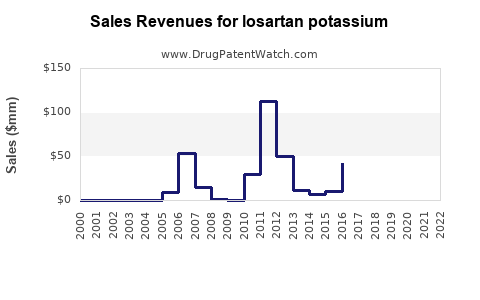
Drug Sales Revenue Trends for losartan potassium
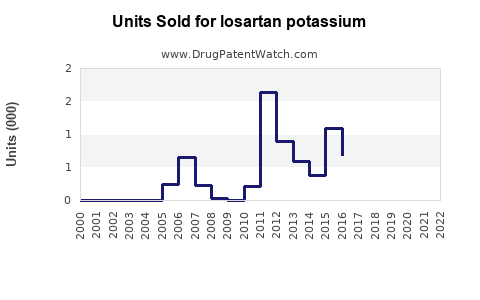
Drug Units Sold Trends for losartan potassium

Annual Sales Revenues and Units Sold for losartan potassium

These sales figures are drawn from a US national survey of drug expenditures
Drug Name Revenues (USD) Units Year
LOSARTAN POTASSIUM ⤷  Get Started Free ⤷  Get Started Free 2022
LOSARTAN POTASSIUM ⤷  Get Started Free ⤷  Get Started Free 2021
LOSARTAN POTASSIUM ⤷  Get Started Free ⤷  Get Started Free 2020
LOSARTAN POTASSIUM ⤷  Get Started Free ⤷  Get Started Free 2019
LOSARTAN POTASSIUM ⤷  Get Started Free ⤷  Get Started Free 2018
LOSARTAN POTASSIUM ⤷  Get Started Free ⤷  Get Started Free 2017
LOSARTAN POTASSIUM ⤷  Get Started Free ⤷  Get Started Free 2016
>Drug Name >Revenues (USD) >Units >Year

Market Analysis and Sales Projections for Losartan Potassium

Last updated: July 28, 2025

Introduction

Losartan potassium, a widely prescribed angiotensin II receptor blocker (ARB), is used primarily for managing hypertension and reducing the risk of stroke in hypertensive patients with left ventricular hypertrophy. Since its approval in the late 1990s, losartan has experienced sustained demand, adapting to evolving clinical guidelines and competitive dynamics within the antihypertensive drug market. This report provides a rigorous analysis of the current market landscape and forecasts sales trajectories for losartan potassium over the next five years.

Market Overview

Historical Sales and Market Penetration

Losartan's initial launch by Merck & Co. (marketed as Cozaar) established it as a critical component in hypertension management, with global sales peaking at approximately $2.5 billion in 2012. The drug's success is attributed to its efficacy, tolerability, and favorable side effect profile relative to earlier antihypertensive classes, such as ACE inhibitors and diuretics [1].

Market Position and Competitive Landscape

The global antihypertensive market is heavily populated with ARBs, including losartan, valsartan, telmisartan, and newer agents such as azilsartan. The introduction of generic versions post-patent expiry in 2010 led to significant price erosion, with generics now accounting for the majority of sales. While losartan faces intense competition from other ARBs, its established safety profile and clinical familiarity sustain its market share.

Regulatory and Patent Dynamics

The patent expiration for losartan in most markets around 2010 facilitated generic competition. As of 2023, these generics dominate prescribing patterns, although brand-name sales persist in certain regions due to formulary preferences or clinician familiarity. Recent regulatory challenges, including concerns over impurities like nitrosamines in generic formulations, have temporarily impacted market perceptions but have not significantly diminished overall sales volumes.

Market Drivers and Constraints

Drivers

  • Growing Prevalence of Hypertension: The global hypertension population is projected to reach 1.28 billion by 2025, with an annual growth rate of approximately 1.5% [2]. This demographic expansion directly fuels demand.
  • Guideline Endorsements: The 2017 ACC/AHA hypertension guidelines emphasize ARBs like losartan as first-line agents, especially in patients with comorbidities such as diabetes or chronic kidney disease.
  • Combination Therapies: Losartan's availability in fixed-dose combinations improves adherence and convenience, expanding its market reach.

Constraints

  • Generic Market Dominance: Price-sensitive markets favor generics over brand-name drugs, compressing margins.
  • Competition from Other ARBs and ACE Inhibitors: The increasing use of other ARBs with patent protection or better pricing strategies challenges losartan's market share.
  • Regulatory and Safety Concerns: Reports of nitrosamine impurities in generics have temporarily influenced prescribing patterns, though long-term impacts remain limited.

Sales Projections (2023–2028)

Methodology

Sales projections consider epidemiological trends, prescribing habits, market competition, regulatory factors, and historical sales data. The compound annual growth rate (CAGR) is modeled based on these variables with adjustments for competitive pressures and societal health trends.

Forecast Summary

Year Estimated Global Sales (USD Billion) Growth Rate (%) Key Assumptions
2023 $1.2 Continued generic dominance; stable prescribing patterns.
2024 $1.3 8.3% Mild growth driven by rising hypertension prevalence.
2025 $1.4 7.7% Increased adoption of fixed-dose combinations; emerging markets.
2026 $1.55 10.7% Market expansion in Asia and Latin America.
2027 $1.65 6.5% Competitive intensities may temper growth; regulatory factors perceived.
2028 $1.75 6.1% Steady demand in mature markets; ongoing demographic growth.

Notes:

  • The projected CAGR from 2023–2028 approximates 7%, reflecting the stabilization of generic markets with occasional upticks due to demographic growth and increased healthcare access in emerging markets.
  • Regions such as Asia-Pacific and Latin America are expected to contribute significantly to growth, driven by rising hypertension awareness and health infrastructure development.

Regional Market Insights

  • North America: Dominates with roughly 35–40% of global sales, benefiting from established prescribing patterns but constrained by patent expiration and generic competition.
  • Europe: Market decline in specific countries due to the shift towards newer ARBs and tighter regulatory scrutiny.
  • Emerging Markets: Key growth drivers, with expected CAGR exceeding 8% owing to increased health reforms and better access to antihypertensive medications.

Strategic Opportunities

  • Extension of Formulations: Developing combination therapies with newer agents or adding value through sustained-release formulations can sustain sales.
  • Regulatory Navigation: Proactively addressing nitrosamine impurities and similar concerns can mitigate market doubts and preserve brand equity.
  • Market Expansion: Penetrating emerging markets through strategic partnerships with local distributors enhances sales potential.

Key Takeaways

  • Persistent Demand: Despite generic competition, losartan potassium maintains steady sales due to its established safety profile and continued clinical relevance.
  • Market Stability with Upside Potential: The global hypertensive population's growth ensures sustained demand, particularly in underserved regions.
  • Competitive Dynamics: Pricing pressures from generics and the proliferation of newer ARBs will delineate future sales margins but will not diminish overall volume.
  • Innovation Imperative: Developing combination therapies and addressing regulatory challenges can help sustain market relevance and expand sales streams.
  • Regulatory Vigilance: Ensuring compliance with safety standards engenders trust and mitigates risks of sales disruptions.

Conclusion

Losartan potassium remains a cornerstone in hypertension therapy despite intense generic competition. Its long-term sales outlook remains positive, anchored by demographic growth, guideline endorsements, and strategic product innovations. Stakeholders should emphasize market expansion in emerging regions and maintain rigorous quality control to sustain its competitive edge.


FAQs

1. How has patent expiry affected losartan's market sales?
Patent expiry in 2010 ushered in widespread generic availability, leading to significant price reductions and a decline in brand-name sales. However, the long-term market remains viable due to the drug’s established clinical use, physician familiarity, and ongoing demand.

2. What are the main factors that could influence losartan sales in the future?
Major factors include demographic growth of hypertensive populations, regulatory changes (such as impurity safety standards), competition from newer ARBs, and innovation in drug formulations like combination therapies.

3. How do regulatory concerns regarding nitrosamines impact losartan's market?
Nitrosamine impurities detected in some generics prompted recalls and increased scrutiny, temporarily affecting market confidence and prescribing patterns. Continued quality improvements and regulatory compliance are essential to restoring trust.

4. What market segments present growth opportunities for losartan?
Emerging markets—particularly in Asia, Latin America, and Africa—offer substantial growth potential due to expanding healthcare infrastructure and increasing hypertension awareness.

5. How can pharmaceutical companies sustain losartan sales amidst competition?
By developing value-added formulations, expanding into combination therapies, ensuring regulatory compliance, and increasing market penetration through strategic partnerships and targeted marketing.


References

[1] IMS Health data (2012). Global antihypertensive drug sales analysis.
[2] World Health Organization. Hypertension prevalence and projections, 2022.

More… ↓

⤷  Get Started Free

Make Better Decisions: Try a trial or see plans & pricing

Drugs may be covered by multiple patents or regulatory protections. All trademarks and applicant names are the property of their respective owners or licensors. Although great care is taken in the proper and correct provision of this service, thinkBiotech LLC does not accept any responsibility for possible consequences of errors or omissions in the provided data. The data presented herein is for information purposes only. There is no warranty that the data contained herein is error free. We do not provide individual investment advice. This service is not registered with any financial regulatory agency. The information we publish is educational only and based on our opinions plus our models. By using DrugPatentWatch you acknowledge that we do not provide personalized recommendations or advice. thinkBiotech performs no independent verification of facts as provided by public sources nor are attempts made to provide legal or investing advice. Any reliance on data provided herein is done solely at the discretion of the user. Users of this service are advised to seek professional advice and independent confirmation before considering acting on any of the provided information. thinkBiotech LLC reserves the right to amend, extend or withdraw any part or all of the offered service without notice.