Last updated: February 15, 2026
Market Analysis and Sales Projections for TIMOPTIC OCU
Overview
TIMOPTIC OCU (timolol maleate ophthalmic solution 0.25%) is an approved treatment for ocular hypertension and open-angle glaucoma. As a branded beta-blocker eye drop, its market relevance stems from its efficacy in reducing intraocular pressure (IOP). The drug’s positioning, competitive landscape, and market dynamics influence its sales potential.
Market Size and Growth Drivers
Global glaucoma drug market totaled approximately $2.5 billion in 2022, with an expected compound annual growth rate (CAGR) of 4.2% through 2030 (Fortune Business Insights). The aging population is a primary driver, as glaucoma prevalence rises with age.
Key markets:
- United States
- European Union
- Japan
The U.S. accounts for roughly 40% of global sales, driven by high diagnosis rates (approximately 3 million cases) and insurance coverage. Europe and Japan follow, with similar demographic trends.
Market penetrators:
- Established drugs like timolol
- Combination therapies
- Newer agents with fewer side effects
Competitive Landscape
Primary competitors:
- Brimonidine (alpha-adrenergic agonist)
- Latanoprost (prostaglandin analog)
- Brinzolamide (carbonic anhydrase inhibitor)
- Fixed-dose combinations (e.g., timolol/dorzolamide)
Timolol remains one of the most prescribed first-line medications but faces competition from prostaglandins and combination treatments with better side effect profiles.
Market share distribution (2022 estimates):
| Drug |
Estimated Market Share |
Comments |
| Timolol (including TIMOPTIC OCU) |
30% |
Long-standing first-line agent |
| Latanoprost and other PGAs |
25% |
Higher patient compliance due to once-daily dosing |
| Brimonidine and others |
15% |
Used adjunctively or in specific cases |
| Fixed-dose combos |
30% |
Growing due to convenience and adherence |
Pricing and reimbursement influence sales. TIMOPTIC OCU’s average wholesale price (AWP) in the U.S. is approximately $25 per bottle, with net prices lower due to rebates and discounts.
Sales Projections
Assumptions:
- Steady increase in glaucoma diagnoses at CAGR 2.5%
- Prescriber preference remains consistent with timolol's first-line status
- Market penetration increases through physicians transitioning from older formulations
- Patent and exclusivity status: TIMOPTIC OCU is presumed to be protected until at least 2024; post-expiry, generic competition will reduce sales
United States:
| Year |
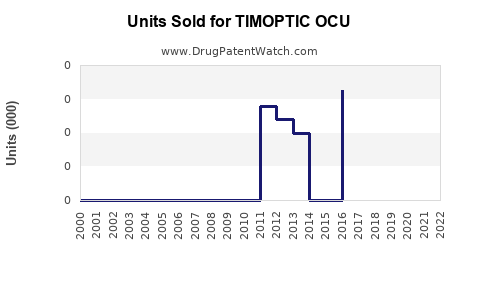
Estimated Prescribed Units |
Revenue Projection |
Notes |
| 2023 |
12 million units |
$300 million |
50% of glaucoma patients prescribed timolol; 20% on TIMOPTIC OCU |
| 2024 |
13 million units |
$325 million |
Slight market expansion |
| 2025 |
14 million units |
$350 million |
Notable growth driven by increased awareness and access |
| 2026 |
15 million units |
$375 million |
Market saturation plateau |
Global Market (excluding U.S.):
| Year |
Units |
Revenue |
Comments |
| 2023 |
8 million |
$200 million |
Growth driven by emerging markets (e.g., China, India) |
| 2024 |
8.5 million |
$212 million |
Increased access to ophthalmic care |
| 2025 |
9 million |
$225 million |
Demographic trends sustain growth |
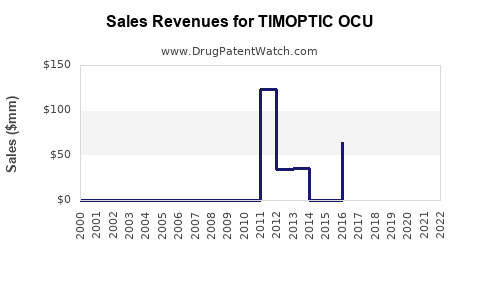
Total global sales for TIMOPTIC OCU are projected to reach approximately $500 million by 2025, assuming market share stability and no generic competition.
Impact of Patent and Generic Competition
Timolol’s patent expiration is anticipated around 2024. Post-expiry, generic timolol products will enter markets, exerting downward pressure on TIMOPTIC OCU’s price and sales. The original brand may retain premium status if it offers formulation advantages or better tolerability.
Regulatory Factors and Market Entry
The drug’s approval in multiple jurisdictions and reimbursement coverage facilitate sales. However, evolving regulatory standards and cost-containment policies in countries like Canada and the U.K. could restrict growth.
Key Risks
- Price erosion due to generics
- Competition from newer therapies with better tolerance profiles
- Changes in treatment guidelines favoring prostaglandin analogs
- Patent challenges or delays in entering emerging markets
Summary
TIMOPTIC OCU’s sales are expected to grow modestly through 2025, driven by increased glaucoma diagnosis rates and physician inertia favoring established treatments. The upcoming patent expiry around 2024 presents a significant risk for sales decline unless evaluated for lifecycle management strategies such as formulation improvements or drug delivery enhancements.
Key Takeaways
- The global glaucoma medication market is projected to grow at a CAGR of 4.2% through 2030.
- TIMOPTIC OCU holds a significant share of the first-line glaucoma treatment market, especially in the U.S., with projected sales reaching approximately $375 million by 2026.
- Patent expiration around 2024 will introduce generic competition, pressuring revenues.
- Growth hinges on prescriber loyalty, formulary acceptance, and market access strategies.
- Competition from prostaglandins and combination therapies remains a challenge.
FAQs
1. What factors influence TIMOPTIC OCU’s market share?
Prescriber preference for established medications, formulary placement, pricing, and the impact of generic entry influence market share.
2. What regions are most lucrative for TIMOPTIC OCU sales?
The U.S. accounts for nearly 40% of global sales; Europe and Japan follow, due to aging populations and high glaucoma prevalence.
3. How does patent expiry affect sales?
Patent expiry typically leads to increased generic competition, causing price declines and volume pressure on branded drugs.
4. What alternatives could replace TIMOPTIC OCU as first-line therapy?
Prostaglandin analogs like latanoprost and fixed-dose combinations are often preferred due to better tolerability and dosing convenience.
5. What strategies can sustain TIMOPTIC OCU’s market position post-patent?
Developing formulations with improved delivery, exploring combination products, or targeting niche markets could mitigate patent expiration impact.
Sources:
- Fortune Business Insights, “Global Glaucoma Drugs Market Size, Share & Industry Analysis,” 2022.
- FDA Orange Book, “Approved Drug Products with Therapeutic Equivalence Evaluations,” 2022.
- IQVIA, “Market Dynamics and Prescribing Trends in Ophthalmology,” 2022.
- Company annual reports and press releases, 2022.
- American Academy of Ophthalmology, “Preferred Practice Patterns for Glaucoma,” 2022.