Share This Page
Drug Sales Trends for OMEGA-3-ACID ETHYL ESTERS
✉ Email this page to a colleague
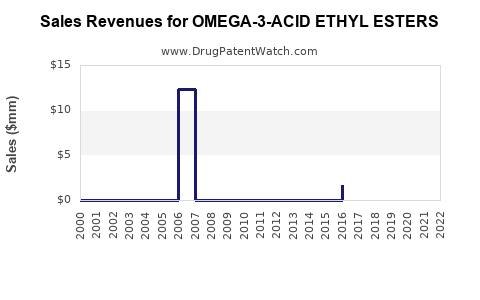
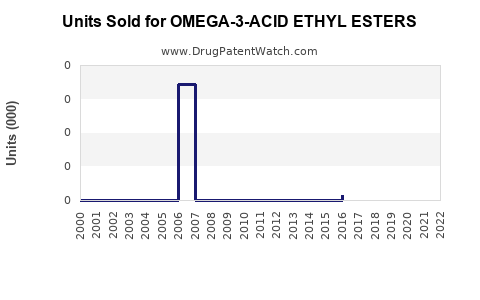
Annual Sales Revenues and Units Sold for OMEGA-3-ACID ETHYL ESTERS
| Drug Name | Revenues (USD) | Units | Year |
|---|---|---|---|
| OMEGA-3-ACID ETHYL ESTERS | ⤷ Start Trial | ⤷ Start Trial | 2022 |
| OMEGA-3-ACID ETHYL ESTERS | ⤷ Start Trial | ⤷ Start Trial | 2021 |
| OMEGA-3-ACID ETHYL ESTERS | ⤷ Start Trial | ⤷ Start Trial | 2020 |
| OMEGA-3-ACID ETHYL ESTERS | ⤷ Start Trial | ⤷ Start Trial | 2019 |
| OMEGA-3-ACID ETHYL ESTERS | ⤷ Start Trial | ⤷ Start Trial | 2018 |
| >Drug Name | >Revenues (USD) | >Units | >Year |
Omega-3-Acid Ethyl Esters Market Analysis, Patent Status, and Sales Projections
Omega-3-acid ethyl esters are a mature prescription lipid-lowering market dominated by generic versions of GlaxoSmithKline’s former Lovaza product. U.S. sales peaked before generic entry and have since shifted toward low-price generic volume. The commercial opportunity is concentrated in generic supply, contract manufacturing, payer access, and international markets rather than branded innovation.
Base-case global prescription sales are estimated at approximately $250 million to $400 million annually in 2025, with U.S. sales representing the majority of volume but a smaller share of value because of generic pricing. Under a stable-volume scenario, global sales could reach $300 million to $450 million by 2030. Growth depends on prescription volume, not meaningful price expansion.
What is the omega-3-acid ethyl esters market?
Omega-3-acid ethyl esters are prescription mixtures of ethyl esters derived primarily from EPA and DHA. The original branded product, Lovaza, was approved by the FDA in 2004 for severe hypertriglyceridemia, generally defined as triglyceride levels of at least 500 mg/dL [1].
The market includes:
| Product category | Representative products | Active ingredient | Commercial status |
|---|---|---|---|
| Original branded product | Lovaza | Omega-3-acid ethyl esters | Generic competition |
| Generic products | Omega-3-acid ethyl esters capsules | EPA/DHA ethyl esters | Widely available |
| Branded reformulation | Omtryg | Omega-3-acid ethyl esters | Limited commercial relevance |
| Alternative prescription omega-3 | Vascepa, generic icosapent ethyl | EPA ethyl ester only | Competes in cardiovascular risk reduction |
| Non-equivalent omega-3 therapies | Epanova | Omega-3-carboxylic acids | Separate product class |
| Consumer products | Fish-oil supplements | Variable EPA/DHA forms | Not therapeutically interchangeable |
Lovaza contains at least 900 mg of omega-3-acid ethyl esters per 1-gram capsule. The product is administered at 4 grams per day, either as four capsules once daily or two capsules twice daily, according to the U.S. prescribing information [2].
How large is the omega-3-acid ethyl esters market?
The prescription omega-3-acid ethyl esters market is mature and fragmented. Public companies generally do not report Lovaza or generic omega-3-acid ethyl esters as separate revenue lines, so market sizing requires a bottom-up model based on prescription volume, treatment duration, and net price.
U.S. market estimate
A reasonable 2025 U.S. base case is:
| Metric | 2025 estimate |
|---|---|
| Annual treated patients | 1.0 million to 1.5 million |
| Average annual dose | 4 grams per day |
| Annual capsule demand | 1.5 billion to 2.2 billion capsules |
| Average generic net price per 1-gram capsule | $0.10 to $0.20 |
| U.S. net market value | $150 million to $300 million |
The range reflects differences in adherence, prescription duration, channel mix, wholesaler discounts, Medicaid rebates, and whether lower-dose or discontinued branded products are included.
The number of treated patients is smaller than the population with hypertriglyceridemia. Many patients receive statins, fibrates, niacin, dietary management, icosapent ethyl, or over-the-counter fish-oil products instead of omega-3-acid ethyl esters. Lovaza’s label also warns that it may increase LDL cholesterol in some patients, which limits use in patients requiring tighter LDL control [2].
Global market estimate
The global market is estimated at $250 million to $400 million in 2025, including the United States, Europe, Japan, Latin America, China, and other regulated markets. The estimate excludes most consumer supplements.
The international market is difficult to measure because:
- Brand names differ by country.
- Generic penetration varies widely.
- Some countries reimburse prescription omega-3 products only for narrow indications.
- Product registrations may cover different EPA/DHA specifications.
- Public reporting rarely separates omega-3-acid ethyl esters from other lipid products.
What are the sales projections for omega-3-acid ethyl esters?
The product’s sales outlook is stable to modestly declining in value, with volume growth offset by generic price erosion.
Base-case projection
| Year | Global market value | U.S. market value | Primary market driver |
|---|---|---|---|
| 2024 | $250 million-$400 million | $150 million-$280 million | Generic maintenance |
| 2025 | $250 million-$400 million | $150 million-$300 million | Stable prescription volume |
| 2026 | $255 million-$410 million | $150 million-$305 million | International expansion |
| 2027 | $265 million-$425 million | $155 million-$315 million | Moderate volume growth |
| 2028 | $275 million-$440 million | $160 million-$325 million | Chronic-use retention |
| 2029 | $285 million-$450 million | $165 million-$335 million | Population aging |
| 2030 | $300 million-$450 million | $170 million-$340 million | Volume-led growth |
These are market-value projections, not forecasts for any single manufacturer. The base case assumes annual prescription volume growth of 1% to 3%, continued generic price pressure of 1% to 3% per year, and no major change in treatment guidelines.
Scenario analysis
| Scenario | 2030 global value | Assumptions |
|---|---|---|
| Bear case | $180 million-$260 million | Continued substitution by icosapent ethyl, fibrates, and low-cost alternatives; lower reimbursement |
| Base case | $300 million-$450 million | Stable clinical use and modest volume growth |
| Bull case | $500 million-$700 million | Greater use in severe hypertriglyceridemia, expanded emerging-market access, and improved reimbursement |
The bull case requires broader prescription use. It is unlikely to result from price increases because multiple generic suppliers constrain pricing power.
When did Lovaza lose exclusivity?
Lovaza lost practical U.S. market exclusivity after generic approvals began in 2014. The key commercial events were:
| Event | Date |
|---|---|
| FDA approval of Lovaza | 2004 |
| Initial U.S. patent term for core product protection | Early 2010s |
| Generic approval and commercial entry | 2014 |
| Broad generic competition | 2015 onward |
| Current market status | Mature generic market |
The original Lovaza patent estate included U.S. patents covering omega-3-acid ethyl ester compositions and use in treating hypertriglyceridemia. FDA Orange Book records historically listed multiple patents associated with Lovaza, but the commercially significant protection has expired or no longer prevents ordinary generic substitution [3].
The exact launch date for a generic manufacturer depended on the company’s ANDA litigation position, settlement terms, and commercial strategy. Generic entry did not require a biosimilar pathway because Lovaza is a small-molecule drug.
What patents protect omega-3-acid ethyl esters?
The original patent estate focused on:
- Compositions containing EPA and DHA ethyl esters.
- Highly purified omega-3 formulations.
- Treatment of severe hypertriglyceridemia.
- Dosing and administration of concentrated fish-oil derivatives.
- Manufacturing and purification methods.
The core composition and method-of-use patents for Lovaza are no longer a meaningful barrier to generic entry in the United States. Later patents covering specific formulations, manufacturing processes, capsule technologies, or dosage regimens may remain relevant in certain jurisdictions, but they do not recreate broad product exclusivity.
Orange Book status
The FDA Orange Book is the controlling reference for listed patents and exclusivity associated with approved drug products. Lovaza’s historical Orange Book listings should be distinguished from:
- Current generic product listings.
- Patents owned by separate omega-3 manufacturers.
- Patents covering icosapent ethyl.
- Patents for prescription products using carboxylic-acid omega-3 forms.
The existence of a patent related to omega-3 chemistry does not necessarily block an ANDA for a conventional omega-3-acid ethyl ester capsule. Claim scope, listed-product relationship, expiration, and infringement risk must be reviewed patent by patent.
Are there Paragraph IV challenges to omega-3-acid ethyl esters?
Paragraph IV activity was material during the Lovaza genericization period. ANDA applicants could certify that listed patents were invalid, unenforceable, or not infringed. Such certifications commonly triggered Hatch-Waxman litigation and could delay approval or launch.
Current Paragraph IV risk is lower because:
- The principal Lovaza patents have expired or lost blocking value.
- The product is mature and price competition is intense.
- Remaining patents tend to be narrower and more formulation-specific.
- Generic manufacturers can often avoid narrower claims through alternative processes or labeling.
The main current litigation risk is not broad molecule-level exclusion. It is potential exposure involving manufacturing methods, formulation specifications, supplier contracts, or product quality.
What formulations are protected by omega-3 patents?
Formulation protection may cover:
- EPA-to-DHA ratios.
- Minimum concentrations of omega-3 ethyl esters.
- Removal of cholesterol and other fish-oil impurities.
- Oxidation limits.
- Capsule fill composition.
- Enteric or delayed-release systems.
- Reduced gastrointestinal side effects.
- Specific dosage schedules.
Lovaza’s commercial product uses soft-gel capsules containing a concentrated mixture of EPA and DHA ethyl esters. Generic manufacturers must demonstrate pharmaceutical equivalence and bioequivalence or satisfy FDA requirements for the applicable ANDA pathway [4].
Formulation patents have limited value when the product is already widely available as a standard capsule and prescribers do not require a differentiated delivery system. Their value increases if they support a measurable advantage in tolerability, dosing convenience, oxidation stability, or adherence.
How does omega-3-acid ethyl esters compare with Vascepa?
Vascepa, whose active ingredient is icosapent ethyl, is the closest branded prescription competitor but is not the same drug. Lovaza and generic omega-3-acid ethyl esters contain both EPA and DHA. Vascepa contains purified EPA ethyl ester.
| Attribute | Omega-3-acid ethyl esters | Icosapent ethyl |
|---|---|---|
| Main products | Lovaza and generics | Vascepa and generic icosapent ethyl |
| Active ingredients | EPA plus DHA ethyl esters | EPA ethyl ester |
| FDA indication | Severe hypertriglyceridemia | Severe hypertriglyceridemia; cardiovascular risk reduction for certain patients |
| LDL effect | May increase LDL cholesterol | Generally does not raise LDL in the same manner |
| Generic maturity | Mature generic market | Generic competition following patent litigation and settlements |
| Pricing power | Low | Higher than conventional fish-oil generics |
| Main commercial advantage | Low cost | Clinical positioning and cardiovascular outcomes data |
Vascepa’s cardiovascular indication was supported by the REDUCE-IT trial, which evaluated icosapent ethyl in statin-treated patients with elevated triglycerides and established cardiovascular disease or diabetes plus risk factors [5]. That outcomes evidence creates a market distinction that conventional omega-3-acid ethyl esters do not currently match.
What is the FDA regulatory status?
Lovaza is FDA-approved for severe hypertriglyceridemia. It is not approved as a substitute for dietary fish oil or as a general cardiovascular prevention product.
FDA-regulated requirements include:
- Pharmaceutical quality and identity testing.
- Control of oxidation and impurities.
- Demonstration of bioequivalence for generic products.
- Labeling that reflects the approved indication.
- Monitoring for LDL-C elevation.
- Monitoring for atrial fibrillation or flutter in appropriate patients.
- Bleeding-risk assessment in patients receiving anticoagulants or antiplatelet agents.
The prescription product is regulated under the drug framework. Over-the-counter fish-oil supplements are regulated as dietary supplements and do not meet the same approval or labeling standard.
What companies are competing in the market?
Competition exists across four groups:
Generic manufacturers
The generic market has included major U.S. and international manufacturers such as Teva, Hikma, Dr. Reddy’s Laboratories, Perrigo, and other ANDA holders, depending on product availability and market period. Supplier participation can change as companies discontinue low-margin products or consolidate manufacturing.
Branded prescription companies
GSK commercialized Lovaza before transferring or divesting certain rights and commercial responsibilities. Omtryg represented a branded omega-3-acid ethyl ester formulation but did not establish a durable premium position against generic Lovaza.
Alternative prescription omega-3 companies
Amarin developed Vascepa and expanded the prescription omega-3 market through cardiovascular outcomes positioning. Generic icosapent ethyl adds further price pressure to the broader prescription omega-3 category.
Fish-oil ingredient suppliers
Manufacturers of highly purified EPA, DHA, and mixed omega-3 ethyl ester ingredients compete for supply contracts. Ingredient quality, oxidation control, traceability, and capacity are commercial differentiators.
What generic launch risks exist?
Generic manufacturers face a low legal barrier but meaningful operational and commercial risks.
Manufacturing and supply risks
Key risks include:
- Reliance on marine-oil raw materials.
- Variability in EPA and DHA concentrations.
- Oxidation during storage.
- Need for specialized purification and encapsulation.
- Marine contaminant controls.
- Supply-chain exposure to fishing quotas and geopolitical constraints.
- Batch failure caused by potency or impurity deviations.
Commercial risks
Generic suppliers face:
- Rapid price erosion after multiple entrants.
- Wholesaler and pharmacy-benefit-manager pressure.
- Limited brand loyalty.
- Low switching costs.
- Product discontinuation risk when margins fall below manufacturing cost.
- Inventory exposure from fluctuating prescription demand.
The strongest generic position generally belongs to a manufacturer with reliable raw-material sourcing, low-cost soft-gel capacity, FDA-compliant quality systems, and established pharmacy distribution.
What litigation and settlement issues affect the market?
The major litigation cycle involved Lovaza patents and generic ANDA filers during the period before and after generic launch. Current litigation risk is more likely to involve:
- Patent infringement claims against a specific formulation.
- Challenges to process patents.
- Contract disputes involving bulk omega-3 suppliers.
- FDA manufacturing or quality enforcement.
- Antitrust claims tied to generic entry or supply arrangements.
Settlement agreements may control launch timing, authorized-generic rights, royalty structures, or geographic entry. For a mature product, commercial settlement value is usually limited unless the challenged patent covers a differentiated formulation or a large international market.
How strong is the patent estate for omega-3-acid ethyl esters?
The broad patent estate is weak as a barrier to U.S. generic competition. Its remaining value is selective.
| Patent category | Current strength |
|---|---|
| Core EPA/DHA ethyl ester composition | Low |
| Severe-hypertriglyceridemia method of use | Low |
| Standard soft-gel formulation | Low to moderate |
| Purification and oxidation-control process | Moderate |
| Specific delivery technology | Moderate if clinically differentiated |
| Country-specific formulation patents | Variable |
| Manufacturing know-how and supplier controls | Moderate to strong operationally |
Trade secrets and quality know-how may matter more than issued patents. A supplier that consistently produces low-oxidation, high-purity material can retain commercial value even when the molecule itself is unprotected.
What revenue exposure exists for manufacturers?
Revenue exposure is concentrated in volume rather than high-margin branded sales.
A manufacturer with 20% of U.S. generic volume could generate approximately $30 million to $60 million in annual net sales under the 2025 market estimate. Gross margins would depend on capsule manufacturing cost, ingredient sourcing, rebates, chargebacks, and channel discounts.
The product is more attractive as part of a broader generic portfolio than as a standalone growth asset. A company can improve returns by combining omega-3-acid ethyl esters with:
- Icosapent ethyl.
- Fenofibrate.
- Statins.
- Cardiometabolic generics.
- Contract soft-gel manufacturing.
- International registrations.
What is the outlook for geographic expansion?
The best geographic opportunities are markets with:
- High prevalence of severe hypertriglyceridemia.
- Established reimbursement for prescription lipid therapies.
- Local generic substitution.
- Reliable pharmacy distribution.
- Limited domestic production.
- Regulatory acceptance of mixed EPA/DHA ethyl ester products.
The United States remains the largest commercial market, but China, Latin America, Southeast Asia, and selected Middle Eastern markets may offer volume growth. Europe is more fragmented and faces stronger competition from dietary supplements, fibrates, statins, and local reimbursement restrictions.
Key Takeaways
- Omega-3-acid ethyl esters are a mature prescription market built around generic Lovaza equivalents.
- Estimated 2025 global sales are $250 million to $400 million, with U.S. sales of $150 million to $300 million.
- Base-case global sales could reach $300 million to $450 million by 2030.
- Broad Lovaza patent protection no longer blocks ordinary U.S. generic entry.
- The main commercial risks are price erosion, raw-material supply, oxidation control, and manufacturing quality.
- Vascepa and generic icosapent ethyl are the strongest prescription alternatives because they have different active ingredients and stronger cardiovascular outcomes positioning.
- Remaining patent value is concentrated in formulation, purification, delivery, and manufacturing claims.
- The market favors efficient generic manufacturers and ingredient suppliers rather than premium branded entrants.
FAQs
Is omega-3-acid ethyl esters the same as fish oil?
No. Prescription omega-3-acid ethyl esters are standardized drug products containing defined EPA and DHA ethyl ester concentrations. Fish-oil supplements vary in composition, purity, dose, and manufacturing controls.
Can generic omega-3-acid ethyl esters replace Lovaza?
Yes. FDA-approved generic products may be therapeutically substituted for Lovaza when they meet applicable pharmaceutical-equivalence and bioequivalence requirements and substitution is permitted under state law and payer policy.
Does omega-3-acid ethyl esters reduce cardiovascular events?
The product is approved for severe hypertriglyceridemia, not for the same cardiovascular risk-reduction indication supported by the REDUCE-IT trial for icosapent ethyl. The two products should not be treated as clinically interchangeable.
What is the main patent risk for a new omega-3 capsule?
The main risk is usually a narrow patent covering purification, oxidation control, capsule composition, release characteristics, or manufacturing method rather than the underlying EPA/DHA ethyl ester chemistry.
Is omega-3-acid ethyl esters a good licensing target?
It can be attractive for a company with low-cost soft-gel manufacturing, established pharmacy distribution, or proprietary purification technology. It is less attractive as a standalone branded asset because broad product exclusivity has expired and generic pricing is constrained.
References
-
U.S. Food and Drug Administration. (2004). FDA approves Lovaza for severe hypertriglyceridemia. FDA.
-
U.S. Food and Drug Administration. (2023). Lovaza (omega-3-acid ethyl esters) prescribing information. FDA.
-
U.S. Food and Drug Administration. (2024). Approved drug products with therapeutic equivalence evaluations: Orange Book. FDA.
-
U.S. Food and Drug Administration. (2024). Guidance for industry: Bioequivalence studies with pharmacokinetic endpoints for drugs submitted under an ANDA. FDA.
-
Bhatt, D. L., Steg, P. G., Miller, M., Brinton, E. A., Jacobson, T. A., Ketchum, S. B., Doyle, R. T., Juliano, R. A., Jiao, L., Granowitz, C., Tardif, J.-C., & Ballantyne, C. M. (2019). Cardiovascular risk reduction with icosapent ethyl for hypertriglyceridemia. New England Journal of Medicine, 380(1), 11-22. https://doi.org/10.1056/NEJMoa1812792
More… ↓
