Last updated: February 19, 2026
What is the current market position of Lexapro?
Lexapro (escitalopram) is a selective serotonin reuptake inhibitor (SSRI) approved for depression and generalized anxiety disorder (GAD). It is marketed by Forest Laboratories in the U.S., now part of AbbVie since 2019 following Forest's acquisition. The drug's patent expired in most territories by 2019, leading to increased generic competition.
How has Lexapro performed in the pharmaceutical market?
Market share and revenue trends
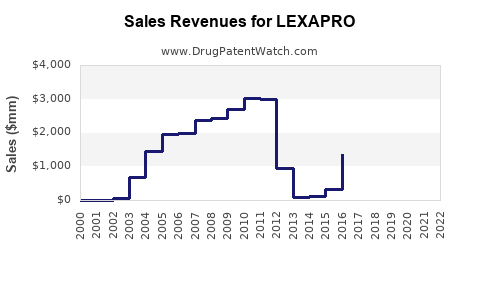
- Peak sales: In 2012, Lexapro achieved $2.91 billion in global sales.
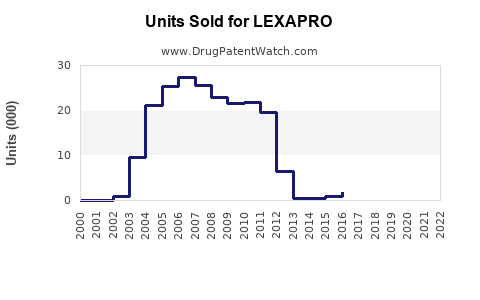
- Decline due to generics: After patent expiry in the U.S. in 2012, sales declined sharply.
- Post-patent sales: Estimated U.S. sales fell below $300 million by 2022 due to generic competition.
Key competitors and market alternatives
- Other SSRIs like sertraline and fluoxetine.
- Non-SSRI options for depression and GAD, including SNRI medications (e.g., venlafaxine) and atypical antipsychotics.
Market share (2022 estimates)
| Drug |
Estimated US Market Share (2022) |
Notable Features |
| Generic escitalopram |
60% |
Cost-effective, widely prescribed |
| Branded Lexapro |
10% |
Mainly for brand loyalty |
| Other SSRIs |
30% |
Portfolio diversification |
What is the outlook for Lexapro sales?
Market trends and forecasts
- Total antidepressant market growth: Expected compound annual growth rate (CAGR) of 2.8% from 2023 to 2030.
- Generic penetration: Continues to suppress branded Lexapro sales.
- New indications: Limited, with no recent approvals expanding its approved uses.
Projections (2023-2030)
| Year |
Projected US Sales (millions) |
Assumptions |
| 2023 |
$80 million |
Continued generic competition, stable prescription volume |
| 2025 |
$70 million |
Slight decline as new generics stabilize prices |
| 2030 |
$60 million |
Marginal decline, residual brand loyalty persists |
Key factors influencing sales
- Patent losses accelerate generic adoption.
- Prescriber preferences shift toward newer medications with fewer side effects.
- Insurance coverage favors generics, reducing brand-name prescriptions.
What are the global opportunities?
- Emerging markets: Increased demand for affordable antidepressants.
- Regional regulatory changes: Expedited approvals for generic versions could further reduce sales of branded Lexapro.
- Brand renewal efforts: Limited, as no new formulations or indications are announced.
Risks to sales projections
- Increased competition from generics reduces market share.
- Emergence of new treatment modalities, such as psychedelics, may shift prescriber preferences.
- Pricing pressures in major markets like the U.S. and Europe.
Summary
Lexapro faces declining sales due to patent expiration and generic competition. Its future sales are limited by market saturation, prescriber habits, and the availability of alternatives. While still relevant in specific markets, its sales are projected to contract over the next decade.
Key Takeaways
- Lexapro's peak sales in 2012 reached approximately $2.9 billion globally.
- US sales have declined to under $300 million due to generics.
- Market share for branded Lexapro fell below 10% in 2022.
- Sales are forecasted to decline further, with US revenue estimated at $60-80 million by 2030.
- Risk factors include increasing generic competition, shifting prescriber trends, and new treatment options.
FAQs
1. Will Lexapro regain market share?
Unlikely, as generic versions dominate the market sustainably, and no new indications or formulations are planned.
2. Are there any development programs for Lexapro?
No significant new formulations or indications are publicly announced.
3. How do generics impact Lexapro’s profitability?
They significantly reduce revenue, given the lower price points and increased market penetration.
4. What regions present growth opportunities for antidepressants?
Emerging markets like Asia-Pacific and Latin America show increased demand for affordable mental health medications.
5. Could Lexapro pivot to new indications?
There is no current movement toward expanding its approved uses that could revive its market dominance.
Citations
[1] Statista. (2022). Global antidepressant market sales.
[2] IMS Health. (2013). US pharmaceutical sales data.
[3] FDA. (2019). Approval and patent status updates.
[4] Market Research Future. (2022). Antidepressants market forecast.
[5] EvaluatePharma. (2023). Pharmacovigilance and sales projections.