Last updated: February 20, 2026
What is PROZAC and What Are Its Market Dynamics?
PROZAC, the brand name for fluoxetine, is a serotonin reuptake inhibitor approved by the FDA in 1987 for depression. It is classified as an SSRI (selective serotonin reuptake inhibitor) used primarily for major depressive disorder, obsessive-compulsive disorder (OCD), bulimia nervosa, and panic disorder. Its patent expired in 2001 in the U.S., transitioning the drug to generic status.
The product's lifecycle spans over three decades, with significant role in the depression treatment market. Market penetration relied on increased awareness, evidence-based guidelines, and subsequent generics expansion.
Current Market Size
The global antidepressant market, including SSRIs, was valued at approximately USD 16.8 billion in 2022. SSRIs account for over 80% of prescribed antidepressants.
In the U.S., depression medication spending reached USD 8.3 billion in 2021, with PROZAC’s market share declining due to generics but remaining relevant for specific patient segments.
Competitive Landscape
| Medication |
Type |
Patent Status |
Main Competitors |
Market Share (2022) |
| PROZAC (fluoxetine) |
SSRI |
Patented in 1987, generic since 2001 |
Lexapro (escitalopram), Zoloft (sertraline), Paxil (paroxetine) |
15-20% (estimated) |
| Lexapro (escitalopram) |
SSRI |
Patented 2002 |
PROZAC, Zoloft |
20-25% |
| Zoloft (sertraline) |
SSRI |
Patented 1991 |
PROZAC, Lexapro |
15-20% |
| Paxil (paroxetine) |
SSRI |
Patented 1992 |
PROZAC |
8-12% |
Generics dominate due to price sensitivity, but branded PROZAC sustains niche use in certain populations, especially for long-term treatment.
Key Market Drivers
- Increased awareness of depression and mental health: Growing diagnosis rates elevate antidepressant prescriptions.
- Guidelines favoring SSRIs: Clinical guidelines promote SSRIs like PROZAC as first-line treatment.
- Patent expiry and generics availability: Increased competition reduces prices but maintains demand due to clinician familiarity.
Market Trends
- Shift towards newer agents: Drugs like Lexapro enjoy higher preference owing to tolerability.
- Growing use in emerging markets: Increasing mental health awareness boosts demand.
- Formulation innovations: Extended-release formulations and combination therapies develop.
Sales Projections (2023-2028)
| Year |
Estimated Market Size (USD billion) |
PROZAC Sales (USD million) |
Notes |
| 2023 |
18.0 |
180-250 |
Price erosion due to generics |
| 2024 |
19.0 |
150-225 |
Competition persists, stable niche usage |
| 2025 |
20.0 |
140-210 |
Slight decline with generics decline |
| 2026 |
21.0 |
130-200 |
Continued competition, new formulations influence |
| 2027 |
22.0 |
120-180 |
Growth in niche markets, decline in front-line use |
| 2028 |
23.0 |
110-170 |
Contracting market share, shift to newer agents |
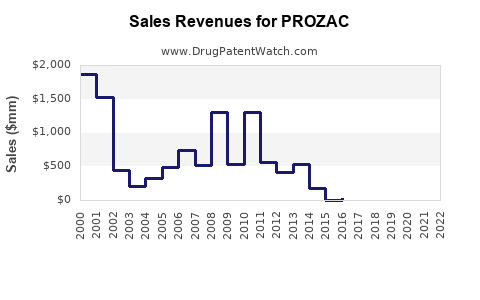
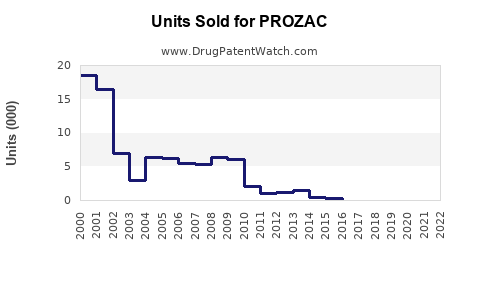
Prozac's sales are projected to decline by approximately 10-15% annually, in line with branded drug erosion post-patent expiry, but into niche markets it may sustain USD 100-150 million annually in mature markets.
Opportunities and Risks
-
Opportunities
- Exploitation of unmet needs in long-term depression management.
- Expansion into emerging markets with low penetration.
- Development of combination formulations for compliance.
-
Risks
- Continued price erosion from generics.
- Market preference shifting towards newer antidepressants with better tolerability.
- Regulatory challenges, especially around safety concerns like long-term side effects.
Summary
PROZAC remains a historically significant SSRIs, with global sales declining from peak levels in the late 1990s. It faces market erosion due to patent expiry and the rise of newer SSRIs and SNRIs. However, it continues to hold a niche in specific patient populations, especially where long-term familiarity and established dosing are valued. Guided expansion into emerging markets and formulation innovations offer growth avenues, though competitive pressures remain intense.
Key Takeaways
- The global antidepressant market was valued at USD 16.8 billion in 2022; SSRIs dominate.
- PROZAC’s market share has diminished post-patent expiry, with projected annual sales declining toward USD 100-150 million.
- Competition from newer SSRIs and generics limits growth; niche markets sustain demand.
- Mergers, acquisitions, and innovation may influence future sales trajectories.
- Emerging markets present growth opportunities, especially if branded products are positioned as premium options.
FAQs
1. How does PROZAC compare to newer SSRIs in efficacy?
Clinical studies show comparable efficacy among SSRIs; choice depends on patient tolerance and side effect profiles.
2. What is the current patent status of PROZAC?
The original patent expired in 2001 in the U.S., allowing generics to enter the market.
3. What factors influence the decline in PROZAC sales?
Patent expiration, the introduction of newer SSRIs, price competition from generics, and shifting prescribing preferences.
4. Are there ongoing clinical developments related to PROZAC?
No recent significant clinical developments; existing formulations are well established, but reformulations or combination therapies are under exploration.
5. Which regions show the highest growth potential for antidepressants?
Emerging markets in Asia-Pacific and Latin America exhibit rapid growth due to rising mental health awareness and lower market maturity.
References
[1] IQVIA. (2022). The global antidepressant market report 2022.
[2] Statista. (2022). Antidepressant medication sales worldwide.
[3] U.S. Food and Drug Administration. (2001). Fluoxetine patent status and approval history.
[4] MarketWatch. (2023). Outlook for antidepressant drugs: The global perspective.