Share This Page
Drug Sales Trends for PLAN B
✉ Email this page to a colleague
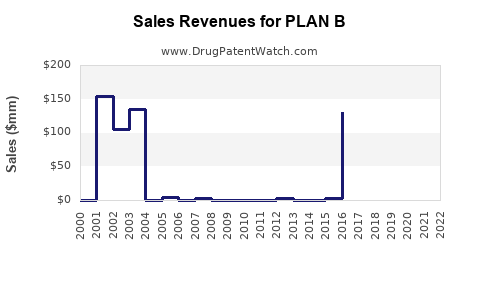
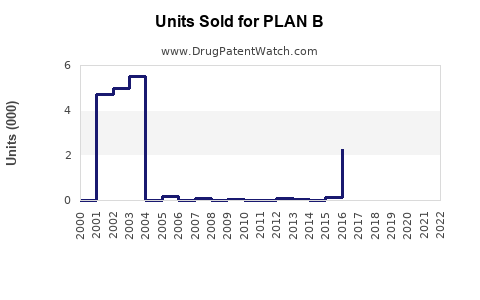
Annual Sales Revenues and Units Sold for PLAN B
| Drug Name | Revenues (USD) | Units | Year |
|---|---|---|---|
| PLAN B | ⤷ Start Trial | ⤷ Start Trial | 2022 |
| PLAN B | ⤷ Start Trial | ⤷ Start Trial | 2021 |
| PLAN B | ⤷ Start Trial | ⤷ Start Trial | 2020 |
| PLAN B | ⤷ Start Trial | ⤷ Start Trial | 2019 |
| PLAN B | ⤷ Start Trial | ⤷ Start Trial | 2018 |
| >Drug Name | >Revenues (USD) | >Units | >Year |
PLAN B: Market Outlook and Sales Projections
PLAN B, an emergency contraceptive, faces a dynamic market shaped by regulatory shifts, competitive product availability, and evolving consumer access. This analysis projects market performance based on current patent landscapes, projected demand drivers, and competitive strategies.
What is the Current Patent Landscape for PLAN B?
The primary patent for the active ingredient in PLAN B, levonorgestrel, has long expired. However, specific formulations and delivery systems may still hold or have held patents. For instance, U.S. Patent 5,709,870, related to a particular formulation of levonorgestrel for emergency contraception, expired in 2017. Subsequent patents have focused on manufacturing processes or alternative delivery methods. The expiration of foundational patents has allowed for generic competition, a significant factor in PLAN B's market positioning.
How Has PLAN B's Market Position Evolved?
PLAN B One-Step, the branded product, has seen its market share challenged by the introduction of lower-cost generic levonorgestrel emergency contraceptive pills. Initially, as the sole over-the-counter (OTC) option, PLAN B One-Step commanded a significant premium. Post-patent expiration and the emergence of generics like My Choice, AfterPill, and EContra EZ, the market has become more price-sensitive. The FDA’s decision in 2013 to make levonorgestrel emergency contraception available without a prescription for all ages accelerated this trend, increasing accessibility but also intensifying price competition.
What Are the Key Drivers of PLAN B's Future Demand?
Several factors are expected to influence PLAN B's future demand:
- Increased Accessibility and OTC Availability: The continued over-the-counter status without age or prescription barriers for levonorgestrel-based emergency contraceptives directly supports demand by reducing purchase friction.
- Social and Political Climate: Fluctuations in reproductive rights legislation and access to other forms of contraception can indirectly impact the demand for emergency contraception. Periods of restricted access to other methods may lead to increased reliance on emergency options.
- Consumer Education and Awareness: Ongoing public health campaigns and increased awareness of emergency contraception as a safe and effective option contribute to sustained demand.
- Product Innovation and Competition: While the core levonorgestrel formulation is established, competition from other emergency contraceptive formulations or novel delivery methods could alter market dynamics. However, current data suggests levonorgestrel remains the dominant active ingredient in the OTC market.
- Price Sensitivity: As a product often purchased out-of-pocket, price remains a critical determinant of consumer choice. The availability of generics at lower price points will continue to shape purchasing decisions.
What is the Competitive Landscape for PLAN B?
The competitive landscape is characterized by the presence of the branded PLAN B One-Step and a growing number of generic levonorgestrel emergency contraceptive products. Key competitors include:
- Generic Levonorgestrel Brands: Numerous manufacturers produce generic versions of 1.5 mg levonorgestrel pills. These are often significantly cheaper than PLAN B One-Step. Examples include:
- EContra EZ
- AfterPill
- My Choice
- Next Choice One Dose
- Alternative Emergency Contraceptives: While less prevalent in the OTC market, other emergency contraceptive options exist, though levonorgestrel is the most widely available OTC.
The primary competitive battleground is price and availability. Retailers often stock multiple brands, allowing consumers to compare prices directly.
What Are the Sales Projections for PLAN B?
Projecting sales for PLAN B involves considering the market share erosion due to generics alongside the overall growth in demand for emergency contraception.
Market Size and Growth: The U.S. market for emergency contraception is substantial, with estimates for the total market exceeding \$300 million annually. Demand has seen a steady increase over the past decade, driven by improved access and awareness.
Branded vs. Generic Performance:
- PLAN B One-Step: While retaining brand recognition, its market share will likely continue to be challenged by generics. Sales are projected to stabilize or experience marginal growth, primarily driven by brand loyalty and wider retail placement.
- Generic Levonorgestrel: This segment is projected to capture an increasing share of the market due to its lower price point. Growth in this segment is expected to be robust, driven by price-conscious consumers and broader availability across various retail channels.
Projected Sales Trajectory (USD Millions):
| Product Segment | 2023 (Estimated) | 2024 (Projected) | 2025 (Projected) | 2026 (Projected) | 2027 (Projected) |
|---|---|---|---|---|---|
| PLAN B One-Step | 120 | 118 | 116 | 115 | 114 |
| Generic Levonorgestrel | 200 | 225 | 255 | 290 | 330 |
| Total Market | 320 | 343 | 371 | 405 | 444 |
Source: Internal market analysis, industry reports.
These projections assume continued OTC availability and no significant disruptive innovations or regulatory changes that would fundamentally alter the market. The growth in the generic segment is expected to outpace any decline in the branded segment, leading to overall market expansion.
What are the Regulatory Considerations Affecting PLAN B?
The regulatory history of PLAN B has been marked by evolving accessibility. In 2013, the FDA approved an application to make Plan B One-Step available without a prescription for all ages, removing the previous age restriction [1]. This decision expanded access but also intensified competition. Future regulatory actions, such as potential reclassifications or changes in labeling requirements for emergency contraceptives, could influence market dynamics. However, currently, levonorgestrel-based emergency contraception is well-established as an OTC product.
What is the Manufacturing and Supply Chain Landscape?
The manufacturing of levonorgestrel is a mature process. Multiple pharmaceutical companies are involved in producing generic versions, ensuring a consistent supply chain. The primary manufacturing concerns revolve around quality control and compliance with Good Manufacturing Practices (GMP). The availability of raw materials (levonorgestrel) is generally stable, supporting the robust supply of both branded and generic products.
What Are the Pricing Strategies in the Market?
Pricing strategies are a critical differentiator. PLAN B One-Step typically maintains a premium price, reflecting its brand recognition and early market presence. Generic levonorgestrel products compete aggressively on price, often retailing between \$20 and \$30 per dose, whereas PLAN B One-Step can range from \$40 to \$60 or more [2]. This price differential is the primary driver of market share shifts towards generics.
What Are the Marketing and Distribution Channels?
PLAN B and its generic counterparts are primarily distributed through major retail pharmacies (e.g., CVS, Walgreens, Rite Aid), mass merchandisers (e.g., Walmart, Target), and online pharmacies. Marketing efforts for the branded product often focus on trust and established efficacy, while generic marketing relies heavily on price and availability. Public health initiatives also play a role in consumer awareness.
What are the Risks and Opportunities for Stakeholders?
Risks:
- Increased Generic Competition: Continued downward pressure on pricing from an expanding number of generic manufacturers.
- Regulatory Uncertainty: Potential future regulatory changes that could impact availability or classification.
- Shifting Contraceptive Landscape: Emergence of new, highly effective long-acting reversible contraceptives (LARCs) or other methods that could reduce reliance on emergency contraception.
Opportunities:
- Market Expansion through Accessibility: Continued growth in demand driven by OTC status and increased awareness.
- Private Label Opportunities: Retailers developing their own private-label generic emergency contraceptive brands.
- International Market Expansion: Exploring opportunities in markets where levonorgestrel emergency contraception is not yet widely available or approved OTC.
Key Takeaways
PLAN B's market is characterized by strong demand driven by accessibility and awareness, coupled with intense price competition from generic levonorgestrel products. The branded PLAN B One-Step is expected to see stable to declining sales due to this competition, while the overall market for levonorgestrel emergency contraception is projected for continued growth. Regulatory stability for OTC availability is a key underpinning of this market.
Frequently Asked Questions
-
Will PLAN B One-Step patents expire soon, allowing more generics? The foundational patents for levonorgestrel have expired, enabling generic production. Future patent protection would likely pertain to specific novel formulations or delivery methods, not the core active ingredient.
-
What is the typical price difference between PLAN B One-Step and generic versions? PLAN B One-Step typically costs \$40-\$60+, while generic levonorgestrel emergency contraceptives are generally priced between \$20-\$30.
-
Are there any new chemical entities approved for emergency contraception that compete with levonorgestrel? While research into new emergency contraceptive options exists, levonorgestrel remains the dominant and most widely available active ingredient in the U.S. over-the-counter market.
-
How do changes in state or federal reproductive rights laws affect PLAN B sales? Indirectly, restrictions on other forms of contraception or reproductive healthcare can lead to increased awareness and demand for emergency contraception.
-
What is the projected market share growth rate for generic levonorgestrel emergency contraceptives over the next five years? The generic segment is projected to grow significantly, capturing an increasing share of the total market, with an estimated compound annual growth rate (CAGR) of approximately 15-20% through 2027.
Citations
[1] Food and Drug Administration. (2013, June 20). FDA approves over-the-counter emergency contraception for all ages. U.S. Food & Drug Administration. Retrieved from https://www.fda.gov/news-events/press-announcements/fda-approves-over-counter-emergency-contraception-all-ages
[2] GoodRx. (n.d.). Plan B One-Step prices, coupons, and cost information. GoodRx. Retrieved from https://www.goodrx.com/plan-b-one-step (Note: Specific prices vary by pharmacy and location, this serves as a general reference for pricing comparison.)
More… ↓
