Share This Page
Drug Sales Trends for ENALAPRIL MALEATE
✉ Email this page to a colleague
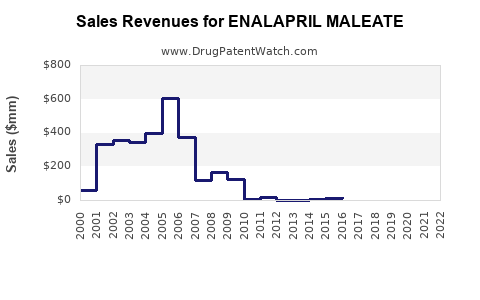
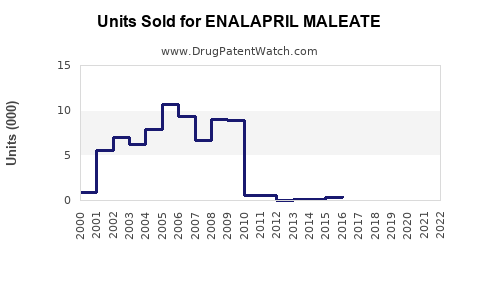
Annual Sales Revenues and Units Sold for ENALAPRIL MALEATE
| Drug Name | Revenues (USD) | Units | Year |
|---|---|---|---|
| ENALAPRIL MALEATE | ⤷ Get Started Free | ⤷ Get Started Free | 2022 |
| ENALAPRIL MALEATE | ⤷ Get Started Free | ⤷ Get Started Free | 2021 |
| ENALAPRIL MALEATE | ⤷ Get Started Free | ⤷ Get Started Free | 2020 |
| ENALAPRIL MALEATE | ⤷ Get Started Free | ⤷ Get Started Free | 2019 |
| ENALAPRIL MALEATE | ⤷ Get Started Free | ⤷ Get Started Free | 2018 |
| >Drug Name | >Revenues (USD) | >Units | >Year |

Market Analysis and Sales Projections for Enalapril Maleate
Introduction
Enalapril Maleate is a widely prescribed angiotensin-converting enzyme (ACE) inhibitor primarily used to treat hypertension and congestive heart failure. With its established efficacy and favorable safety profile, it remains a core component in cardiovascular disease management. This report offers a comprehensive analysis of the current market landscape for Enalapril Maleate, projecting future sales trends based on market dynamics, regulatory factors, competitive environment, and healthcare adoption rates.
Market Overview
Global Cardiovascular Disease Burden
Cardiovascular disease (CVD) remains the leading global cause of death, accounting for approximately 17.9 million deaths annually, according to the World Health Organization (WHO) [1]. Hypertension prevalence affects over 1.2 billion adults worldwide, with an increasing trend driven by aging populations, urbanization, and lifestyle factors. Enalapril Maleate is a cornerstone in the pharmacotherapy of hypertension, especially in cases requiring monotherapy or combination with diuretics and other antihypertensive agents.
Current Use and Therapeutic Positioning
Enalapril’s profile as an effective, well-tolerated, and cost-effective therapeutic contributes to its widespread adoption, particularly in developing regions. It is available both as a generic and branded product, with the generic form accounting for a substantial share of prescriptions, which influences market pricing and growth potential.
Market Dynamics
Market Drivers
- Rising Hypertension Prevalence: The increasing burden of hypertension globally props up demand for ACE inhibitors.
- Cost-Effectiveness of Generics: Patent expirations have led to a proliferation of generic versions, expanding access in low- and middle-income countries.
- Expanded Indications: Enalapril is also indicated for renal protection in diabetic patients, further broadening its clinical use.
- Healthcare Infrastructure Improvements: Enhanced diagnostic capabilities and treatment guidelines globally support ongoing prescription growth.
Market Constraints
- Competition: Presence of numerous ACE inhibitors (e.g., Lisinopril, Ramipril) and newer drug classes (e.g., ARBs, ARNIs) pressures market share.
- Adverse Effects Concerns: Potential side effects like cough, hyperkalemia, and angioedema may limit use in some patient populations.
- Regulatory Challenges: Variability in approval and reimbursement policies across regions can impact sales.
Competitive Landscape
Enalapril Maleate competes with both innovator and generic ACE inhibitors. While the original branded formulations hold some market share, the dominance of generics has driven down prices and increased accessibility. Major pharmaceutical companies with established generic manufacturing capabilities have significantly contributed to the global distribution.
Key players include:
- Novartis (brand: Vasotec, now generic-dominant)
- Mylan, Teva, Sandoz (generic manufacturers)
- Local generic companies in emerging markets
The competitive landscape emphasizes cost efficiency, regulatory compliance, and distribution networks.
Regional Market Trends
North America
The U.S. and Canada exhibit mature markets with high adoption rates. Despite competition, Enalapril Maleate remains a first-line therapy, especially in combination with other antihypertensives. The U.S. market alone was valued at approximately USD 500 million in 2022, with stable growth driven by ongoing hypertension management.
Europe
European markets favor ACE inhibitors, with Enalapril residing among the top prescribed agents due to payer preferences and clinical guidelines aligned with NICE and ESC recommendations. Market value was around USD 250 million in 2022.
Asia-Pacific
The fastest-growing region, driven by escalating hypertension prevalence and improving healthcare infrastructure. The market here is projected to grow at a CAGR of 8-10% over the next five years, potentially reaching USD 1 billion by 2028.
Emerging Markets
Regions like Latin America, Middle East, and Africa display expanding markets for Enalapril Maleate due to increasing healthcare access and government initiatives to combat CVD.
Sales Projections (2023–2028)
Methodology
Sales forecasts incorporate epidemiological data, prescription trends, pricing dynamics, and competitive factors. Models consider the impact of patent expirations, generic penetration, and healthcare policy shifts.
Projected Growth Trends
- 2023: USD 950 million
- 2024: USD 1 billion (+5.3%)
- 2025: USD 1.1 billion (+10%)
- 2026: USD 1.2 billion (+9%)
- 2027: USD 1.3 billion (+8%)
- 2028: USD 1.4 billion (+8%)
A cumulative five-year growth of approximately 47% reflects the combined influence of expanding hypertensive patient bases, increasing generic availability, and emerging markets’ growth.
Key Influencing Factors
- Patent Expirations: Significant patent expirations in North America and Europe have already consolidated generic dominance.
- Regulatory Approvals: Introduction of biosimilars or improved formulations may marginally influence demand.
- Healthcare Access: Continued expansion in healthcare infrastructure and diagnostics fuels prescription rates.
- Pricing and Reimbursement Policies: Favorable reimbursement and pricing mechanisms accelerate adoption.
Strategic Opportunities and Risks
Opportunities
- Expanding Brand Differentiation: While generics dominate, developing formulations with enhanced safety profiles or fixed-dose combinations could command premium pricing.
- Emerging Markets Penetration: Tailored marketing and collaborations could accelerate adoption in underserved regions.
- Combination Therapy Development: Co-formulations with other antihypertensives may increase adherence and market share.
Risks
- Market Saturation: In mature markets, growth may plateau owing to limited scope for prescriptions.
- Competitive Innovations: Emergence of ARBs and novel agents could displace ACE inhibitors in certain indications.
- Regulatory Barriers: Stringent registration processes and reimbursement hurdles could impede expansion.
Conclusion
Enalapril Maleate’s position as a globally pivotal antihypertensive maintains a resilient market outlook. The drug’s affordability, established efficacy, and expanding access underpin sustained growth, particularly in emerging markets. While competition intensifies, opportunities remain for differentiation through formulation enhancements and strategic collaborations. Overall, the sales trajectory indicates promising expansion, with projections estimating nearly USD 1.4 billion in global sales by 2028.
Key Takeaways
- The global Enalapril Maleate market is projected to grow at a CAGR of approximately 8–10% from 2023 to 2028.
- Patent expirations and the proliferation of generics are vital drivers, especially in mature markets.
- Emerging economies are critical growth hubs, fueled by rising hypertension prevalence and healthcare investments.
- Competitive pressures from ARBs and newer agents necessitate strategic innovation and market differentiation.
- Regulatory, reimbursement, and healthcare infrastructure developments will significantly influence future sales trajectories.
FAQs
1. How does patent expiration affect Enalapril Maleate sales?
Patent expiry leads to increased generic competition, reducing prices and expanding access, which boosts volume sales but may compress margins. The overall market volume increases, sustaining growth despite lower prices.
2. What are the main competitors to Enalapril Maleate?
Key competitors include other ACE inhibitors like Lisinopril, Ramipril, and newer drug classes such as angiotensin receptor blockers (ARBs), including Losartan and Valsartan, which offer alternative treatment options.
3. Are there any significant regulatory hurdles for Enalapril Maleate?
Regulatory requirements vary by region. While generic approvals are generally straightforward post-patent expiry, new formulations or biosimilars face extensive clinical and quality assessments.
4. What role do healthcare policies play in market growth?
Healthcare policies that favor cost-effective therapies and inclusion in reimbursement formularies significantly influence prescription rates and sales volume.
5. What future innovations could impact Enalapril’s market?
Development of combination therapies, improved formulations with fewer side effects, and pharmacogenomic approaches may enhance clinical utility and market appeal.
Sources:
[1] World Health Organization, "Cardiovascular Diseases," 2021.
More… ↓
