Share This Page
Drug Price Trends for rivastigmine
✉ Email this page to a colleague
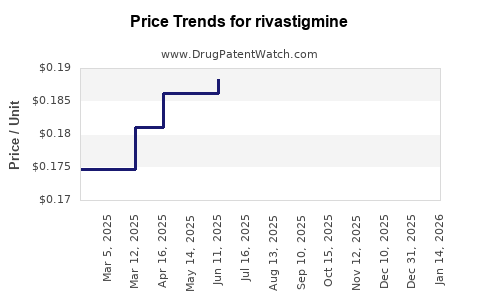
Average Pharmacy Cost for rivastigmine
| Drug Name | NDC | Price/Unit ($) | Unit | Date |
|---|---|---|---|---|
| RIVASTIGMINE 1.5 MG CAPSULE | 00904-7107-61 | 0.15497 | EACH | 2026-07-22 |
| RIVASTIGMINE 1.5 MG CAPSULE | 33342-0089-09 | 0.15497 | EACH | 2026-07-22 |
| RIVASTIGMINE 1.5 MG CAPSULE | 33342-0089-15 | 0.15497 | EACH | 2026-07-22 |
| RIVASTIGMINE 1.5 MG CAPSULE | 55111-0352-05 | 0.15497 | EACH | 2026-07-22 |
| >Drug Name | >NDC | >Price/Unit ($) | >Unit | >Date |
Best Wholesale Price for rivastigmine
| Drug Name | Vendor | NDC | Count | Price ($) | Price/Unit ($) | Unit | Dates | Price Type |
|---|---|---|---|---|---|---|---|---|
| RIVASTIGMINE 9.5MG/24HR PATCH | Sandoz, Inc. | 00781-7309-31 | 30 | 53.56 | 1.78533 | EACH | 2023-08-15 - 2028-08-14 | FSS |
| EXELON TTS 9.5MG PATCH | Sandoz, Inc. | 00078-0502-15 | 30 | 509.91 | 16.99700 | EACH | 2023-09-29 - 2028-08-14 | FSS |
| RIVASTIGMINE 9.5MG/24HR PATCH | Sandoz, Inc. | 00781-7309-31 | 30 | 46.81 | 1.56033 | EACH | 2024-01-01 - 2028-08-14 | FSS |
| EXELON TTS 9.5MG PATCH | Sandoz, Inc. | 00078-0502-15 | 30 | 510.97 | 17.03233 | EACH | 2024-01-01 - 2028-08-14 | FSS |
| >Drug Name | >Vendor | >NDC | >Count | >Price ($) | >Price/Unit ($) | >Unit | >Dates | >Price Type |
Rivastigmine Market Analysis and Price Projections
Rivastigmine, a cholinesterase inhibitor used to treat mild to moderate dementia associated with Alzheimer's disease and Parkinson's disease, exhibits a stable market with projected growth driven by an aging global population and increasing Alzheimer's diagnoses. Patent expirations for originator products have opened the market to generic competition, leading to price erosion. However, ongoing research into novel delivery methods and potential new indications could influence future market dynamics.
What is the Current Global Market Size and Projected Growth for Rivastigmine?
The global rivastigmine market was valued at approximately USD 1.2 billion in 2023. Market projections indicate a compound annual growth rate (CAGR) of 4.2% from 2024 to 2030, reaching an estimated USD 1.5 billion by 2030. This growth is primarily attributed to the increasing prevalence of dementia, particularly Alzheimer's disease, which affects an estimated 55 million people globally as of 2023 [1]. The aging demographic, with a rising proportion of individuals over 65, is a key driver for the demand for treatments like rivastigmine. The World Health Organization estimates that the number of people aged 65 and over will increase from 594 million in 2020 to 1.2 billion in 2050 [2].
Which Geographic Regions Dominate the Rivastigmine Market?
The North America region currently holds the largest market share, accounting for approximately 35% of the global rivastigmine market. This dominance is due to high healthcare expenditure, established reimbursement policies, and a high prevalence of Alzheimer's disease. Europe follows, representing around 30% of the market, driven by similar demographic trends and advanced healthcare infrastructure. The Asia-Pacific region is projected to experience the fastest growth, with a CAGR of 5.5%, fueled by increasing awareness, improving healthcare access, and a large and aging population base in countries like China and India.
What is the Competitive Landscape for Rivastigmine?
The rivastigmine market is characterized by a mix of originator brands and a significant number of generic manufacturers. The patent expiry of the original formulation, Exelon, developed by Novartis, led to the entry of numerous generic players, intensifying competition.
Key market players include:
- Novartis AG (Originator, with branded products and generic offerings)
- Teva Pharmaceutical Industries Ltd.
- Sun Pharmaceutical Industries Ltd.
- Mylan N.V. (now Viatris Inc.)
- Lupin Ltd.
- Dr. Reddy's Laboratories Ltd.
- Gilead Sciences, Inc. (through acquisitions)
- Apotex Inc.
- Zydus Lifesciences Limited
The competitive landscape is largely driven by pricing strategies and the ability to achieve broad market penetration through generic formulations. Differentiation is emerging in the form of different dosage forms and delivery systems.
What are the Key Rivastigmine Dosage Forms and Their Market Impact?
Rivastigmine is available in several dosage forms, each with varying market penetration and growth potential.
- Oral Capsules and Solutions: These are the most established and widely used forms. Their market share is significant, but growth is moderated by the availability of newer delivery systems.
- Transdermal Patches: Rivastigmine patches, like Exelon Patch, have gained substantial market traction. They offer improved patient compliance and reduced gastrointestinal side effects compared to oral formulations. The patch segment is projected to grow at a CAGR of 5.0% due to these advantages.
- Emerging Formulations: Research is ongoing for novel delivery methods, including long-acting injectables, which could further enhance patient convenience and potentially capture a larger market share if proven effective and cost-efficient.
The shift towards transdermal patches signifies a move towards patient-centric treatment options, which is influencing prescribing patterns.
What are the Primary Drivers of Demand for Rivastigmine?
Several factors are driving the demand for rivastigmine:
- Aging Global Population: The increasing number of individuals aged 65 and older is the most significant driver, as this demographic has a higher incidence of neurodegenerative diseases.
- Rising Incidence of Alzheimer's Disease: Global prevalence of Alzheimer's is escalating, creating a consistent demand for symptomatic treatments.
- Increased Diagnosis Rates: Greater awareness among the public and healthcare professionals, coupled with advancements in diagnostic tools, is leading to earlier and more accurate diagnoses, thus expanding the patient pool for treatments.
- Government Initiatives and Healthcare Spending: Increased government focus on dementia care and rising healthcare expenditure in developing economies are contributing to market growth.
- Preference for Non-Oral Formulations: The convenience and reduced side-effect profile of transdermal patches are boosting their adoption, particularly among elderly patients or those with swallowing difficulties.
What are the Key Restraints on the Rivastigmine Market?
Despite the growth drivers, certain factors are limiting the market expansion:
- Generic Competition and Price Erosion: The extensive presence of generic versions has led to significant price reductions, impacting the revenue potential for manufacturers. The average selling price (ASP) of generic rivastigmine capsules has decreased by an estimated 20-30% since initial generic entry.
- Side Effects and Tolerability: While rivastigmine offers symptomatic relief, it does not halt disease progression. Side effects such as nausea, vomiting, and diarrhea can affect patient adherence.
- Development of Disease-Modifying Therapies: Emerging research into disease-modifying treatments for Alzheimer's disease, which aim to slow or reverse cognitive decline rather than just manage symptoms, could potentially reduce the reliance on cholinesterase inhibitors like rivastigmine in the long term.
- High Research and Development Costs: Developing new formulations or indications for existing drugs requires substantial investment, posing a barrier for smaller market participants.
- Regulatory Hurdles: Obtaining regulatory approval for new formulations or expanded indications can be a lengthy and costly process.
What are the Price Trends and Projections for Rivastigmine?
The pricing of rivastigmine is significantly influenced by the presence of generic competition.
- Originator Product (e.g., Exelon): Branded rivastigmine products command a premium price, typically ranging from USD 150 to USD 300 per month for a standard course of treatment, depending on the formulation and dosage.
- Generic Rivastigmine: Generic oral capsules can be purchased for as low as USD 20 to USD 50 per month. Generic patches are also available at substantially lower prices than the originator, often in the range of USD 70 to USD 150 per month.
Price Projections:
- Continued Price Erosion for Generics: The market for generic rivastigmine is expected to see continued, albeit slower, price erosion as more players enter and competition intensifies. Price reductions of 1-3% annually are anticipated for generic capsules.
- Stable or Slight Decrease for Patches: While generic patches offer cost savings, their pricing may remain relatively stable due to the complexity of their manufacturing and the continued demand for this more convenient formulation. A slight decrease of 0.5-1.5% annually is projected.
- Premium for Novel Formulations: Any new, innovative delivery systems or improved formulations that offer significant clinical advantages or enhanced patient convenience could command premium pricing, at least until generic versions become available.
What is the Role of Patents and Intellectual Property in the Rivastigmine Market?
The patent landscape for rivastigmine has evolved significantly. The primary patents for the original rivastigmine molecule and its immediate uses have expired in major markets, paving the way for generic entry.
- Composition of Matter Patents: These foundational patents have largely expired. For example, the original composition of matter patent for rivastigmine expired in the U.S. in 2007 and in Europe in 2008.
- Formulation Patents: Patents related to specific formulations, such as the transdermal patch, have also expired or are nearing expiry in various jurisdictions. The initial patent for the Exelon Patch was granted in the U.S. in 1997, with subsequent extensions.
- Method of Use Patents: Patents covering specific uses or treatment regimens may still be active for certain indications or patient populations, but these have less impact on the broader market for treating dementia.
- Patent Expirations and Generic Entry: The expiration of key patents in the early to mid-2010s was a pivotal event, directly leading to the significant influx of generic competitors and subsequent price reductions. The market is now largely dominated by off-patent generic products.
Manufacturers continue to seek patent protection for incremental innovations, such as new delivery systems, specific polymorphs, or new therapeutic combinations, to extend market exclusivity where possible. However, the primary growth driver for the market is now volume rather than patent-protected pricing.
What are the Future Trends and Opportunities for Rivastigmine?
The future of the rivastigmine market is shaped by ongoing research and evolving treatment paradigms.
- Advancements in Delivery Systems: Development of more convenient and effective delivery methods, such as extended-release formulations or novel patch technologies that reduce skin irritation, presents an opportunity for market differentiation.
- Combination Therapies: Research into combining rivastigmine with other therapeutic agents or even exploring its potential use in conjunction with emerging disease-modifying therapies could uncover new treatment strategies.
- Expanded Indications: While rivastigmine is primarily used for Alzheimer's and Parkinson's disease dementia, exploring its efficacy in other forms of dementia or cognitive impairment could broaden its market.
- Focus on Early Intervention: As diagnostic capabilities improve, there is a potential for earlier intervention in the disease process. Understanding rivastigmine's efficacy in earlier stages of dementia could create a new market segment.
- Emerging Markets: The growing healthcare infrastructure and increasing prevalence of dementia in emerging economies in Asia and Latin America offer significant growth opportunities for both branded and generic rivastigmine products.
Key Takeaways
- The rivastigmine market is projected to grow at a CAGR of 4.2% to reach USD 1.5 billion by 2030, driven by an aging population and rising dementia diagnoses.
- North America and Europe are the largest markets, while Asia-Pacific shows the fastest growth potential.
- Generic competition has led to significant price erosion, with oral capsules priced much lower than originator brands.
- Transdermal patches represent a growing segment due to improved patient compliance and reduced side effects.
- The expiration of key patents has facilitated generic entry and intensified market competition.
- Future opportunities lie in novel delivery systems, potential combination therapies, and expansion into emerging markets.
Frequently Asked Questions
-
Will the development of new disease-modifying Alzheimer's drugs impact rivastigmine sales? Yes, the introduction of effective disease-modifying therapies could potentially reduce the reliance on symptomatic treatments like rivastigmine over the long term, although it may take years to see a significant impact.
-
What is the typical price difference between branded rivastigmine patches and generic versions? Generic rivastigmine patches are typically 30-50% less expensive than their branded counterparts, offering substantial cost savings for patients and healthcare systems.
-
Are there any pending patent applications that could significantly alter the rivastigmine market in the near future? While major composition of matter and formulation patents have expired, ongoing patent filings typically focus on incremental innovations like manufacturing processes, specific polymorphic forms, or novel combination therapies. These are unlikely to create broad market disruptions in the short term.
-
What are the primary challenges in manufacturing generic rivastigmine patches compared to oral formulations? Manufacturing transdermal patches is more complex, requiring advanced technology for drug loading, adhesion, and controlled release, which can lead to higher production costs and potential barriers to entry for some generic manufacturers.
-
Are there any specific regions where rivastigmine is facing particular pricing pressure due to government policies? In many European countries and some Asian markets, governments actively promote the use of generics through formulary restrictions and preferred pricing policies, leading to accelerated price pressure on both branded and generic rivastigmine products in those regions.
Citations
[1] World Health Organization. (2023). Dementia. https://www.who.int/news-room/fact-sheets/detail/dementia [2] United Nations, Department of Economic and Social Affairs, Population Division. (2022). World Population Ageing Highlights 2022. https://www.un.org/development/desa/pd/sites/www.un.org.development.desa.pd/files/files/documents/2023/Sep/undesa_pop_2022_world_population_ageing_highlights_2022.pdf
More… ↓
