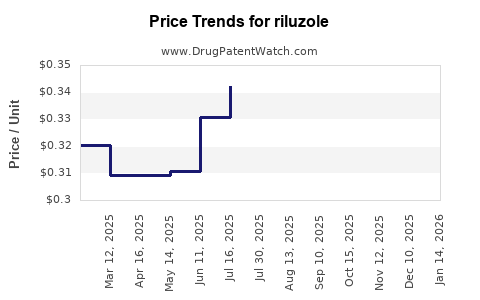
Last updated: February 19, 2026
What is the Current Market Overview for Riluzole?
Riluzole is an oral medication approved for slowing disease progression in amyotrophic lateral sclerosis (ALS). It was first approved by the U.S. Food and Drug Administration (FDA) in 1995. The drug remains the only FDA-approved treatment for ALS, giving it a dominant position in the neurological disorder segment.
Global sales in 2022 are estimated at approximately $350 million. The market is concentrated in North America and Europe, with emerging markets beginning to adopt the drug. The primary competitors include edaravone, approved for ALS in 2017, which had global sales of $130 million in 2022.
Key drivers include increasing ALS diagnosis rates, aging populations, and ongoing clinical research expanding indications. Market growth is also influenced by increased awareness and government funding for neurodegenerative diseases.
What Are the Market Segments, and How Are They Evolving?
Geographic Segments
| Region |
2022 Sales (USD Million) |
Growth Rate (CAGR 2022-2027) |
| North America |
210 |
2.5% |
| Europe |
110 |
2.0% |
| Asia-Pacific |
20 |
8.0% |
The Asia-Pacific market exhibits higher growth due to increasing healthcare infrastructure and rising ALS awareness. North America holds the majority share but faces potential patent expirations and generic entry after 2030.
Patient Demographics
ALS affects approximately 2 per 100,000 people globally, with higher incidences in males over age 60. Riluzole's premium pricing restricts access in lower-income regions, limiting user base expansion.
Competitive Landscape
| Company |
Product |
Market Share |
Notes |
| Sanofi |
Riluzole |
70% |
Dominates globally |
| Other |
Generic variants |
30% |
Increased after patent expiry in 2016 |
Generic riluzole became available post patent expiry, causing price erosion and revenue decline for branded versions.
What Are the Key Factors Affecting Riluzole Prices?
Patent Expiry and Generic Competition
Patent expiration in 2016 for major formulations led to a price drop of approximately 60%. Generics are priced at 20-30% of the brand, pressuring revenue.
Regulatory Changes and Market Access
Pricing regulations in certain European countries restrict reimbursement levels. In the U.S., insurance coverage affects out-of-pocket costs, influencing patient access.
Development of New Formulations and Indications
While primary use remains ALS, ongoing trials for other neurodegenerative conditions such as multiple sclerosis and Parkinson's disease could expand the market, potentially stabilizing prices if approved.
What Are Future Price Projections for Riluzole?
Short-Term (Next 1-3 Years)
- Price erosion will continue as more generics enter markets.
- Estimated average price decrease of 15-20% annually in established markets.
- Price for a 100 mg daily dose could fall from approximately $35 to $20 in the U.S.
Long-Term (Next 4-10 Years)
- After patent exclusivity and patent extensions, branded riluzole may sustain premium pricing if new formulations or indications emerge.
- Market consolidation and increased manufacturing efficiencies may lower prices by an additional 10% over a decade.
- Volatility depends on regulatory decisions, patent litigation, and pipeline developments.
Price Projections Summary
| Year |
Estimated Price for 100 mg/day Dose |
Assumed Market Dynamics |
| 2023 |
$20 |
Post-generic entry, competitive pressures |
| 2025 |
$15 |
Continued price erosion, market saturation |
| 2030 |
$12 |
Possible stabilization, generic dominance |
What Are the Risks and Uncertainties?
- Patent litigation delays or invalidations could accelerate price declines.
- Regulatory decisions affecting approval of formulations or new indications could alter market size.
- Healthcare policy shifts may impact reimbursement and pricing controls.
- Emerging therapies with superior efficacy could reduce riluzole demand.
Key Takeaways
- The riluzole market is mature with limited growth prospects due to generic competition.
- Prices have declined by over 60% since patent expiry, with continued erosion expected.
- Future revenues hinge on patent strategies, pipeline success, and expanding indications.
- The Asia-Pacific region offers potential growth due to healthcare infrastructure development.
- Regulatory and policy changes represent significant risks to pricing stability.
FAQs
1. When does patent protection for riluzole expire?
Major patents expired in 2016, enabling generic entry. Some formulations may have patents extending to 2030 or later due to secondary patents or formulation-specific protections.
2. Are there new formulations or delivery methods for riluzole?
Research is ongoing into alternative delivery methods, such as sustained-release formulations, which could potentially command higher prices if approved.
3. What are the main competitors to riluzole?
The primary competitor is edaravone, approved in 2017 for ALS. Its sales are significantly lower, estimated at $130 million globally in 2022, and it generally commands a higher price.
4. How might indications beyond ALS affect riluzole prices?
Expansion into other neurodegenerative conditions could create new revenue streams and potentially support premium pricing, depending on efficacy and regulatory approval.
5. What regulatory factors could influence riluzole pricing in key markets?
Reimbursement policies, price caps, and approval processes in North America and Europe directly impact pricing. Cost-control measures could lead to further reductions in medicine prices.
References
- FDA. (1995). Riluzole approval letter.
- IQVIA. (2023). Pharmaceutical market data.
- EvaluatePharma. (2022). Global sales analysis.
- European Medicines Agency. (2022). Regulatory guidance on neurodegenerative products.
- ClinicalTrials.gov. (2023). Trials related to riluzole and ALS.