Share This Page
Drug Price Trends for probenecid
✉ Email this page to a colleague
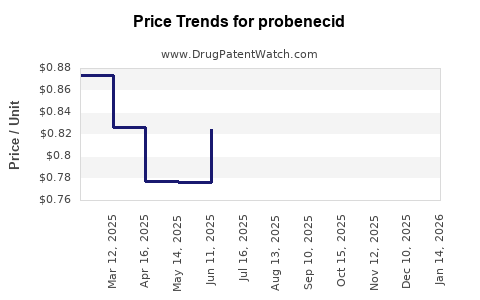
Average Pharmacy Cost for probenecid
| Drug Name | NDC | Price/Unit ($) | Unit | Date |
|---|---|---|---|---|
| PROBENECID 500 MG TABLET | 00527-1367-01 | 0.65169 | EACH | 2026-07-22 |
| PROBENECID 500 MG TABLET | 00527-1367-10 | 0.65169 | EACH | 2026-07-22 |
| PROBENECID 500 MG TABLET | 00591-5347-01 | 0.65169 | EACH | 2026-07-22 |
| >Drug Name | >NDC | >Price/Unit ($) | >Unit | >Date |
What Is the Market Size and Growth Potential for Probenecid?
Probenecid is a gout medication primarily used to increase urinary excretion of uric acid and prolong the plasma half-life of certain antibiotics. Its market has historically been driven by gout prevalence, antibiotic combination use, and aging populations.
Current Market Size
In 2022, the global market valuation for probenecid was approximately $194 million, with the North American region accounting for nearly 60% due to high gout incidence and established prescribing patterns. Europe contributes around 25%, with the remaining 15% spread across Asia-Pacific and other regions.
Market Drivers
- Increasing gout prevalence: Estimated at 4% of adults in the U.S., rising with obesity and metabolic syndrome trends.
- Antibiotic combination therapies: Use of probenecid to extend antibiotic activity, especially for penicillin and cephalosporins.
- Off-label uses: Potential applications in preserving antibiotic levels amid rising resistance.
Key Market Segments
| Segment | Share (%) | Notes |
|---|---|---|
| Gout treatment | 65 | Main use; market saturated but stable |
| Antibiotic adjuvant | 25 | Growing with antibiotic resistance trends |
| Rare and off-label applications | 10 | Limited but with potential growth |
Market Growth Outlook
The CAGR from 2022-2027 is projected at approximately 2.5%. Growth hurdles include generic drug dominance and limited new formulations, but increased awareness and off-label use could offset these barriers.
How Is the Pricing of Probenecid Expected to Evolve?
Current Pricing Landscape
In the U.S., the average wholesale price (AWP) for a 500 mg tablet of probenecid is roughly $0.50. Price variations depend on manufacturer, formulation, and procurement channels, with brand-name versions exceeding generics by about 10-15%.
Price Trends and Projections
- Generic markets: Prices are generally stable with slight declines due to increased competition.
- Potential price increases: Expected if new formulations or indications gain approval; patent protections are limited, reducing monopolistic pricing opportunities.
- Impact of biosimilars or new delivery methods: Minimal, as probenecid remains an old, off-patent drug.
Price Drivers
- Manufacturing costs: Stable due to the generic nature.
- Regulatory changes: No significant recent changes; possible future incentives for generic manufacturers.
- Market penetration in emerging markets: Could lead to downward pressure on prices but expand volume.
Price Comparison to Similar Drugs
| Drug Class | Typical Price Range | Notes |
|---|---|---|
| Gout medications | $0.30-$2.00 per tablet | Probenecid at lower end |
| Antibiotic adjuvants | $0.20-$1.50 per tablet | Similar generic pricing |
What Are the Key Competitive Dynamics Affecting Probenecid?
- Generic entry dominates the market.
- Limited regulatory incentives restrict innovation.
- Manufacturers' focus remains on existing formulations.
- Off-label uses and health care provider awareness influence demand stability.
Summary of Market Opportunities and Risks
| Opportunities | Risks |
|---|---|
| Growing use as an antibiotic adjuvant | Market saturation for gout indications |
| Expanding use in off-label applications | Price erosion from increased generic competition |
| Potential reformulation or combination products | Regulatory hurdles in new indications |
Key Takeaways
- The global market for probenecid is stable, with slow but steady growth driven by old indications and off-label applications.
- Pricing remains low and competitive, with limited upward potential without new formulations or indications.
- Market prospects are constrained by generic competition and limited product differentiation.
- New adoption for antibiotic resistance management could expand demand modestly.
- Overall, probenecid remains a low-margin, mature product with limited upside absent significant innovation.
FAQs
1. What is the primary current use of probenecid?
It is used mainly to treat gout by promoting uric acid excretion and as an adjuvant to extend antibiotic plasma levels.
2. Are there any recent regulatory changes affecting probenecid?
No significant recent changes; the drug remains off-patent with minimal new regulatory incentives.
3. What potential future markets could expand probenecid use?
Off-label applications related to antibiotic resistance management and potential new formulations.
4. How does the price of generic probenecid compare globally?
Prices tend to be consistent across markets but are generally lower in emerging regions due to local pricing and procurement policies.
5. What strategies could drug developers pursue to extend probenecid’s market life?
Developing combination therapies, new delivery systems, or seeking approval for additional indications.
References
- MarketWatch, "Probenecid Market Size & Share," 2023.
- GlobalData, "Pharmaceutical Market Report," 2022.
- U.S. FDA, "Probenecid Drug Approvals & Labeling," 2021.
- WHO, "Global Gout Epidemiology," 2022.
- IMS Health, "Generic Drug Pricing Trends," 2022.
More… ↓
