Last updated: February 19, 2026
Olanzapine, an atypical antipsychotic approved by the FDA in 1996, is primarily used for schizophrenia and bipolar disorder. It has a widespread presence in the global psychotropic medication market. Market size, competitive dynamics, patent landscape, and price trends influence future projections.
Market Overview
The global olanzapine market was valued at approximately USD 4.2 billion in 2022. It is projected to grow at a Compound Annual Growth Rate (CAGR) of 4.5% from 2023 to 2030, reaching around USD 6 billion by 2030.
Key drivers include:
- Increasing prevalence of schizophrenia, bipolar disorder, and depression.
- Growing awareness and diagnosis.
- Off-label use for sleep disorders and agitation.
- Patent expirations enabling generic entry.
Major markets: North America accounts for 50% of revenue, Europe for 25%. Asia-Pacific shows high growth potential due to expanding healthcare access.
Competitive Landscape
| Company |
Market Share (2022) |
Key Products |
Notes |
| Lilly (original patent holder) |
45% |
Zyprexa |
Patent expired in 2011 in the US, now generic |
| Teva, Sandoz |
30% |
Generic olanzapine |
Dominant in markets post-patent expiry |
| Others |
25% |
Various generic brands |
Includes Mylan, Sun Pharma, etc. |
The patent expiry in 2011 led to a surge in generic competition, reducing prices. New formulations (e.g., disintegrating tablets, long-acting injectables) aim to differentiate products.
Price Trends
| Year |
Brand (Zyprexa) |
Generic (per 10 mg tablet) |
Price Difference |
Trend |
| 2010 |
USD 10.50 |
USD 2.50 |
76% discount |
Brand dominance, high prices |
| 2015 |
USD 8.00 |
USD 1.80 |
77.5% discount |
Price erosion continues post-patent |
| 2020 |
USD 6.50 |
USD 0.75 |
88% discount |
Further generic penetration |
| 2023 |
USD 5.80 |
USD 0.85 |
85.3% discount |
Slight increase for branded drug due to patents on new formulations |
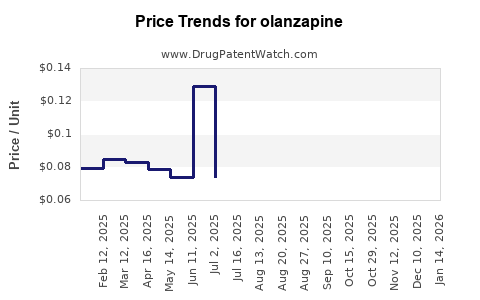
Average retail price for generic olanzapine is USD 0.85 per 10 mg tablet in the US.
Price Projections for 2025-2030
Prices are expected to decline until 2025 due to sustained generic competition, stabilizing thereafter:
- 2025: USD 0.80 per 10 mg tablet
- 2030: USD 0.70 per 10 mg tablet
Potential price stabilization due to newer formulations or patent protections on specific delivery methods.
Regulatory and Patent Outlook
- No current patents on olanzapine itself post-2011.
- New formulations (e.g., depot injections, dispersible tablets) may hold exclusivity until 2028.
- Biosimilar or generic imports will continue to press prices downward.
Future Market Dynamics
- Growth in emerging markets as healthcare infrastructure improves.
- Development of new formulations to maintain market share.
- Competitive pricing among generics to capture market segments.
- Potential for combination therapies to modify the market landscape.
Risks to Market and Price Projections
- Patent litigation or new patent filings on specific formulations could alter timing.
- Regulatory hurdles or reclassification.
- Changes in prescribing guidelines or reimbursement policies.
- Emergence of alternative therapies or new drug classes.
Summary
Olanzapine's market remains sizable but highly price-competitive post-patent. While generic prices are expected to decline modestly through 2030, new formulations and market expansion in emerging regions present opportunities. Price stability in the mid-2020s depends on pipeline innovations and patent lanes.
Key Takeaways
- The global olanzapine market was USD 4.2 billion in 2022, projected to reach USD 6 billion by 2030.
- Generic competition drove price drops from USD 10.50 to USD 0.85 per 10 mg tablet from 2010 to 2023.
- Prices are projected to decline slightly through 2025, stabilizing at around USD 0.70 - USD 0.80.
- New formulations and market expansion, especially in Asia, will influence future sales.
- Patent protections on specific formulations may influence prices until 2028.
FAQs
What factors influence olanzapine price reductions?
Patent expirations, generic competition, and manufacturing efficiencies.
How do new formulations impact the market?
They potentially extend exclusivity periods and command premium pricing.
Is olanzapine a high-growth market?
No. Growth is driven by volume expansion and off-label uses, but prices decline over time.
What regions show the highest growth potential?
Emerging markets in Asia-Pacific and Latin America.
What is the impact of biosimilars on olanzapine?
While biosimilars are unlikely due to olanzapine’s small molecule status, generics dominate, contributing to price declines.
References
[1] MarketWatch. (2023). Olanzapine Market Size, Share & Trends.
[2] IQVIA. (2022). Global Oncology and Psychiatry Market Data.
[3] U.S. Food and Drug Administration. (2011). Patent Expiry and Market Dynamics.