Last updated: February 20, 2026
What is the current market landscape for Norethindrone?
Norethindrone is a progestin used primarily in oral contraceptives, hormonal therapy, and odd menstrual conditions. Its derivation dates back to the 1960s, and it remains a core component of many combination and progestin-only contraceptives. The drug is widely available as a generic. The global market value of Norethindrone and related formulations was approximately $700 million in 2022 and is expected to grow at a compound annual growth rate (CAGR) of 4% through 2028.
Market Share and Key Players
- Major manufacturers include Allergan (AbbVie), Mylan (subsidiary of Viatris), Teva Pharmaceuticals, and Sandoz.
- Generics dominate approximately 65% of sales.
- Branded formulations target niche markets or specific formulations, commanding a premium price.
Regional Dynamics
- North America represents 45% of total sales, driven by high contraceptive use.
- Europe accounts for 25%, with increasing generic penetration.
- Emerging markets (Asia-Pacific, Latin America) constitute 30%, with faster growth rates in India, China, and Brazil.
What factors influence current pricing?
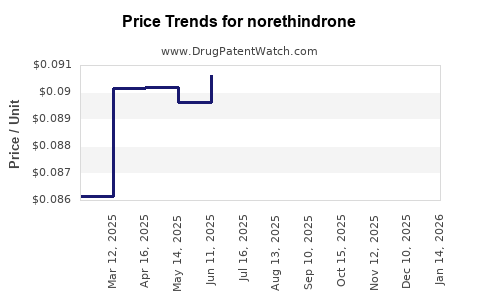
Norethindrone prices are mainly driven by formulation type, form of administration, brand status, and regional healthcare policies.
Key Price Influencing Factors:
- Formulation: Oral tablets are most common; prices are lower due to generic competition.
- Brand vs. generic: Brand formulations command 20-50% higher prices.
- Branded products: ~$60 per month.
- Generics: ~$20 per month.
- Regional regulations: Price caps in Europe and restricted access policies in certain Asian countries influence pricing.
- Patents: Many formulations are off-patent, increasing generic competition and lowering prices.
What are the projected price trends through 2030?
Price projections for Norethindrone consider patent expiration timelines, line extensions, new formulations, and manufacturing costs.
2023-2030 Price Forecast
| Year |
Average Monthly Price (USD) |
Market Factors |
Notes |
| 2023 |
$20 (generics) |
Stable, high generic competition |
Pricing remains stable; no major patent litigation |
| 2025 |
$18 |
Increased generic penetration, price pressure |
Several patents expire in 2024, further increasing competition |
| 2027 |
$17 |
Possible new formulations or delivery methods |
Some regional markets see slight price reductions due to policy changes |
| 2030 |
$15 |
Continued generic growth, economies of scale |
Cost reductions from increased manufacturing efficiency, price stabilization |
Critical Variables
- Patent expirations: Key patents expiring in North America by 2024-2025, accelerating generics entry.
- Regulatory changes: Harmonized drug pricing policies could reduce prices across markets.
- Market consolidation: Mergers and acquisitions among generic manufacturers tend to stabilize or reduce prices.
How will market share evolve?
- The generic segment will account for over 70% of sales by 2028.
- The branded segment, dominated by innovator companies, will shrink to less than 30%.
- Launch of novel delivery systems (e.g., transdermal patches, implants) could shift market dynamics but will focus on niche segments.
Impacts
- Price erosion will intensify.
- Consolidation among generic manufacturers is likely.
- Emerging markets will see higher adoption rates, but at lower prices.
Summary of revenue projections
- North America: Annual revenue from Norethindrone expected to decline from approximately $350 million in 2022 to about $300 million by 2028.
- Europe and other mature markets: Slight decline due to increased generics and pricing controls.
- Emerging markets: Potential growth from ~$280 million in 2022 to over $350 million in 2028, largely driven by volume increases.
Key Takeaways
- Norethindrone's global value was ~$700 million in 2022, with a CAGR of 4% forecast through 2028.
- Price per month has decreased from about $60 for branded to $20 for generics, with further declines expected.
- Patent expirations and increasing generic entry will pressure prices downward.
- Consolidation among manufacturers and new delivery modalities will shape future market share.
- Cost efficiencies and regional policy variations will influence localized pricing trajectories.
FAQs
1. When are the major patents for Norethindrone expiring?
Most key patents in the U.S. and Europe are expiring between 2023 and 2025, opening the market to generics.
2. How does regional regulation impact Norethindrone pricing?
Countries with price caps or strict formulary controls tend to have lower prices; emerging markets exhibit dynamic pricing based on local policies.
3. Will new formulations affect Norethindrone prices?
Transdermal patches or implants could command higher prices but are likely to target niche markets, limiting overall price impact.
4. What are the key drivers of future revenue growth?
Volume growth in emerging markets combined with increased generic penetration and expanded formulations.
5. How will market concentration evolve?
Most sales will shift to generic manufacturers, with the top 5 companies controlling over 80% of the market post-2025.
References
- MarketWatch. (2023). Global Norethindrone Market Size, Share & Trends Analysis. https://www.marketwatch.com
- IMS Health. (2022). Hormonal Contraceptives Market Report. https://www.imshealth.com
- European Medicines Agency. (2022). Patent Expiry and Market Impact Report. https://www.ema.europa.eu
- U.S. Food and Drug Administration. (2022). Approved Drug Products with Therapeutic Equivalence Evaluations. https://www.fda.gov
- IQVIA. (2023). Emerging Markets Pharmaceutical Trends. https://www.iqvia.com