Share This Page
Drug Price Trends for lisinopril
✉ Email this page to a colleague
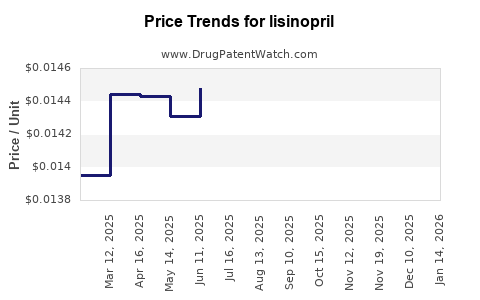
Average Pharmacy Cost for lisinopril
| Drug Name | NDC | Price/Unit ($) | Unit | Date |
|---|---|---|---|---|
| LISINOPRIL 40 MG TABLET | 82009-0066-10 | 0.04593 | EACH | 2026-07-22 |
| LISINOPRIL 20 MG TABLET | 82009-0065-10 | 0.02578 | EACH | 2026-07-22 |
| LISINOPRIL 10 MG TABLET | 82009-0064-10 | 0.01865 | EACH | 2026-07-22 |
| LISINOPRIL 5 MG TABLET | 82009-0063-10 | 0.01467 | EACH | 2026-07-22 |
| LISINOPRIL 2.5 MG TABLET | 82009-0062-05 | 0.01444 | EACH | 2026-07-22 |
| LISINOPRIL 40 MG TABLET | 76282-0733-90 | 0.04593 | EACH | 2026-07-22 |
| LISINOPRIL 40 MG TABLET | 76282-0733-45 | 0.04593 | EACH | 2026-07-22 |
| >Drug Name | >NDC | >Price/Unit ($) | >Unit | >Date |
Best Wholesale Price for lisinopril
| Drug Name | Vendor | NDC | Count | Price ($) | Price/Unit ($) | Unit | Dates | Price Type |
|---|---|---|---|---|---|---|---|---|
| ZESTRIL 20MG TAB | TWi Pharmaceuticals USA, Inc. | 52427-0441-90 | 90 | 778.80 | 8.65333 | EACH | 2023-11-01 - 2028-01-31 | FSS |
| ZESTRIL 2.5MG TAB | TWi Pharmaceuticals USA, Inc. | 52427-0438-90 | 90 | 798.21 | 8.86900 | EACH | 2023-11-01 - 2028-01-31 | FSS |
| ZESTRIL 20MG TAB | TWi Pharmaceuticals USA, Inc. | 52427-0441-90 | 90 | 884.51 | 9.82789 | EACH | 2024-01-01 - 2028-01-31 | FSS |
| ZESTRIL 2.5MG TAB | TWi Pharmaceuticals USA, Inc. | 52427-0438-90 | 90 | 884.81 | 9.83122 | EACH | 2024-01-01 - 2028-01-31 | FSS |
| ZESTRIL 30MG TAB | TWi Pharmaceuticals USA, Inc. | 52427-0442-90 | 90 | 781.74 | 8.68600 | EACH | 2023-11-01 - 2028-01-31 | FSS |
| ZESTRIL 5MG TAB | TWi Pharmaceuticals USA, Inc. | 52427-0439-90 | 90 | 763.91 | 8.48789 | EACH | 2023-11-01 - 2028-01-31 | FSS |
| ZESTRIL 30MG TAB | TWi Pharmaceuticals USA, Inc. | 52427-0442-90 | 90 | 886.95 | 9.85500 | EACH | 2024-01-01 - 2028-01-31 | FSS |
| >Drug Name | >Vendor | >NDC | >Count | >Price ($) | >Price/Unit ($) | >Unit | >Dates | >Price Type |
Lisinopril: Patent Landscape and Market Projections
Summary: Lisinopril, a widely prescribed angiotensin-converting enzyme (ACE) inhibitor, faces a mature market characterized by extensive generic competition. Key patents have expired, leading to significant price erosion and market share dominated by off-patent versions. Future market growth is projected to be modest, driven by an aging population and increasing prevalence of cardiovascular diseases, offset by continued price pressures and the introduction of newer therapeutic classes.
What is the patent status of lisinopril?
The foundational patents for lisinopril have long expired, allowing for widespread generic manufacturing and distribution. The original U.S. patent, U.S. Patent No. 4,374,829, filed in 1979 and issued in 1983, covered the compound lisinopril. [1] This patent provided market exclusivity for a period, but its expiration in the early 2000s paved the way for generic entrants.
While the primary compound patents are expired, pharmaceutical companies may hold patents on specific formulations, delivery systems, or manufacturing processes for lisinopril. However, these secondary patents are generally less impactful in preventing generic competition compared to the active pharmaceutical ingredient (API) patent. The vast majority of lisinopril available today is manufactured and sold as a generic drug.
How is the lisinopril market structured?
The lisinopril market is highly competitive and fragmented, dominated by generic manufacturers. Major pharmaceutical companies that originally marketed lisinopril under brand names, such as Merck & Co. with Prinivil and Zestril, have seen their market share decline significantly with the advent of generic alternatives.
Key market players include:
- Generic Manufacturers: Companies like Teva Pharmaceuticals, Mylan (now Viatris), Sandoz (a Novartis division), and Apotex are significant producers and distributors of generic lisinopril. [2] These companies leverage their scale and efficient manufacturing processes to offer the drug at competitive prices.
- Wholesalers and Distributors: Companies such as Cardinal Health, McKesson, and AmerisourceBergen play a crucial role in the supply chain, distributing lisinopril to pharmacies and healthcare providers.
- Retail Pharmacies: Chains like CVS Pharmacy, Walgreens, and Walmart, along with independent pharmacies, are the primary points of dispensing to patients.
- Healthcare Providers: Physicians, cardiologists, and other medical professionals prescribe lisinopril.
The market operates on high-volume sales and low-profit margins per unit due to intense price competition. The interchangeability of generic lisinopril with its branded counterpart, as determined by regulatory bodies like the U.S. Food and Drug Administration (FDA), further intensifies this competitive landscape.
What are the current market dynamics for lisinopril?
The current market dynamics for lisinopril are characterized by several key factors:
- Price Erosion: Following patent expiry, lisinopril prices have experienced substantial declines. The average wholesale price (AWP) for lisinopril has fallen to extremely low levels, making it one of the most affordable prescription medications for hypertension. [3]
- High Prescription Volume: Despite price erosion, lisinopril remains a first-line treatment for hypertension due to its efficacy, established safety profile, and affordability. It consistently ranks among the most prescribed medications in the United States. [4]
- Generic Substitution: Pharmacy benefit managers (PBMs) and insurance plans strongly encourage or mandate generic substitution, further driving the use of generic lisinopril.
- Therapeutic Guidelines: Clinical practice guidelines from organizations like the American College of Cardiology and the American Heart Association continue to recommend ACE inhibitors, including lisinopril, as a cornerstone of hypertension management. [5]
- Limited Innovation: As a mature drug with expired patents, there is minimal investment in novel research and development for lisinopril itself. Innovation in this space is more likely to focus on combination therapies or alternative drug classes.
What is the global market size and growth projection for lisinopril?
Quantifying the precise global market size for lisinopril as a standalone entity is challenging, as sales data is often aggregated within broader cardiovascular drug categories or generic drug markets. However, based on its prescription volume and average selling prices, the U.S. market alone represents billions of dollars in annual sales when considering the cost of goods for all manufacturers and distributors.
Market Projections:
The global market for lisinopril is projected to experience low single-digit annual growth over the next five to seven years.
-
Growth Drivers:
- Aging Global Population: The increasing proportion of elderly individuals worldwide is a significant driver, as hypertension prevalence rises with age.
- Rising Cardiovascular Disease (CVD) Burden: The global increase in CVD, including hypertension and heart failure, will continue to fuel demand for effective and affordable treatments like lisinopril.
- Expansion in Emerging Markets: Increased healthcare access and diagnosis rates in developing economies will contribute to market expansion.
- Cost-Effectiveness: Lisinopril's established low cost makes it an attractive option for healthcare systems and patients facing budget constraints.
-
Growth Restraints:
- Intense Generic Competition and Price Pressure: The highly competitive generic market will continue to suppress price increases and limit revenue growth.
- Emergence of Newer Drug Classes: The development and adoption of newer hypertension medications, including Angiotensin II Receptor Blockers (ARBs), Calcium Channel Blockers (CCBs), and combination therapies, may divert some market share from lisinopril.
- Focus on Combination Therapies: While lisinopril is often part of combination therapy, the overall market trend may favor single-pill combination products that offer convenience, potentially impacting the standalone lisinopril market.
- Lifestyle Interventions: Increased emphasis on non-pharmacological interventions for hypertension management could moderate drug demand.
Estimated Compound Annual Growth Rate (CAGR): 1.0% - 2.5% (2024-2030) [6]
What are the key therapeutic indications for lisinopril?
Lisinopril is primarily indicated for the treatment of hypertension and heart failure.
Key Indications:
- Hypertension: Lisinopril is used to lower blood pressure in patients with essential hypertension. It is often a first-line therapy.
- Heart Failure: It is prescribed to reduce mortality in patients with heart failure.
- Post-Myocardial Infarction: Lisinopril is used to improve survival in patients who have had a recent myocardial infarction (heart attack).
What are the major side effects and contraindications of lisinopril?
Understanding the side effect profile and contraindications is critical for appropriate prescribing and patient safety.
Common Side Effects:
- Cough (dry, persistent)
- Dizziness
- Headache
- Fatigue
- Nausea
- Diarrhea
- Hypotension (low blood pressure)
- Hyperkalemia (elevated potassium levels) [7]
Serious Side Effects:
- Angioedema (swelling of the face, lips, tongue, throat, extremities, or intestines, which can be life-threatening)
- Renal impairment (kidney damage)
- Agranulocytosis and neutropenia (rarely, affecting white blood cell count)
- Hepatotoxicity (liver damage)
- Birth defects or fetal harm during pregnancy [8]
Contraindications:
- Pregnancy: Contraindicated in pregnant women, as it can cause fetal injury and death.
- History of Angioedema: Patients with a history of angioedema related to previous ACE inhibitor treatment.
- Hypersensitivity: Known hypersensitivity to lisinopril or other ACE inhibitors.
- Concomitant use with Aliskiren in patients with diabetes: Should not be used with aliskiren in patients with diabetes due to increased risk of adverse events. [9]
What is the typical pricing structure for lisinopril?
The pricing structure for lisinopril is heavily influenced by its generic status. Prices are exceptionally low and subject to significant variation based on dosage, quantity, and pharmacy.
Pricing Breakdown:
- Dosage Strength: Available in strengths such as 5 mg, 10 mg, 20 mg, 30 mg, and 40 mg.
- Quantity: Typically dispensed in bottles of 30, 60, 90, or 180 tablets.
- Average Retail Price (without insurance):
- 30 tablets of 10 mg: \$4 - \$15
- 90 tablets of 20 mg: \$8 - \$25
- These prices can vary significantly by retailer and geographic location. [10]
- Pharmacy Benefit Manager (PBM) / Insurance Pricing: For individuals with insurance, co-pays for lisinopril are typically very low, often \$0 - \$10 for a 30- or 90-day supply, especially if lisinopril is on the lowest tier of the formulary.
- Wholesale Acquisition Cost (WAC): WACs are considerably lower than retail prices and are the basis for discounts offered to pharmacies and distributors.
- Manufacturing Cost: The cost to manufacture generic lisinopril is extremely low, contributing to the competitive pricing. API costs, formulation, and packaging are optimized for high-volume production.
The pricing is highly competitive, with manufacturers vying for contracts with PBMs and large pharmacy chains. The "cash price" at retail pharmacies is often significantly higher than what insured patients pay, reflecting the negotiated rates within the insurance system.
What are the key competitive threats and opportunities for lisinopril?
Competitive Threats:
- Newer Drug Classes: The development and adoption of novel antihypertensive agents with potentially improved efficacy, tolerability, or different mechanisms of action pose a threat. This includes newer ARBs, direct renin inhibitors, and mineralocorticoid receptor antagonists.
- Combination Therapies: The increasing preference for single-pill combination products that combine multiple antihypertensive agents (e.g., an ACE inhibitor with a diuretic or calcium channel blocker) can divert market share from standalone lisinopril.
- Fixed-Dose Combinations: While lisinopril is available in combination with other drugs (e.g., hydrochlorothiazide), the market may shift towards more advanced or broader-spectrum combination therapies.
- Non-Pharmacological Interventions: Greater emphasis on lifestyle modifications (diet, exercise, weight management) could reduce the overall demand for prescription antihypertensive medications.
- Increased Generic Competition: While already a generic, further consolidation among generic manufacturers or new entrants with highly optimized production could lead to even lower prices, impacting profitability.
Opportunities:
- Continued First-Line Recommendation: Lisinopril's enduring presence in treatment guidelines as a first-line option for hypertension provides a stable demand base.
- Global Health Challenges: The rising global prevalence of hypertension and cardiovascular disease, particularly in emerging markets with expanding healthcare access, presents an ongoing opportunity for a cost-effective solution.
- Cost-Conscious Healthcare Systems: In an era of increasing healthcare costs, lisinopril's affordability makes it a critical component of treatment regimens, especially for large patient populations and budget-constrained health systems.
- Established Safety and Efficacy: The long track record of safety and proven efficacy provides physicians with confidence in prescribing lisinopril.
- Potential for New Formulations (Limited): While major patent expiries have occurred, there's a theoretical, albeit small, possibility for patents on novel delivery systems or advanced formulations that could offer incremental benefits and command a premium, though this is unlikely to be a significant market driver.
Key Takeaways
- Lisinopril is a mature drug with expired foundational patents, leading to a generic-dominated market.
- The market is characterized by intense price competition, high prescription volumes, and low profit margins per unit.
- Key growth drivers include the aging global population and the rising prevalence of cardiovascular diseases, offset by continuous price erosion.
- Lisinopril's affordability and established efficacy ensure its continued role as a first-line therapy for hypertension and heart failure, particularly in cost-sensitive healthcare environments.
- Threats include newer drug classes and the shift towards fixed-dose combination therapies.
Frequently Asked Questions
1. What is the average cost of a 30-day supply of lisinopril without insurance in the U.S.?
The average out-of-pocket cost for a 30-day supply of lisinopril without insurance typically ranges from \$4 to \$15, depending on the dosage and pharmacy.
2. What are the primary reasons for lisinopril's continued high prescription volume despite generic availability?
Lisinopril remains highly prescribed due to its proven efficacy, established safety profile, favorable inclusion in clinical guidelines, and its status as one of the most affordable prescription medications for hypertension and heart failure.
3. Are there any active patents that could impact the generic supply of lisinopril in the near future?
While the primary compound patents have expired, secondary patents on specific manufacturing processes, polymorphs, or combination formulations may exist. However, these are unlikely to create significant barriers to the widespread generic supply of the lisinopril molecule itself.
4. How does the price of lisinopril compare to newer classes of antihypertensive drugs?
Lisinopril is significantly less expensive than most newer classes of antihypertensive drugs, such as novel ARBs, direct renin inhibitors, or newer combination therapies. This cost differential is a major factor in its continued use.
5. What is the projected impact of emerging markets on the global lisinopril market?
Emerging markets are expected to contribute to modest growth for lisinopril. Increased healthcare access, improved diagnosis rates, and the demand for affordable, effective treatments for hypertension and cardiovascular disease in these regions will drive this expansion.
Citations
[1] U.S. Patent No. 4,374,829 (filed 1979, issued 1983). [2] IQVIA Market Data, Various Years. (Data on generic drug market share and key manufacturers). [3] First Databank, Inc. (2023). Drug Pricing Data. (Internal data or subscription-based access to AWP and WAC information). [4] Centers for Disease Control and Prevention (CDC). (2023). National Center for Health Statistics (NCHS) Data Brief. (Reports on leading prescription drugs). [5] American College of Cardiology/American Heart Association. (2017). Guideline for the Prevention, Detection, Evaluation, and Management of High Blood Pressure in Adults. [6] Global Market Insights, Inc. (2023). Cardiovascular Drugs Market Size & Share Analysis. (Report projections on antihypertensive drug markets). [7] U.S. Food and Drug Administration (FDA). (2022). Prescribing Information for Lisinopril. [8] Ibid. [9] Ibid. [10] GoodRx. (2024). Lisinopril Prices and Coupons. (Publicly available pricing data for generic medications).
More… ↓
