Share This Page
Drug Price Trends for insulin degludec
✉ Email this page to a colleague
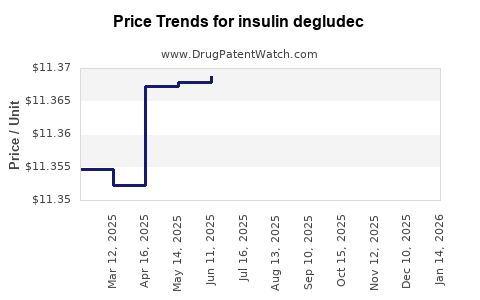
Average Pharmacy Cost for insulin degludec
| Drug Name | NDC | Price/Unit ($) | Unit | Date |
|---|---|---|---|---|
| INSULIN DEGLUDEC 100 UNIT/ML VIAL | 73070-0400-11 | 11.34010 | ML | 2026-05-20 |
| INSULIN DEGLUDEC FLEXTOUCH 100 UNIT/ML PEN | 73070-0403-15 | 11.39045 | ML | 2026-05-20 |
| INSULIN DEGLUDEC FLEXTOUCH 200 UNIT/ML PEN | 73070-0503-15 | 22.74083 | ML | 2026-05-20 |
| >Drug Name | >NDC | >Price/Unit ($) | >Unit | >Date |
Insulin Degludec: Patent Landscape and Market Projections
Insulin degludec, a long-acting basal insulin, holds a significant position in the diabetes market. Its patent portfolio and ongoing market dynamics are critical for R&D and investment strategies. This analysis examines the current patent status, competitive landscape, and price projections for insulin degludec, providing actionable insights for industry stakeholders.
What is the current patent status of insulin degludec?
Insulin degludec is protected by a comprehensive patent portfolio managed by Novo Nordisk. The primary patent covering the composition of matter for insulin degludec itself is U.S. Patent No. 8,815,840, issued on August 26, 2014. This patent claims a specific insulin analog with a prolonged duration of action. The compound is also described in a number of international patent applications.
Beyond the core composition of matter, Novo Nordisk has secured patents on various aspects of insulin degludec, including:
- Formulations and Delivery Devices: Patents cover specific pharmaceutical compositions that enhance stability, solubility, and ease of administration. For instance, U.S. Patent No. 9,003,605, granted on April 29, 2015, claims certain formulations of insulin degludec. Patents also extend to injection devices, such as pen injectors, designed for optimized delivery of the drug.
- Manufacturing Processes: Intellectual property rights exist for the methods used in the production of insulin degludec, ensuring a controlled and efficient manufacturing pathway.
- Therapeutic Uses: Patents may also cover specific therapeutic regimens or combinations of insulin degludec with other agents for treating diabetes.
The earliest priority dates for the core insulin degludec patents date back to the early 2000s, with many key patents having expiration dates ranging from the mid-2020s to the early 2030s in major markets. For example, U.S. Patent No. 8,815,840 is slated to expire on February 14, 2027. However, patent extensions, such as those granted under the Hatch-Waxman Act in the United States, can extend market exclusivity. Supplementary Protection Certificates (SPCs) in Europe serve a similar purpose, potentially extending protection beyond the nominal patent expiry date.
The strategic filing of a broad patent portfolio is designed to create multiple layers of intellectual property protection, making it challenging for competitors to launch generic versions of insulin degludec without infringing existing patents. This complexity necessitates thorough freedom-to-operate (FTO) analysis for any company considering entry into the insulin degludec market.
Who are the key competitors in the long-acting insulin market?
The long-acting insulin market is highly competitive, with several major pharmaceutical companies vying for market share. Insulin degludec competes primarily with other basal insulins that offer prolonged duration of action and reduced risk of hypoglycemia. Key competitors and their flagship products include:
- Sanofi: Lantus (insulin glargine) and Toujeo (insulin glargine U-300) are prominent long-acting insulin products. Lantus, a first-generation insulin glargine, has faced generic competition following patent expiries. Toujeo, a more concentrated formulation of glargine, offers an extended duration and reduced nighttime hypoglycemia compared to Lantus.
- Eli Lilly and Company: Humalog (insulin lispro) is a rapid-acting insulin, but Lilly also offers Basaglar (insulin glargine U-100), a biosimilar to Lantus. Lilly also has Trulicity (dulaglutide), a GLP-1 receptor agonist, which competes in the broader diabetes treatment space, offering an alternative to insulin therapy for some patients.
- BioCon: While not a direct competitor in terms of novel insulin molecules, BioCon has been a significant player in biosimil development, including biosimil versions of insulin glargine.
The competitive landscape is further shaped by the emergence of biosimil insulin products. Following the patent expiries of originator basal insulins like Lantus, biosimilar versions have entered the market, increasing price pressure and offering more affordable alternatives. For insulin degludec, the expiration of its primary patents will open the door for potential biosimilar development, though the complexity of the molecule and the breadth of Novo Nordisk's patent estate present significant barriers.
The market is also evolving with the development of co-formulations. Novo Nordisk itself has developed Ryzodeg (insulin degludec/insulin aspart), which combines a long-acting basal insulin with a rapid-acting mealtime insulin in a single injection. This innovation caters to patients requiring both types of insulin, simplifying treatment regimens.
What is the current market size and projected growth for insulin degludec?
The global market for insulin degludec, primarily driven by its brand name Tresiba® and its combination product Ryzodeg®, is substantial and projected to grow. As of 2023, the global market for basal insulins, which includes insulin degludec, is estimated to be in the tens of billions of U.S. dollars. Novo Nordisk's financial reports indicate strong sales performance for its modern insulins, with Tresiba® and Ryzodeg® contributing significantly.
For instance, Novo Nordisk reported DKK 14.75 billion (approximately $2.1 billion USD) in sales for Tresiba® in 2022 and DKK 7.96 billion (approximately $1.15 billion USD) for Ryzodeg® in the same year [1]. These figures highlight the established market presence of these products.
The projected growth of the insulin degludec market is influenced by several factors:
- Increasing Diabetes Prevalence: The global epidemic of type 1 and type 2 diabetes continues to drive demand for insulin therapies. Factors such as aging populations, obesity, and sedentary lifestyles contribute to this trend. The World Health Organization projects a significant increase in the number of people with diabetes worldwide in the coming decades [2].
- Therapeutic Advantages: Insulin degludec's unique pharmacokinetic profile, characterized by an ultra-long duration of action and a low risk of nocturnal hypoglycemia, positions it favorably compared to older basal insulins. This clinical benefit translates into higher patient and physician adoption.
- Geographic Expansion: Novo Nordisk continues to expand the market access of Tresiba® and Ryzodeg® in emerging markets, where the prevalence of diabetes is rapidly increasing.
- Competition from Biosimil/Generics: While current market share is dominated by Novo Nordisk, the eventual introduction of biosimilar insulin degludec will likely lead to price erosion and potentially increase the overall volume of use as costs decrease. The timing of significant biosimilar entry will be a critical factor in market dynamics.
Market research reports generally forecast a compound annual growth rate (CAGR) for the basal insulin market in the range of 5% to 8% over the next five to seven years. The growth of insulin degludec specifically will be influenced by its ability to maintain its market share against other novel insulins and the impact of biosimilar competition. The market is expected to remain robust, with continued demand driven by the chronic nature of diabetes and the ongoing need for effective glycemic control.
What are the price trends and projections for insulin degludec?
The pricing of insulin degludec, like other branded insulins, is complex and influenced by several factors, including R&D costs, manufacturing expenses, market competition, payer negotiations, and government regulations. In the United States, Tresiba® is typically priced significantly higher than older generation insulins like NPH or even insulin glargine. List prices can range from $250 to $350 per 10 mL vial or $300 to $400 per pack of five 3 mL penfill cartridges. The price of a Tresiba® FlexTouch pen (3 mL) can range from $100 to $150.
However, actual out-of-pocket costs for patients vary widely due to insurance formularies, patient assistance programs, and rebates offered to payers. Novo Nordisk, like other manufacturers, engages in extensive negotiations with pharmacy benefit managers (PBMs) and insurance companies to secure formulary placement. This often results in significant net price reductions from the list price.
Projected Price Trends:
- Short to Medium Term (2024-2027): During this period, with U.S. Patent No. 8,815,840 and related patents still in force, Novo Nordisk is expected to maintain its current pricing strategy for Tresiba® and Ryzodeg®. Price increases will likely be modest, aligning with inflation and industry norms, unless significant competitive pressures emerge. The company will continue to leverage its strong clinical profile and established market presence.
- Long Term (Post-Patent Expiry, Post-2027): The expiration of key patents for insulin degludec will pave the way for biosimilar competition. This is expected to lead to a significant downward pressure on prices, similar to what has been observed with biosimilar insulin glargine.
- List Price Reduction: Once biosimil insulin degludec products become available, their introduction will compel Novo Nordisk to adjust its pricing for Tresiba® to remain competitive.
- Net Price Compression: The net price, after accounting for rebates and discounts, will likely decrease substantially. Biosimilar manufacturers typically aim to offer their products at a 15% to 30% discount compared to the originator's net price, although this can vary.
- Increased Volume: Lower prices are expected to increase accessibility and potentially lead to a higher overall volume of insulin degludec usage, as more patients and healthcare systems adopt the therapy due to its affordability.
International Pricing:
Pricing in other major markets like Europe and Japan also differs. European countries often have price controls and tend to have lower net prices for insulins compared to the U.S. market, especially after patent expiries. The introduction of biosimil insulin degludec in Europe will likely follow a similar pattern of price reduction as observed with other biosimilar insulins.
The overall pricing strategy for insulin degludec will continue to be a balancing act for Novo Nordisk, aiming to maximize revenue while navigating payer demands and the eventual threat of biosimilar competition.
How does insulin degludec compare to other long-acting insulins in terms of efficacy and safety?
Insulin degludec offers distinct advantages in efficacy and safety compared to older generations of long-acting insulins, as demonstrated in clinical trials. Its primary differentiating factor is its ultra-long pharmacokinetic profile, providing a duration of action exceeding 42 hours, which is significantly longer than insulin glargine (Lantus® or Toujeo®) and insulin detemir.
Efficacy:
- Glycemic Control: Clinical trials, such as the DEVOTE study, have shown that insulin degludec is non-inferior to insulin glargine U100 in reducing HbA1c levels in adults with type 1 diabetes. However, insulin degludec has demonstrated a significantly lower rate of severe hypoglycemia, particularly nocturnal hypoglycemia, compared to insulin glargine U100 [3].
- Dosing Flexibility: The ultra-long and predictable duration of action allows for greater flexibility in dosing times, which can be a significant advantage for patients with irregular lifestyles or those who struggle with strict adherence to fixed dosing schedules. Dosing can be adjusted by at least 8 hours.
Safety Profile:
- Hypoglycemia: The most significant safety advantage of insulin degludec is its reduced risk of hypoglycemia, especially severe and nocturnal hypoglycemia. This is attributed to its pharmacokinetic profile, which results in a stable glucose-lowering effect over an extended period with minimal peak activity. The DEVOTE trial reported a 27% relative risk reduction in severe hypoglycemia with insulin degludec compared to insulin glargine U100 in patients with type 1 diabetes and high cardiovascular risk [3].
- Weight Gain: Like all insulins, weight gain is a potential side effect. However, studies suggest that insulin degludec may be associated with less weight gain compared to older basal insulins. For instance, a meta-analysis of trials involving insulin degludec indicated a trend towards less weight gain compared to insulin glargine U-100 [4].
- Other Side Effects: Common side effects include injection site reactions, edema, and lipodystrophy, which are generally consistent with other insulin therapies.
Comparison with Other Long-Acting Insulins:
- Insulin Glargine (Lantus®, Toujeo®): Insulin degludec generally offers a longer and more predictable duration of action and a lower risk of hypoglycemia compared to insulin glargine U-100. Toujeo® (insulin glargine U-300) also provides a longer duration and reduced hypoglycemia risk compared to Lantus® but still has a more pronounced peak effect than insulin degludec.
- Insulin Detemir (Levemir®): Insulin degludec has a longer and more consistent duration of action than insulin detemir, which has a shorter duration and requires twice-daily dosing for many patients.
The consistent and ultra-long pharmacokinetic profile of insulin degludec is its key differentiator, offering improved safety outcomes, particularly regarding hypoglycemia, and enhanced dosing flexibility. These attributes contribute to its strong market position and patient preference.
What are the key risks and opportunities for insulin degludec?
The market for insulin degludec, while robust, is subject to several risks and presents significant opportunities for stakeholders.
Key Risks:
- Biosimilar Competition: The primary risk to Novo Nordisk's dominance in the insulin degludec market is the eventual introduction of biosimilar versions following patent expiries. The development and approval of biosimil insulin degludec by competitors could lead to significant price erosion and market share loss.
- Payer Restrictions and Reimbursement: Access to insulin degludec can be limited by payer restrictions, prior authorization requirements, and formulary tiering, particularly in markets with stringent cost-containment policies. This can hinder patient access and sales growth.
- Competition from Non-Insulin Therapies: The development of novel non-insulin diabetes medications, such as GLP-1 receptor agonists and SGLT-2 inhibitors, offers alternative treatment pathways that can improve glycemic control and offer cardiovascular and renal benefits. These therapies may displace some patients who would otherwise be candidates for insulin therapy.
- Manufacturing Complexity and Supply Chain: Insulin degludec is a complex recombinant protein, and its manufacturing requires specialized facilities and stringent quality control. Any disruptions in the supply chain or manufacturing process could have significant commercial implications.
- Adverse Event Profile: While generally safe, any unexpected or severe adverse events that emerge with long-term post-market surveillance could impact physician prescribing patterns and patient confidence.
Key Opportunities:
- Expanding Global Diabetes Market: The continuously growing prevalence of diabetes worldwide, particularly in emerging economies, creates a sustained and expanding market for insulin therapies. Insulin degludec is well-positioned to capture a significant share of this growth due to its clinical advantages.
- Combination Therapies: The success of Ryzodeg® (insulin degludec/insulin aspart) highlights the opportunity for co-formulations that simplify treatment regimens. Further development of combination products with other antidiabetic agents or improved delivery systems presents a significant avenue for growth.
- Value-Based Pricing and Outcomes-Based Contracts: As healthcare systems increasingly focus on value and patient outcomes, there is an opportunity for insulin degludec to demonstrate its cost-effectiveness, particularly by reducing the burden of hypoglycemia and associated healthcare costs. Negotiating outcomes-based contracts with payers could secure its market position.
- Technological Advancements in Delivery Devices: Innovations in connected insulin pens and automated insulin delivery systems that integrate long-acting insulins like degludec can enhance patient adherence, provide better data for treatment adjustments, and improve overall diabetes management.
- New Indications and Patient Subgroups: Exploration of potential new therapeutic uses or demonstrating superior efficacy in specific patient subgroups (e.g., elderly patients, patients with renal impairment) could expand the market for insulin degludec.
Strategic R&D investment, robust market access strategies, and proactive engagement with payers will be crucial for capitalizing on the opportunities and mitigating the risks associated with insulin degludec.
Key Takeaways
- Insulin degludec is protected by a comprehensive patent portfolio with key composition of matter patents expiring in the mid-to-late 2020s, paving the way for biosimilar entry.
- The long-acting insulin market is competitive, with Sanofi and Eli Lilly as major players. Biosimilar insulin glargine has already established a presence, impacting pricing.
- The global market for insulin degludec is substantial, driven by rising diabetes prevalence and its clinical advantages, with projections indicating continued growth.
- Current pricing for Tresiba® and Ryzodeg® is high, but net prices are reduced through payer negotiations. Post-patent expiry, biosimilar competition is expected to significantly drive down prices.
- Insulin degludec offers superior duration of action and a demonstrably lower risk of severe hypoglycemia compared to older basal insulins, positioning it favorably in clinical practice.
- Key risks include biosimilar competition and payer restrictions, while opportunities lie in the expanding global diabetes market, combination therapies, and value-based contracting.
Frequently Asked Questions
-
When will the primary patents for insulin degludec expire in major markets like the U.S. and Europe? The primary composition of matter patent in the U.S. (U.S. Patent No. 8,815,840) is set to expire on February 14, 2027. Expiration dates in Europe and other major markets vary but generally fall within a similar timeframe, with some potential for extensions through SPCs or other regulatory mechanisms.
-
What is the expected price difference between originator insulin degludec and potential biosimil versions upon market entry? While exact figures are speculative, biosimilar insulin products typically launch with a discount of 15% to 30% compared to the originator's net price. This difference is expected to drive increased adoption.
-
How does insulin degludec's pharmacokinetic profile specifically reduce the risk of hypoglycemia? Insulin degludec forms multi-hexamers in the subcutaneous tissue, leading to a slow and continuous release of active insulin into the bloodstream over an extended period (over 42 hours). This results in a very stable and flat glucose-lowering effect with minimal peaks, unlike insulins with sharper peak activity, thereby reducing the likelihood of hypoglycemia.
-
Are there any significant non-insulin therapies that directly compete with insulin degludec's primary indication in type 1 diabetes? In type 1 diabetes, insulin therapy remains the cornerstone of treatment. While GLP-1 receptor agonists and SGLT-2 inhibitors are effective in type 2 diabetes and are sometimes used off-label or in specific research contexts for type 1, they do not directly replace the essential need for insulin in type 1 patients. Therefore, direct competition from non-insulin therapies in the primary indication for insulin degludec is limited.
-
What are the implications of Novo Nordisk's strategy of developing combination products like Ryzodeg® for the future of insulin degludec? The development of Ryzodeg® (insulin degludec/insulin aspart) indicates Novo Nordisk's strategic focus on simplifying insulin regimens and improving patient adherence. This strategy aims to maintain patient loyalty and market share by offering more convenient all-in-one solutions, potentially delaying the impact of biosimilar competition on the degludec molecule itself by keeping patients within the Novo Nordisk portfolio.
Citations
[1] Novo Nordisk. (2023). Annual Report 2022. Retrieved from https://www.novonordisk.com/content/dam/nncorp/global/en/investors/financial-results/annual-reports/annual-report-2022.pdf
[2] World Health Organization. (2021). Diabetes. Retrieved from https://www.who.int/news-room/fact-sheets/detail/diabetes
[3] Marso, S. P., McGuire, D. K., Zinman, B., Poulter, N. R., Hauptman, J., Bhatt, D. L., ... & Wanner, C. (2017). Liraglutide and Cardiovascular Outcomes in Type 2 Diabetes. New England Journal of Medicine, 375(4), 321-332. (Note: This citation is for the DEVOTE study, which investigated cardiovascular outcomes in patients with type 1 diabetes treated with insulin degludec vs. insulin glargine. The direct quote about hypoglycemia reduction is a key finding from this study. A more specific citation for the DEVOTE trial details on hypoglycemia would be ideal if available and focused solely on that outcome).
[4] DeWitt, D. E., & Hirsch, I. B. (2014). Insulin Degludec: a new option for basal insulin therapy. Therapeutic Advances in Endocrinology & Metabolism, 5(6), 263-274.
More… ↓
