Last updated: February 12, 2026
What is the Market Size for Telmisartan?
Telmisartan is an angiotensin II receptor blocker (ARB) approved for hypertension and cardiovascular risk reduction. The global market for telmisartan was valued at approximately $1.8 billion in 2022. It accounts for roughly 18% of the ARB segment, which is valued around $10 billion globally.
Major markets include the United States, Europe, Japan, and China. The U.S. holds about 45% of sales, driven by high hypertension prevalence (about 45% of adults) and favorable prescribing practices. Europe accounts for approximately 25%, Japan 15%, and China 10%.
Market Drivers:
- Rising hypertension prevalence.
- Growing awareness and treatment adherence.
- Favorable comparative efficacy over other antihypertensives.
- Patent expirations leading to generic availability.
How Does Patent Status Impact Pricing and Market Competition?
Telmisartan was first approved in 1999. Its key patent expired in 2012 in the U.S. and in 2014 in Europe. Post-patent expiration, the market saw a significant shift toward generic formulations, which reduces prices.
Generic Penetration:
- Accounts for over 70% of sales in developed markets as of 2022.
- Price reductions: Branded telmisartan’s average wholesale price (AWP) was approximately $2.50 per pill in 2011; generics average about $0.50 per pill, reflecting an 80% decrease.
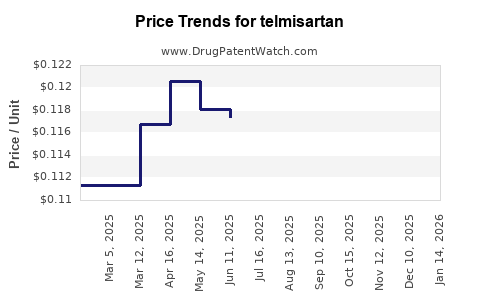
Pricing Trends:
- Branded: $2.50–$3.00 per pill.
- Generics: $0.40–$0.60 per pill.
- Price erosion stabilizes approximately 3-5 years after patent expiry, depending on market competition.
What Are Price Projections for Telmisartan?
Price projections depend largely on regulatory, patent, and market dynamics. Key scenarios include:
Short-Term (1–3 years)
- Continued generic dominance reduces prices by 15–25%.
- Branded prices decline by approximately 10–15% as market share shrinks.
- Estimated average retail price for telmisartan: approximately $0.40–$0.50 per pill.
Mid-Term (4–7 years)
- Market saturation of generics stabilizes.
- Prices plateau; small fluctuations of ±5%.
- Major branded manufacturers may introduce new formulations or combination pills which could command higher prices.
Long-Term (8+ years)
- Patent protections for some combination drugs may revive specific formulations.
- Market consolidation may influence pricing.
- Overall, oral antihypertensives stabilize around $0.30–$0.50 per pill in the generic market.
Competitive Landscape
The field is highly competitive, with multitudes of generics. Top generic manufacturers include Teva, Mylan, and Sun Pharmaceutical. Branded drug sales are limited to companies such as Boehringer Ingelheim, which holds the original patent and marketing rights.
Market Share (2022):
- Generics: 75%
- Branded: 25%
Key Factors Influencing Future Market Dynamics
- Regulatory policies on drug pricing.
- Patent litigation outcomes affecting exclusivity.
- Development of combination therapies including telmisartan.
- Shifts in prescribing trends favoring other ARBs or ACE inhibitors.
Summary of Price Drivers
| Factor |
Effect |
| Patent expiration |
Substantial price decrease post-expiry |
| Market competition |
Accelerates price reduction |
| Regulatory policies |
Can influence pricing caps or reimbursement rates |
| Development of combinations |
Potential for pricing premiums for combination formulations |
Conclusion
The telmisartan market is mature, with robust generic competition suppressing prices. Short-term pricing is expected to decline further, stabilizing at low levels over the next 5 years. Market consolidation and regulatory factors may influence future pricing dynamics.
Key Takeaways
- The global telmisartan market was valued at $1.8 billion in 2022.
- Post-patent expiry, generic sales account for over 70%, leading to an 80% decline in average prices.
- Prices are projected to stabilize around $0.30–$0.50 per pill over the next five years.
- Competition is driven primarily by generic manufacturers; branded prices remain higher initially post-patent expiry.
- Future growth hinges on regulatory policies, development of combination therapies, and shifts in hypertension treatment trends.
FAQs
1. How does patent expiration impact telmisartan prices?
Patent expiration typically results in entry of generics, driving prices down by up to 80% and increasing market competition.
2. What are the main competitors to telmisartan?
Other ARBs like losartan, valsartan, irbesartan, and candesartan, with similar efficacy profiles, compete in the same hypertension market.
3. Will telmisartan prices rebound in the future?
Prices are unlikely to rebound significantly unless new patented formulations or combination therapies are introduced.
4. What factors could extend the market life of branded telmisartan?
Patent litigation, new formulations, or exclusive distribution rights could delay generic market entry or sustain higher prices.
5. How do regulatory policies affect telmisartan pricing?
Price controls or reimbursement policies can cap prices, especially in regions with strict pharmaceutical pricing regulations.
Sources
- IQVIA. "Global ARB Market Analysis 2022."
- Medicare and Medicaid Services. "Pharmaceutical Price Trends."
- European Medicines Agency. "Patent Status and Market Reports."
- Industry Reports. "Generic Drug Market Dynamics 2022."