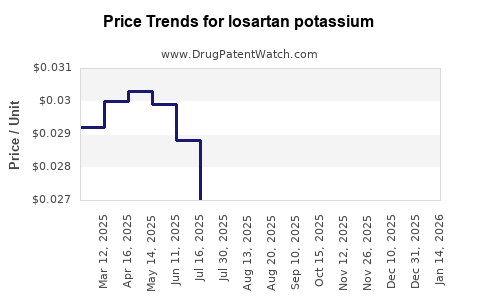
Last updated: February 19, 2026
What is the Current Market Landscape for Losartan Potassium?
Losartan potassium is an angiotensin II receptor blocker (ARB) used primarily to treat hypertension and reduce the risk of stroke in patients with high blood pressure. It also manages diabetic nephropathy. Its patent expired in 2010, leading to widespread generic competition. The drug's market comprises both generic manufacturers and branded producers, with the latter maintaining a niche market through brand loyalty and direct marketing.
Market Size and Trends (Pre-2023)
- The global antihypertensive drugs market was valued at approximately USD 30 billion in 2021, with ARBs accounting for roughly 30%.[1]
- Losartan held around 60% of the ARB segment before patent expiry and remained a key product for generics.
- The demand for losartan is driven by increasing hypertension prevalence, especially in developing economies.
Key Players
- Generics: Mylan, Teva, Sandoz, and Sun Pharma dominate the losartan market.
- Branded: Merck (original developer), with limited ongoing sales post-patent expiry.
Regulatory and Patent Situation
- Patent expiration (2010) opened the active market for generics.
- Regulatory barriers are minimal post-patent, facilitating rapid market entry for new generics.
- Some regions require bioequivalence studies but generally follow established generic approval pathways.
How Have Prices Evolved?
Post-patent expiry, prices for losartan declined sharply:
| Year |
Average Price per 100 mg Tab (USD) |
Price Change Since Patent Expiry (%) |
| 2010 |
$0.50 |
— |
| 2015 |
$0.10 |
80% decrease |
| 2020 |
$0.08 |
84% decrease since 2010 |
| 2023 |
$0.07 |
86% decrease since 2010 |
Price reductions stem from increased generic competition, which has stabilized at low levels. The emergence of multiple generics has kept prices down in most markets, particularly in North America and Europe.
What are the Price Projections?
Short-Term (Next 2 Years)
- Prices are expected to remain stable or decline marginally as existing generics reach manufacturing efficiency.
- No new branded formulations are projected unless indicated by niche therapeutic claims or combination formulations.
- Price floor estimated at USD 0.05 per 100 mg tablet in mature markets.
Long-Term (3-5 Years)
- As patents for other ARBs expire, the market share shifts predominantly toward generic producers.
- Incremental price declines could occur due to increased competition; however, factors like supply chain disruptions or regulatory changes could alter trends.
- Brand-name prices might stabilize or slightly increase if branded firms reintroduce formulations with added benefits or delivery methods.
Factors Influencing Future Price Trends
- Regulatory environment: Stringent bioequivalence and quality standards can influence market entry costs.
- Market dynamics: Mergers and acquisitions among generic manufacturers could impact price competition.
- Global health trends: Rising hypertension prevalence in emerging economies may lead to increased demand, albeit at lower prices due to global commoditization.
Market Size and Revenue Projections (Next 5 Years)
Based on current consumption data and generics' market penetration:
| Year |
Estimated Global Volume (billion tablets) |
Estimated Market Revenue (USD billion) |
| 2023 |
12 |
0.84 |
| 2025 |
14 |
0.98 |
| 2028 |
16 |
1.12 |
Increased access in developing regions and rising cardiovascular disease prevalence suggest moderate growth, but price reductions suppress revenue gains.
What Investment Opportunities Exist?
- Market consolidation among generic producers could lead to pricing power.
- Niche formulations, such as combination drugs incorporating losartan, may sustain higher prices.
- Emerging markets may see volume-driven growth rather than price premiums.
Risks and Challenges
- Regulatory tightening might increase compliance costs.
- Patent litigations or patent thickets could inhibit entry of new generics.
- Competitive pressures from alternative therapies, including newer ARBs and direct renin inhibitors.
Key Takeaways
- Losartan potassium's patent expired in 2010; generics dominate the market, maintaining low prices.
- Prices have stabilized near USD 0.05-0.07 per 100 mg tablet in mature markets.
- Future pricing will depend on emerging generics, patent landscapes, and regional healthcare policies.
- Market growth will be volume-based, primarily in developing countries, with modest revenue increases.
- Potential exists in niche formulations and combination drugs to sustain higher pricing.
FAQs
1. Will losartan prices rebound if patents are refiled or new formulations are developed?
Unlikely. Given the low base price and mature generic competition, any new patents or formulations are unlikely to significantly influence global prices.
2. How does the rise of biosimilars impact the losartan market?
Losartan is a small molecule drug, not a biologic, so biosimilar development does not apply. Generics remain the primary competition.
3. Are there regional differences in losartan market dynamics?
Yes. Developed regions like North America and Europe have mature, low-price markets. Emerging economies see higher volume growth, but prices tend to be even lower due to increased competition.
4. Could supply chain disruptions influence losartan prices?
Supply disruptions could temporarily increase prices or reduce availability, but long-term price trends depend more on competition and regulatory factors.
5. Is there a market for branded losartan products?
Minimal. The market is predominantly generic due to patent expiry; branded products exist mainly for marketing and trust reasons, with negligible impact on pricing or volume.
References
[1] MarketResearch.com. (2022). Global Antihypertensive Drugs Market.
[2] IQVIA. (2021). Global Cardiovascular Market Analysis.
[3] U.S. Food and Drug Administration. (2010). ANDA Approvals and Patent Status for Losartan.
[4] Statista. (2023). Hypertension Treatment Market Revenue.
[5] GlobalData. (2022). Future of the ARB Market.