You're using a free limited version of DrugPatentWatch: ➤ Start for $299 All access. No Commitment.

Last Updated: December 15, 2025

Drug Price Trends for latanoprost


✉ Email this page to a colleague

« Back to Dashboard


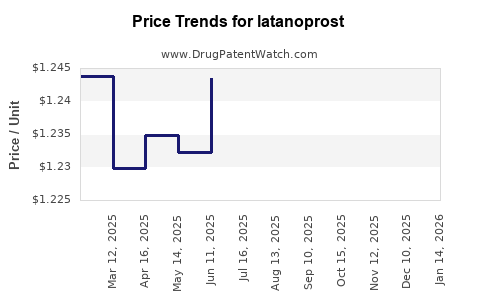
Drug Price Trends for latanoprost

Average Pharmacy Cost for latanoprost

These are average pharmacy acquisition costs (net of discounts) from a US national survey
Drug Name NDC Price/Unit ($) Unit Date
LATANOPROST 0.005% EYE DROPS 25021-0001-02 1.83254 ML 2025-12-10
LATANOPROST 0.005% EYE DROPS 70069-0421-03 1.20139 ML 2025-11-19
LATANOPROST 0.005% EYE DROPS 61314-0547-03 1.20139 ML 2025-11-19
LATANOPROST 0.005% EYE DROPS 68462-0944-03 1.83254 ML 2025-11-19
LATANOPROST 0.005% EYE DROPS 24208-0463-25 1.83254 ML 2025-11-19
LATANOPROST 0.005% EYE DROPS 64980-0516-25 1.83254 ML 2025-11-19
LATANOPROST 0.005% EYE DROPS 59762-0333-02 1.83254 ML 2025-11-19
>Drug Name >NDC >Price/Unit ($) >Unit >Date

Best Wholesale Price for latanoprost

These are wholesale prices available to the US Federal Government which, by law, must be the best prices available to any customer under comparable terms and conditions
Drug Name Vendor NDC Count Price ($) Price/Unit ($) Unit Dates Price Type
LATANOPROST 0.005% SOLN,OPH Golden State Medical Supply, Inc. 70069-0421-03 2.5ML 20.72 8.28800 ML 2023-06-15 - 2028-06-14 FSS
IYUZEH 0.005% SOLN,OPH Thea Pharma, Inc. 82584-0003-30 30X0.2ML 223.82 2023-09-20 - 2028-01-31 FSS
IYUZEH 0.005% SOLN,OPH Thea Pharma, Inc. 82584-0003-30 30X0.2ML 223.66 2024-02-15 - 2028-01-31 FSS
VYZULTA 0.024% SOLN,OPH Bausch & Lomb Americas Inc. 24208-0504-02 2.5ML 161.87 64.74800 ML 2024-01-01 - 2027-09-14 Big4
VYZULTA 0.024% SOLN,OPH Bausch & Lomb Americas Inc. 24208-0504-05 5ML 369.46 73.89200 ML 2024-01-01 - 2027-09-14 FSS
VYZULTA 0.024% SOLN,OPH Bausch & Lomb Americas Inc. 24208-0504-02 2.5ML 194.20 77.68000 ML 2024-01-01 - 2027-09-14 FSS
VYZULTA 0.024% SOLN,OPH Bausch & Lomb Americas Inc. 24208-0504-05 5ML 311.89 62.37800 ML 2022-09-15 - 2027-09-14 Big4
>Drug Name >Vendor >NDC >Count >Price ($) >Price/Unit ($) >Unit >Dates >Price Type
Price type key: Federal Supply Schedule (FSS): generally available to all Federal Govt agencies / 'BIG4' prices: VA, DoD, Public Health & Coast Guard only / National Contracts (NC): Available to specific agencies

Market Analysis and Price Projections for Latanoprost: A Strategic Overview

Last updated: July 27, 2025

Introduction

Latanoprost, marketed under brand names such as Xalatan, is a prostaglandin analog used primarily for the management of elevated intraocular pressure in conditions like glaucoma and ocular hypertension. Since its introduction in the mid-1990s, latanoprost has become a cornerstone therapy owing to its efficacy, once-daily dosing, and favorable safety profile. As the global burden of glaucoma increases concurrent with aging populations and rising awareness, understanding the evolving market landscape and pricing trends for latanoprost is vital for stakeholders, including pharmaceutical companies, healthcare providers, insurers, and investors.

Market Landscape

Global Market Size and Growth Drivers

The global glaucoma medications market was valued at approximately USD 5.8 billion in 2022 and is projected to grow at a compound annual growth rate (CAGR) of around 4.2% through 2030[1]. Latanoprost remains the dominant prostaglandin analog, accounting for over 65% of the prostaglandin market segment due to its proven efficacy and favorable administration profile.

Key drivers include:

  • Aging Populations: Predominantly affects those over 60, driving an increase in glaucoma prevalence globally.
  • Increased Diagnostic Rates: Rising screening efforts improve early detection, expanding treatment markets.
  • Generic Entry: Patent expiration of branded latanoprost products has led to a surge in generic versions, impacting market dynamics and pricing.

Regional Market Dynamics

  • North America: The largest market, driven by high disease prevalence and healthcare spending.
  • Europe: Similar growth patterns, with strong national healthcare policies promoting early intervention.
  • Asia-Pacific: Fastest-growing region due to demographic shifts, increasing urbanization, and expanding healthcare access.

Competitive Landscape

Brand-name players like Pfizer (Xalatan) face competition from multiple approved generics, such as Systane, Mylan, and Teva. This proliferation has significantly pressured prices and margins. Emerging markets are witnessing increased adoption of generic latanoprost formulations, further intensifying competition.

Pricing Trends

Historical Price Trends

Historically, branded latanoprost has been priced at premium levels, with annual costs of approximately USD 1,200–1,500 in developed markets per patient[2]. The introduction of generics has caused substantial price erosion—often by over 50% within five years of patent expiry.

In the U.S., generic latanoprost prices declined from approximately USD 300–400 per bottle (2.5 mL) in 2018 to below USD 150 by 2022[3].

Current Pricing Landscape

  • Branded Products: Continue to command top dollar, particularly in markets with limited generic penetration.
  • Generics: Prices are highly variable, often under USD 50 per bottle in emerging markets; in developed countries, prices typically range from USD 80–120 due to distribution and insurance markups.

Impact of Reimbursement Policies

Reimbursement schemes and formulary inclusions heavily influence drug prices. Countries with national health systems or bulk purchasing agreements tend to secure significantly lower prices for latanoprost, thereby constraining retail margins.

Future Price Projections

Factors Influencing Future Pricing

  • Patent Expirations and Generics: The patent for Xalatan expired in many markets around 2018-2019, leading to sustained generic competition.
  • Product Differentiation: Advances such as preservative-free formulations (e.g., Travatan Z) and sustained-release devices may influence pricing strategies.
  • Regulatory Policies: Countries moving toward price caps and value-based pricing will impact revenue potential.
  • Market Consolidation: Increased biosimilar and generic manufacturer entry will likely sustain downward price pressures.

Projected Price Trends (2023–2030)

Based on current trajectories, the following projections are reasonable:

  • Developed Markets: Generic latanoprost prices will stabilize around USD 50–100 per bottle by 2030, driven by intense competition.
  • Emerging Markets: Prices could decline further, approaching USD 20–50, depending on local healthcare policies.
  • Innovative Formulations: Premium priced preservative-free and sustained-release formulations may maintain higher prices but will constitute a smaller market share initially.

Overall, a sustained decline in per-unit prices is expected as market saturation intensifies and competition persists.

Market Opportunities and Challenges

Opportunities

  • Expansion in Underpenetrated Markets: Improving healthcare infrastructure and ophthalmologic screening in Africa, Asia, and Latin America could expand market size.
  • Innovative Delivery Systems: Sustained-release eye drops and minimally invasive devices can command premium pricing.
  • Combination Therapies: Fixed-dose combinations with other ocular hypotensives can enhance patient adherence and expand indications.

Challenges

  • Price Pressure: The prevalence of generics constrains revenue potential for branded products.
  • Regulatory Barriers: Variations in approval pathways may delay or restrict market entry.
  • Market Saturation: Mature markets face slower growth, necessitating differentiated strategies.

Conclusion

Latanoprost remains integral in the management of glaucoma, with a resilient market structural position bolstered by ongoing demographic trends. However, the commoditization driven by generic competition will continue to suppress prices over the medium term. Future pricing strategies must focus on technological innovation, delivery systems, and expanding access into emerging markets to sustain profitability.


Key Takeaways

  • Market Growth: The global glaucoma medication market, dominated by latanoprost, is forecasted to grow at approximately 4.2% CAGR through 2030, fueled by demographic shifts and improved screening.
  • Pricing Decline: Generic competition has significantly reduced latanoprost prices, with further declines projected—particularly in emerging markets.
  • Innovation: Differentiated formulations and delivery methods offer avenues for premium pricing amid pervasive commoditization.
  • Regional Variation: North America and Europe see sustained high prices, while Asia-Pacific and Latin America experience more aggressive price erosion.
  • Strategic Focus: Stakeholders should prioritize expanding access, investing in innovative formulations, and optimizing market entry strategies aligned with regional policy landscapes.

FAQs

1. When did patent expiry for branded latanoprost occur, and how did it impact pricing?
The primary patent for Xalatan expired in many markets around 2018-2019, leading to an influx of generic versions and a sharp decline in retail prices across regions, especially in developed countries.

2. What are the key factors influencing the regional variability in latanoprost pricing?
Pricing disparities stem from healthcare infrastructure, reimbursement policies, market competition, and regulatory frameworks—regions with centralized healthcare systems tend to negotiate lower prices.

3. How might emerging innovations affect future latanoprost market dynamics?
Innovations like preservative-free formulations, sustained-release implants, and combination therapies can command higher prices, potentially offsetting the downward pressure from generics temporarily.

4. Will biosimilars or new prostaglandin analogs threaten latanoprost's market share?
While biosimilars are less common for small-molecule drugs like latanoprost, new prostaglandin analogs or delivery systems might challenge existing therapies, especially if they demonstrate superior efficacy or safety.

5. How should pharmaceutical companies strategize amid declining prices?
Focusing on differentiated products, expanding into underserved markets, leveraging technological innovation, and optimizing supply chains are essential strategies for maintaining profitability.


References

[1] MarketsandMarkets. (2022). Glaucoma therapeutics market analysis.
[2] IQVIA. (2022). Global ophthalmic drugs pricing report.
[3] GoodRx. (2022). Latanoprost price trends in the United States.

More… ↓

⤷  Get Started Free

Make Better Decisions: Try a trial or see plans & pricing

Drugs may be covered by multiple patents or regulatory protections. All trademarks and applicant names are the property of their respective owners or licensors. Although great care is taken in the proper and correct provision of this service, thinkBiotech LLC does not accept any responsibility for possible consequences of errors or omissions in the provided data. The data presented herein is for information purposes only. There is no warranty that the data contained herein is error free. We do not provide individual investment advice. This service is not registered with any financial regulatory agency. The information we publish is educational only and based on our opinions plus our models. By using DrugPatentWatch you acknowledge that we do not provide personalized recommendations or advice. thinkBiotech performs no independent verification of facts as provided by public sources nor are attempts made to provide legal or investing advice. Any reliance on data provided herein is done solely at the discretion of the user. Users of this service are advised to seek professional advice and independent confirmation before considering acting on any of the provided information. thinkBiotech LLC reserves the right to amend, extend or withdraw any part or all of the offered service without notice.