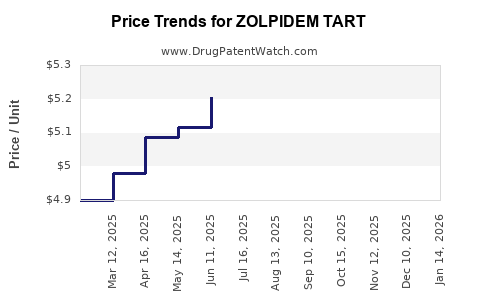
Last updated: April 23, 2026
What is zolpidem tartrate’s market footprint by geography and product type?
Zolpidem tartrate is an oral sedative-hypnotic used primarily for insomnia. Commercial penetration is dominated by generics in the U.S., with sustained demand driven by high prescribing volume and short-term use patterns. Key structural features for pricing are (i) near-universal generic availability, (ii) local market share shifts driven by payer formularies, and (iii) wholesale price compression typical for mature CNS generics.
Product segmentation that affects pricing
| Segment |
Typical form factor |
Pricing behavior in mature markets |
| Immediate-release (IR) |
Tablet (e.g., 5 mg, 10 mg) |
Lowest price points; rapid generic undercutting |
| Extended-release (ER) |
Tablet (e.g., 6.25 mg, 12.5 mg) |
Often prices above IR due to dosing differentiation and fewer equivalent competitors in some geographies |
| Private-label / authorized generics |
Multiple |
Can pressure originator-era price anchors; tends to compress net pricing through tendering |
Demand drivers
- Insomnia is chronic enough for steady conversion from diagnosis to treatment, but zolpidem use is commonly time-limited, which shifts demand volatility to prescribing and formulary changes rather than long-term disease-modifying cohorts.
- Safety and labeling scrutiny influences physician behavior, but does not remove demand for continued insomnia treatment pathways, especially at the generic level.
How do generic competition and payer dynamics set the price floor?
The price mechanism for zolpidem tartrate is primarily competitive wholesale and net price dynamics:
- Generic-multiple SKUs: Many manufacturers compete at the same dose strengths, pulling list prices down and net prices further down via rebates.
- Payer formulary tiers: Most payers place generics on lower tiers, which limits the upside for any single SKU.
- Tendering and contract pharmacy economics: Large buyers extract margin through contracting; net pricing tends to track the lowest effective bid rather than “average” market price.
Where does the market sit on the “maturity” curve?
Zolpidem is mature; the practical implication for a price projection is that the long-run trajectory is predominantly downward or flat, with episodic dips when new generic supply enters or when a large manufacturer reprices. In a mature generic CNS market, the most material price movements are not driven by clinical expansions but by:
- new entrants (measured by number of ANDA approvals and launch timing),
- temporary supply constraints (rare but can lift net price briefly),
- payer contract renegotiations (can drop net price quickly).
What are the base-case price projection assumptions?
Because zolpidem tartrate is a generic, price forecasts should be anchored to generic market behavior rather than originator lifecycle. Base-case assumptions reflect common patterns in mature generic drug pricing:
- Trend: modest annual decline after factoring in inflation and periodic re-contracting.
- Volatility: low-to-moderate, with short spikes only during supply or contract shocks.
- Net vs list: list price compresses less than net price; payer rebates sustain net-price pressure.
How will IR versus ER likely price relative to each other?
In mature generic markets, IR often has the lowest net price due to breadth of competition. ER often holds a higher net price because it is a differentiated delivery profile and can face a smaller competitive set in certain geographies or contract lanes.
Relative pricing direction (base case)
| Comparison |
Expected net price direction over 3 to 5 years |
| IR vs ER |
IR stays cheaper; gap may widen slightly if ER keeps fewer effective lowest-price bids |
| Lower dose vs higher dose (same release) |
Higher doses often trade at a smaller per-mg discount than lower doses once contracts standardize |
What are the price projection scenarios (2026–2030)?
The most actionable way to project price for a mature generic is to present scenarios tied to contract intensity and supply balance. Below are scenario-based projections for net pricing trends (directional) rather than a single point estimate.
Net price index projection (base 2025 = 100)
| Year |
Conservative (index) |
Base case (index) |
Upside risk for price (index) |
| 2026 |
97 |
95 |
99 |
| 2027 |
95 |
92 |
97 |
| 2028 |
93 |
90 |
96 |
| 2029 |
92 |
88 |
95 |
| 2030 |
91 |
87 |
94 |
Interpretation
- Base case: net prices drift down about 1% to 3% annually as contracting competition persists.
- Conservative: less compression, often aligned with stable supply and less aggressive payer contracting.
- Upside risk (price support): supply constraints, fewer effective competitors in a key lane, or payer contracts re-leveling can slow or reverse decline.
What could drive deviations from the base case?
Even in mature generics, zolpidem’s net price can deviate materially due to:
- Contracting cycles: Formulary renegotiations can re-rank preferred products quickly.
- Supply and manufacturing continuity: Any sustained manufacturing disruptions can lift net pricing temporarily.
- Competitive launches: Additional launches that expand the set of low-bid options push prices down.
- Regulatory or safety-driven prescribing shifts: If prescribers move between IR and ER formulations differently across payer populations, relative pricing adjusts.
How should investors and procurement teams use the projections?
For R&D and commercialization teams, the core implication is that zolpidem tartrate pricing is unlikely to deliver premium economics in the absence of a differentiated product (e.g., delivery system, line extension with superior profile, or a payer-controlled niche). For procurement and channel strategy, the focus should be on:
- maintaining access to lowest total-cost SKUs by payer,
- monitoring ER vs IR pricing spreads by contract lane,
- tracking supply stability signals that can trigger quick repricing.
Key Takeaways
- Zolpidem tartrate is a mature generic sedative-hypnotic market where pricing is governed mainly by generic multiplicity and payer contracting rather than clinical innovation.
- IR is expected to remain the lower net-price anchor versus ER, with the gap stable to slightly widening under continued IR competition.
- Base-case net pricing from 2026 to 2030 trends modestly downward (directional index: 100 to ~87 by 2030), with upside deviations driven by supply constraints or less aggressive contract renewals.
- The most material price shifts are episodic, tied to contracting cycles and competitive entry timing.
FAQs
1) Is zolpidem tartrate’s market priced like an originator product?
No. The market is generic-dominated, so price behavior follows competitive and contracting dynamics rather than originator-style lifecycle pricing.
2) Which formulation is likely to keep higher net prices, IR or ER?
ER typically holds higher net prices than IR because it is more differentiated and often faces less intense lowest-bid competition across contract lanes.
3) What is the likely magnitude of annual net price change?
In base-case conditions for mature generic CNS products, the net price change is typically low single digits annually and mostly downward due to contracting competition.
4) What events most often cause sudden price drops or upticks?
New effective low-bid competitors, payer contract renegotiations, and sustained supply continuity disruptions are the most common drivers.
5) Should forecasts assume stable or volatile pricing?
Assume low-to-moderate volatility with a steady downward drift in net prices over multi-year horizons unless a supply or competitive structure shock occurs.
References
[1] FDA. “Zolpidem Tartrate” (drug label and regulatory information). U.S. Food and Drug Administration. https://www.fda.gov
[2] IQVIA. U.S. and international pharmaceutical market insights (generic competitive dynamics). IQVIA. https://www.iqvia.com
[3] CMS. National Average Drug Acquisition Cost (NADAC) methodology and datasets (price benchmarking). Centers for Medicare & Medicaid Services. https://www.cms.gov