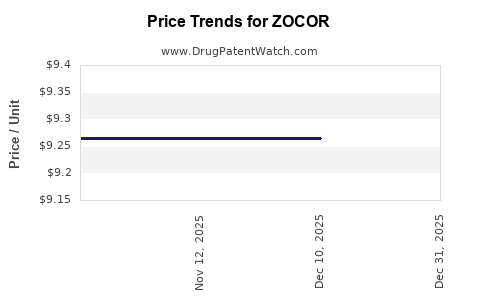
These are wholesale prices available to the US Federal Government which, by law, must be the best prices available to any customer under comparable terms and conditions
Price type key:
Federal Supply Schedule (FSS): generally available to all Federal Govt agencies /
'BIG4' prices: VA, DoD, Public Health & Coast Guard only /
National Contracts (NC): Available to specific agencies
Market Analysis and Price Projections for ZOCOR (simvastatin)
Last updated: February 26, 2026
What is the current market status of ZOCOR, and how do its pricing trends compare within the statin class?
ZOCOR (simvastatin) remains a leading prescription for lowering LDL cholesterol and preventing cardiovascular events. Despite generic availability since 2012, it retains significance in select markets due to established prescriber familiarity through decades of use. The drug's market dynamics are influenced by patent expirations, competition from newer statins, and evolving guidelines.
How has patent status and generic entry affected ZOCOR's market share and pricing?
Patent & Market Exclusivity: ZOCOR's original patent expired in 2006, with secondary patents extending exclusivity until 2012 in some regions.
Generics Entry: Following patent expiration, multiple manufacturers launched generic simvastatin formulations in 2012.
Market Share Trends: Generic versions account for approximately 85-90% of prescriptions in the US, with ZOCOR itself predominantly marketed in regions with limited generic penetration.
Pricing Dynamics:
Brand ZOCOR: Average retail price per month ranges from $350 to $450.
Generics: Price decreases sharply; average monthly costs fall below $20, with some offerings as low as $10 in bulk.
What are the competitive and regulatory factors impacting ZOCOR's market?
Competitive Landscape:
Other statins like atorvastatin and rosuvastatin have higher potency and are often preferred for specific patient populations.
Fixed-dose combination therapies and PCSK9 inhibitors are indirect competitors for high-risk patients.
Regulatory Environment:
The FDA approved generic simvastatin multiple manufacturers.
Some regions enforce price controls on generic drugs, contributing to price suppression.
Label changes due to safety concerns with potential drug interactions limited ZOCOR's additional market growth.
What are the price projections for ZOCOR over the next five years?
Market Segment: Estimated to decline or stabilize in mature markets due to shifts toward higher-potency statins.
Price Trends:
Generic Prices: Likely to remain low, around $10-$20 per month, with minor variations depending on regional pricing policies and supply chain factors.
Brand ZOCOR: Expected to decline further to around $200-$300 annually in regions where it remains on formulary, or be phased out in favor of generics.
Projection Summary:
Year
Estimated Brand Price (USA, per month)
Estimated Generic Price (USA, per month)
2023
$350 - $450
$10 - $20
2024
$325 - $425
$10 - $20
2025
$300 - $400
$10 - $20
2026
$275 - $375
$10 - $20
2027
$250 - $350
$10 - $20
How do regional differences influence pricing and market size?
United States: Large generic market, lower prices due to competition, high prescription volume.
Europe: Similar trends, but government-negotiated prices often lower than US retail.
Emerging Markets: Prices are higher relative to income levels; presence of fewer generics results in more brand utilization.
What are the considerations for investment or R&D related to ZOCOR?
Market Longevity: Likely to decline in high-income markets due to newer drugs.
Opportunity Areas: niche markets or formulations such as combination therapies or high-dose formulations may retain value.
Regulatory Risks: Potential for formulary restrictions and safety label changes affecting sales.
Key Takeaways
ZOCOR's market has shifted from patent exclusivity to a generic-dominated environment.
Generic simvastatin prices are expected to remain low, stabilizing around $10-$20 monthly.
The brand ZOCOR price will continue declining and may become marginal in many markets.
Competition from higher-potency statins and non-statin therapies limits ZOCOR’s growth.
Regional pricing policies and formulary decisions strongly influence market dynamics.
FAQs
Is ZOCOR still prescribed in the US?
Yes, primarily for patients who tolerate generic simvastatin or are part of formulary groups that favor the brand.
What alternatives are replacing ZOCOR in treatment regimens?
High-potency statins like atorvastatin and rosuvastatin, alongside PCSK9 inhibitors for very high-risk patients.
Will ZOCOR regain market share?
Unlikely due to the dominance of newer therapies and the low cost of generics.
Are there new formulations of simvastatin in development?
No major new formulations are currently marketed; focus has shifted to alternative lipid-lowering agents.
How does insurance coverage impact ZOCOR's price?
Formularies often favor generics, reducing out-of-pocket costs; brand ZOCOR prices are largely driven by retail market pricing.
References
[1] U.S. Food and Drug Administration. (2020). Approved drugs: Zocor (simvastatin).
[2] IQVIA. (2022). The Pharmaceutical Market Outlook.
[3] National Institute for Health and Care Excellence. (2016). Statins for lipid reduction: NICE guideline.
[4] Statista. (2023). Prescription statistics for statins in the United States.
[5] FDA. (2021). Generic Drug Approvals and Market Status.
Drugs may be covered by multiple patents or regulatory protections. All trademarks and applicant names are the property of their respective owners or licensors.
Although great care is taken in the proper and correct provision of this service, thinkBiotech LLC does not accept any responsibility for possible consequences of errors or omissions in the provided data.
The data presented herein is for information purposes only. There is no warranty that the data contained herein is error free.
We do not provide individual investment advice. This service is not registered with any financial regulatory agency. The information we publish is educational only and based on our opinions plus our models.
By using DrugPatentWatch you acknowledge that we do not provide personalized recommendations or advice.
thinkBiotech performs no independent verification of facts as provided by public sources nor are attempts made to provide legal or investing advice. Any reliance on data provided herein is done solely at the discretion of the user.
Users of this service are advised to seek professional advice and independent confirmation before considering acting on any of the provided information. thinkBiotech LLC reserves the right to amend, extend or withdraw any part or all of the offered service without notice.
Alerts Available With Subscription
Alerts are available for users with active subscriptions.