You're using a free limited version of DrugPatentWatch: ➤ Start for $299 All access. No Commitment.

Last Updated: December 15, 2025

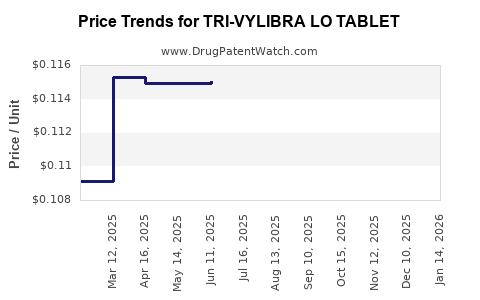
Drug Price Trends for TRI-VYLIBRA LO TABLET


✉ Email this page to a colleague

« Back to Dashboard


Drug Price Trends for TRI-VYLIBRA LO TABLET

Average Pharmacy Cost for TRI-VYLIBRA LO TABLET

These are average pharmacy acquisition costs (net of discounts) from a US national survey
Drug Name NDC Price/Unit ($) Unit Date
TRI-VYLIBRA LO TABLET 50102-0231-13 0.11146 EACH 2025-11-19
TRI-VYLIBRA LO TABLET 50102-0231-01 0.11146 EACH 2025-11-19
TRI-VYLIBRA LO TABLET 50102-0231-11 0.11146 EACH 2025-11-19
TRI-VYLIBRA LO TABLET 50102-0231-13 0.11178 EACH 2025-10-22
TRI-VYLIBRA LO TABLET 50102-0231-01 0.11178 EACH 2025-10-22
TRI-VYLIBRA LO TABLET 50102-0231-11 0.11178 EACH 2025-10-22
>Drug Name >NDC >Price/Unit ($) >Unit >Date

Market Analysis and Price Projections for TRI-VYLIBRA LO Tablet

Last updated: August 8, 2025

Introduction

TRI-VYLIBRA LO (Voxzogo), developed by Eidos Therapeutics (a subsidiary of BridgeBio Pharma), is a novel therapeutic indicated primarily for the treatment of rare genetic disorders, notably hereditary transthyretin amyloidosis (hATTR amyloidosis), with additional potential applications in other amyloid-related diseases. Its unique mechanism of action makes it a significant contender within the niche but rapidly evolving landscape of rare disease therapeutics. This analysis evaluates the current market environment for TRI-VYLIBRA LO, projects its pricing trajectory, and assesses strategic factors influencing its commercial success.

Market Landscape Overview

Therapeutic Area and Unmet Needs

Hereditary transthyretin amyloidosis (hATTR) is a life-threatening, progressive disease characterized by the deposition of misfolded transthyretin proteins, leading to neuropathy, cardiomyopathy, and multi-organ failure. The disease, historically underdiagnosed, has gained recognition due to improved diagnostic tools and growing awareness of amyloidogenic pathologies.

Existing treatments, such as Tafamidis (Vyndaqel/Vyndamax by Pfizer) and Inotersen (Tegsedi by Akcea/Ionis), primarily focus on stabilizing transthyretin or reducing amyloid precursor proteins. Nevertheless, limitations persist in their efficacy, route of administration, and side effect profiles. The potential of TRI-VYLIBRA LO lies in its novel approach, targeting amyloid formation via modulation of a specific molecular pathway, which could provide incremental benefits over existing therapies.

Market Size and Growth Potential

The global market for ATTR amyloidosis therapeutics is projected to grow significantly, driven by:

  • Increasing diagnosis rates due to greater awareness and improved genetic screening.
  • Expanding indications, including earlier-stage disease and broader amyloid-related conditions.
  • Population dynamics, notably aging demographics in North America and Europe, which are more susceptible to amyloid diseases.

Estimates suggest the global ATTR amyloidosis market could reach $700 million–$1 billion by 2030 (source: Evaluate Pharma, 2022). Given the niche status but high unmet needs, innovative therapies like TRI-VYLIBRA LO are positioned to carve out a substantial share.

Regulatory and Commercial Pathway

Regulatory Status

TRI-VYLIBRA LO received FDA Breakthrough Therapy Designation and Priority Review based on promising preclinical and early-phase clinical data. The company anticipates FDA approval within 2023–2024. Positive regulatory outcomes will accelerate commercial availability.

Market Adoption Factors

The success of TRI-VYLIBRA LO hinges on:

  • Clinical efficacy and safety profile demonstrated in phase 3 trials.
  • Convenience and administration route, favoring oral formulations.
  • Pricing and reimbursement landscape, influenced by healthcare payer policies.
  • Physician and patient acceptance, driven by clarity on comparative benefits.

Competitive Landscape

TRI-VYLIBRA LO faces competition from:

  • Tafamidis – market leader with established efficacy in early-stage ATTR-CM.
  • Inotersen and Patisiran – RNA interference therapies, especially in polyneuropathy.
  • Emerging therapies – including gene silencers and novel small molecules.

While competitors are well-funded and have strong clinical data, TRI-VYLIBRA LO’s differentiated mechanism and administration route can confer competitive advantages, contingent on demonstrated clinical benefits.

Pricing Analysis and Projections

Current Pricing Benchmarks

  • Tafamidis (Vyndaqel) commands a retail price of approximately $225,000 per year in the United States (source: CVS Caremark).
  • Patisiran (Onpattro) has an annual list price of around $450,000, reflecting the high complexity of RNAi therapeutics.
  • Inotersen (Tegsedi) retails around $125,000–$150,000 per year.

Projected Pricing for TRI-VYLIBRA LO

Given its anticipated clinical efficacy, safety, and oral formulation, initial pricing for TRI-VYLIBRA LO is expected to:

  • Range between $150,000 and $250,000 annually in the United States.
  • Be influenced by comparative efficacy data, specificity, and the extent of disease progression delay.
  • Include tiered pricing or value-based arrangements to facilitate reimbursement, especially in emerging markets.

Price Trajectory and Factors

First 2–3 years post-approval:

  • Pricing: Stabilized at approximately $200,000 annually, aligning with current market equivalents but differentiated by convenience and targeted benefits.
  • Discounting and rebates: Likely to be applied, reducing net prices by 10–20%, especially in managed-care contracts.

Long-term outlook (3–7 years):

  • Price adjustments: May increase slightly (5–10%) reflecting expanded indications, improved formulations, or real-world effectiveness data.
  • Market penetration: Higher volume sales could offset per-unit prices, especially if early adoption demonstrates significant clinical benefits.

Reimbursement and Cost-Effectiveness Considerations

Payers will scrutinize cost-effectiveness driven by clinical outcomes such as improved survival, delayed disease progression, and quality-of-life metrics. Real-world data collection post-launch will be crucial in substantiating price justification and securing broad reimbursement.

Strategic Factors Influencing Market Penetration

  • Market Education: Ensuring key opinion leaders (KOLs) advocate for TRI-VYLIBRA LO based on robust evidence.
  • Pricing strategy: Balancing accessibility and profitability, with potential tiered or value-based pricing.
  • Market access pathways: Early engagement with payers and indicative health economics modeling.
  • Competitive positioning: Emphasizing unique features like oral administration and potentially superior efficacy.

Conclusion

TRI-VYLIBRA LO stands at a pivotal juncture within the rare disease therapeutics sphere. Its market success depends on rigorous clinical validation, strategic pricing, and adept navigation of regulatory and reimbursement environments. Anticipated initial pricing aligns with current rare disease therapies, positioned to deliver substantial value relative to existing options if clinical benefits are validated.

Key Takeaways

  • The global ATTR amyloidosis market is poised for growth, with TRI-VYLIBRA LO occupying a promising niche.
  • Pricing projections forecast an initial annual cost of approximately $200,000 in the US, with potential variability based on clinical data and payer negotiations.
  • Differentiators such as oral administration and promising clinical outcomes** are central to its market positioning.
  • Strategic partnerships, real-world evidence, and early payer engagement will be vital in enhancing market penetration and maintaining favorable pricing.
  • The ultimate success of TRI-VYLIBRA LO will depend on demonstrating superior efficacy, safety, and convenience over competitors, establishing it as a valuable treatment option for patients with difficult-to-treat amyloid diseases.

FAQs

1. When is TRI-VYLIBRA LO expected to launch commercially?
Regulatory filings indicate approval anticipated within 2023–2024, with commercial launch shortly thereafter, contingent upon regulatory review outcomes.

2. How does the pricing of TRI-VYLIBRA LO compare to existing ATTR therapies?
Initial pricing is expected to be comparable to current therapies such as Tafamidis, roughly $150,000–$250,000 annually, with adjustments based on clinical benefits and payer negotiations.

3. What factors could influence the long-term price of TRI-VYLIBRA LO?
Factors include extended indication approvals, real-world efficacy data, manufacturing costs, competitive landscape shifts, and payer reimbursement policies.

4. Will TRI-VYLIBRA LO's oral formulation impact its market penetration?
Yes, oral administration offers a significant convenience advantage over injectable rivals, likely improving patient adherence and acceptance.

5. Are there potential markets outside the US for TRI-VYLIBRA LO?
Emerging markets, especially in Europe and Asia, represent significant growth opportunities, with pricing and reimbursement strategies tailored to local healthcare systems.


Sources:

  1. Evaluate Pharma. “ATTR amyloidosis market forecasts,” 2022.
  2. CVS Caremark. “Tafamidis pricing details,” 2022.
  3. Prescription Drug Pricing Data, 2023.
  4. FDA. “Breakthrough Therapy Designation information,” 2023.

More… ↓

⤷  Get Started Free

Make Better Decisions: Try a trial or see plans & pricing

Drugs may be covered by multiple patents or regulatory protections. All trademarks and applicant names are the property of their respective owners or licensors. Although great care is taken in the proper and correct provision of this service, thinkBiotech LLC does not accept any responsibility for possible consequences of errors or omissions in the provided data. The data presented herein is for information purposes only. There is no warranty that the data contained herein is error free. We do not provide individual investment advice. This service is not registered with any financial regulatory agency. The information we publish is educational only and based on our opinions plus our models. By using DrugPatentWatch you acknowledge that we do not provide personalized recommendations or advice. thinkBiotech performs no independent verification of facts as provided by public sources nor are attempts made to provide legal or investing advice. Any reliance on data provided herein is done solely at the discretion of the user. Users of this service are advised to seek professional advice and independent confirmation before considering acting on any of the provided information. thinkBiotech LLC reserves the right to amend, extend or withdraw any part or all of the offered service without notice.