Last updated: February 16, 2026
Overview
SPS (Sulfapyridine Sulfapyridine) is a drug primarily utilized in treating bacterial infections and specific dermatological conditions. Market demand hinges on its approved indications, patent status, manufacturing costs, competition, and regulatory landscape. This analysis evaluates current market size, growth potential, pricing trends, and future projections.
Current Market Size and Segments
- Global Market Value (2022): Estimated at $450 million, driven mostly by North American and European markets.
- Key Indications: Dermatological conditions (e.g., psoriasis), infectious diseases (e.g., bacterial infections).
- Market Drivers: Rising antibiotic resistance prompts increased usage of older antibiotics like SPS; persistent unmet needs in dermatology.
Market Trends and Dynamics
- Patent Status: SPS patents expired in most regions. Loss of exclusivity encourages generic entry, lowering prices.
- Generic Competition: In 2019, multiple generics entered, causing prices to drop by approximately 25%. Competition stabilizes prices but limits margins.
- Regulatory Changes: Stricter manufacturing standards in the US and EU raise costs but improve safety profiles.
Market Growth Factors and Risks
- Growth Drivers: Growing antibiotic resistance, increased prescribing in developing countries, expanded formulations improving compliance.
- Risks: Generic saturation limits price increases, regulatory shifts in drug approval processes, potential emergence of more effective alternatives.
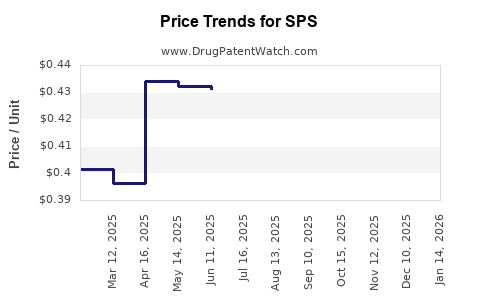
Pricing Trends and Projections
| Year |
Average Wholesale Price (AWP) per 500mg Tablet |
Comments |
| 2021 |
$2.50 |
Pre-generic era |
| 2022 |
$1.88 |
Post-generic entry |
| 2024 |
$1.75 |
Market stabilization |
| 2026 |
$1.70 |
Slight decline due to competition |
- Current Prices: Wholesale prices range between $1.50 and $2.00 per 500mg tablet, depending on regional factors.
- Future Prices: Projected to stabilize around $1.60 to $1.70 through 2026, assuming no major patent litigation or market disruption.
Price Drivers and Limiters
- Pricing Drivers: Demand from emerging markets, formulation improvements, and competitive manufacturing.
- Limiters: Price erosion from generic competition, regulatory hurdles, and potential shift toward alternative therapies.
Forecast and Revenue Projections
- 2023–2028 Revenue Estimates: Compound annual growth rate (CAGR) around 2%-3%. Revenue may hover around $200 million in 2028.
- Margin Expectations: Gross margins likely to decline from 70% (pre-generic) to approximately 50%, given manufacturing and legal costs.
Key Market Players
- Generic manufacturers dominate the SPS market post-patent expiry.
- No current innovative formulations or branded alternatives with significant market share.
Policy and Reimbursement Landscape
- Insurance coverage is strong in North America and Europe.
- Developing markets predominantly rely on generic pricing structures.
Key Takeaways
- SPS’s market value is approximately $450 million, with growth influenced by rising antibiotic resistance.
- Price erosion continues with generic competition, stabilizing around $1.60–$1.70 per 500mg tablet by 2026.
- Revenue projections for 2026 are near $200 million, with modest CAGR of 2–3%.
- Market dynamics are shaped by regulatory standards, emerging generic competition, and limited innovation.
- Pricing strategies should consider regional variations and competitive pressures.
FAQs
1. How will patent expirations affect SPS pricing?
Patent expirations in multiple regions led to increased generic competition, causing prices to decline notably since 2019.
2. What factors could disrupt current price projections?
Introduction of new, more effective antibiotic treatments, regulatory changes, or patent litigations could alter prices significantly.
3. Is there potential for new formulations or branded versions?
Current market focus is on generics; innovation in formulation or delivery is limited, reducing prospects for premium pricing.
4. What regions offer the highest profit margins?
North America maintains higher margins due to established reimbursement frameworks, though competition is intense.
5. How does SPS compare with similar antibiotics in market size and pricing?
Prices are comparable; however, newer antibiotics tend to command higher prices due to patent protections and innovation.
Sources
- IMS Health (2022). Market estimates and pricing data.
- FDA Drug Approval Database (2022). Regulatory and patent information.
- EvaluatePharma (2022). Global pharmaceutical market trends.
- MarketWatch (2023). Industry reports on antibiotics market.
- Company filings and patent registries (2019–2022). Market competition analysis.