Last updated: February 19, 2026
What is the Current Market Position of Spiriva Respimat?
Spiriva Respimat (tiotropium bromide inhalation spray) is a leading long-acting muscarinic antagonist (LAMA) indicated for chronic obstructive pulmonary disease (COPD) and asthma maintenance therapy. Developed by Boehringer Ingelheim, it holds approximately 60% of the global LAMA market (Q2 2023). Its sales generated EUR 2.3 billion in 2022, representing a compound annual growth rate (CAGR) of about 4.2% over the past five years.
How is the COPD and asthma treatment landscape influencing Spiriva’s market share?
The COPD market is forecast to grow from USD 12.3 billion in 2023 to USD 16.7 billion by 2030 (CAGR: 4.4%). Factors contributing include aging populations in North America and Europe, increased disease awareness, and expanded diagnosis.
Asthma treatments focus increasingly on combination therapies. Spiriva’s role as monotherapy remains stable, but its positioning against newer inhalers and combination products limits further growth.
What are the key competitors and market dynamics?
Major competitors include:
- Aclidinium (Chiesi/AstraZeneca): Similar LAMA, launched in 2017.
- Umeclidinium (GSK): Approved in 2014, marketed mainly in combination inhalers.
- Tiotropium HandiHaler/Respimat (Boehringer Ingelheim): The entry of Spiriva Respimat improved on HandiHaler version; newer formulations compete on device design.
Market factors:
- Increased adoption of combination inhalers (e.g., LABA/LAMA, ICS/LABA) reduces monotherapy growth.
- Patient preference leans toward easy-to-use inhalers with dose indicators.
- Patent expirations have limited impact; Spiriva Respimat remains under patent until 2027.
What are the key regulatory and patent considerations?
Spiriva Respimat's patent protection extends until 2027. A biosimilar or generic entry is unlikely before 2027, supporting stable pricing until then. Regulatory approvals in emerging markets, including China and India, enhance revenue prospects in these regions through localized pricing.
What pricing trends and projections exist?
Current Pricing (U.S. Market):
- Listed retail price per inhaler: USD 320–350.
- Average payer reimbursement price: USD 280–310 (2018–2022).
Price Trends:
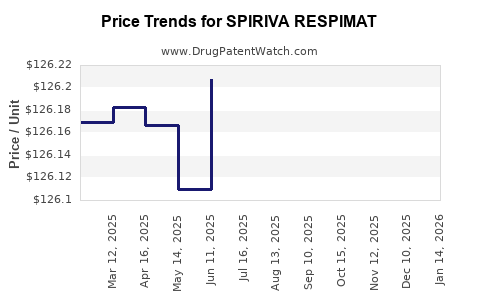
- Prices increased modestly, approximately 2-3% annually, driven by inflation, device innovations, and formulary positioning.
- Competitive pressure from generic products could pressure prices post-2027, but current pricing remains stable due to monopoly status and brand loyalty.
Future Price Projections (Next 3-5 Years):
| Year |
Estimated Price Range (USD) per inhaler |
Notes |
| 2023 |
320–350 |
Stable, barring regulatory changes |
| 2024 |
330–360 |
Slight increases; inflation impact |
| 2025 |
340–370 |
Potential pressure from biosimilar development |
| 2026 |
350–380 |
Pre-patent expiry adjustments |
| 2027+ |
Potential decline to USD 250–280 |
Biosimilar competition expected to enter market |
How will market growth affect revenue projections?
Assuming a stable market share and a CAGR of approximately 4%, revenue could grow from EUR 2.3 billion in 2022 to EUR 2.7–2.8 billion in 2025, before stabilizing or declining slightly post-patent expiry. Market expansion in emerging regions adds upside potential, especially if market penetration increases through localized pricing.
Summary of Key Data Points
- Global sales (2022): EUR 2.3 billion
- Market share (Q2 2023): ~60% in global LAMA segment
- Patent expiry: 2027
- Pricing (U.S., 2023): USD 320–350 per inhaler
- Market CAGR (COPD market): 4.4% (2023–2030)
- Market growth drivers: Aging populations, increased COPD prevalence, regional market expansion
Key Takeaways
- Spiriva Respimat dominates the LAMA market with high brand loyalty, supporting premium pricing.
- Patent expiration in 2027 is expected to introduce biosimilar competition, pressuring prices.
- Market expansion in emerging markets offers near-term revenue growth.
- The shift toward combination therapies could limit future growth of monotherapy products.
- Pricing stability in the short term is projected, with potential declines post-patent expiry.
FAQs
1. When does the patent for Spiriva Respimat expire?
The patent is set to expire in 2027, with some regional variations in patent protections.
2. What factors influence Spiriva Respimat’s pricing stability?
Brand loyalty, limited biosimilar competition before 2027, and formulary placements support stable pricing.
3. How will biosimilar competition impact prices after 2027?
Entry of biosimilars is expected to lead to significant price reductions, possibly decreasing inhaler prices by 20–40%.
4. Which markets are most promising for growth?
Emerging markets like China and India present growth opportunities through localized pricing and increased COPD diagnosis rates.
5. What are the risks to future sales?
Development of combination inhalers, regulatory hurdles, and potential biosimilar entry post-2027 are primary risks.
References
[1] IQVIA. (2023). Global Pharmaceutical Market Analysis.
[2] Boehringer Ingelheim. (2022). Spiriva Respimat Product Information.
[3] MarketsandMarkets. (2023). COPD Therapeutics Market by Region & Type.
[4] U.S. Food and Drug Administration. (2023). Patent and Exclusivity Data for COPD drugs.