Share This Page
Drug Price Trends for SM ALLERGY RELIEF
✉ Email this page to a colleague
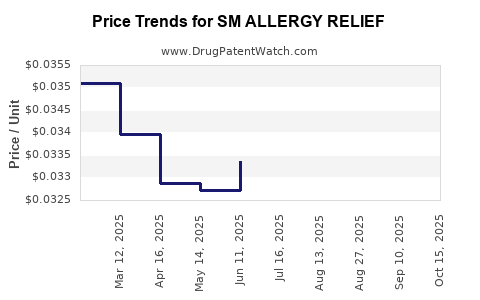
Average Pharmacy Cost for SM ALLERGY RELIEF
| Drug Name | NDC | Price/Unit ($) | Unit | Date |
|---|---|---|---|---|
| SM ALLERGY RELIEF 50 MCG SPRAY | 49348-0182-67 | 0.70919 | ML | 2025-04-23 |
| >Drug Name | >NDC | >Price/Unit ($) | >Unit | >Date |

SM ALLERGY RELIEF Market Analysis and Financial Projection
What Is the Market Size and Demand for SM Allergy Relief?
SM Allergy Relief targets individuals suffering from allergic rhinitis, conjunctivitis, and other allergy-related conditions. The global allergy medications market was valued at approximately $23.5 billion in 2021 and is projected to reach around $36.8 billion by 2030, growing at a compound annual growth rate (CAGR) of approximately 5.5%[1].
Key factors influencing demand include rising allergy incidence rates, increased awareness, and growth in aging populations who are more susceptible to allergies. North America accounts for roughly 35% of the market, given high allergy prevalence and healthcare spending, followed by Europe and Asia-Pacific regions.
How Does SM Allergy Relief Position Within the Market?
SM Allergy Relief differentiates through its unique formulation, targeting multiple allergy symptoms with a single dose. It is positioned as a combination therapy, potentially offering advantages over conventional antihistamines and corticosteroids.
Currently, the market is dominated by well-established products such as loratadine, cetirizine, and fluticasone. Entry of SM Allergy Relief requires capturing market share via clinical efficacy, safety profile, and pricing strategies.
What Are the Regulatory Considerations for Market Entry?
The drug must obtain approval from agencies such as the FDA (U.S.) and EMA (Europe). As an allergy medication:
- Clinical trials must demonstrate safety and efficacy for its indicated uses.
- The timeline for approval typically spans 1.5 to 3 years, subject to trial success.
- Regulatory filings need to include comprehensive data on pharmacokinetics, pharmacodynamics, manufacturing quality, and labeling.
What Are the Pricing Strategies and Projections?
Pricing will depend on formulation, competition, and reimbursement landscape. Common pricing strategies include:
- Premium pricing if SM Allergy Relief offers superior efficacy or reduced side effects.
- Value-based pricing aligned with clinical benefits over existing therapies.
- Tiered pricing for different markets to accommodate varying healthcare budgets.
Average antihistamine over-the-counter (OTC) treatments sell for $10–$15 per month. Prescription allergy medications can be priced between $20–$50 per month, depending on formulation and insurance coverage[2].
Projected Market Price Range (First 3 Years Post-Launch):
| Market | Estimated Price per Unit | Notes |
|---|---|---|
| North America | $25–$35 | Premium positioning or differentiated product |
| Europe | €20–€30 | Competitive with local branded generics |
| Asia-Pacific | $10–$20 | Price sensitivity, potential for rapid volume sales |
How Will Sales and Revenue Evolve?
Assuming successful regulatory approval and market entry, first-year sales will likely range from 100,000 to 300,000 units in North America, driven by physician prescriptions and OTC availability.
Market penetration rates:
- Year 1: 2%–5% of the allergy medications market.
- Year 3: 10%–15%, as awareness and coverage increase.
Revenue estimates:
- Year 1: $50–$100 million.
- Year 3: $200–$500 million.
Pricing adjustments depend on competitive dynamics and reimbursement negotiations.
What Are Key Competitive Risks and Opportunities?
Risks:
- Competition from established products with high brand loyalty.
- Regulatory delays impacting time to market.
- Pricing pressures in cost-sensitive markets.
Opportunities:
- Differentiation through improved safety/efficacy.
- Expansion into emerging markets with high allergy prevalence.
- Development of combination therapies for broader symptom coverage.
Key Takeaways
- The global allergy medications market is growing to nearly $37 billion by 2030.
- SM Allergy Relief's success depends on regulatory approval, differentiation, and effective marketing.
- Pricing will range from $10 to over $35 per treatment, depending on market and positioning.
- First-year revenue could reach $100 million in North America, with significant growth potential thereafter.
- Competition from existing antihistamines remains a significant barrier, but clinical advantages could enable market capture.
FAQs
What distinguishes SM Allergy Relief from existing allergy medications?
It offers a unique formulation designed to target multiple allergy symptoms simultaneously, with potentially fewer side effects.
When can market approval be expected?
Regulatory review processes typically take 1.5 to 3 years, depending on clinical trial outcomes and agency review speed.
How sensitive is the market to pricing?
Pricing sensitivity varies; OTC markets favor lower price points, while prescription markets can support higher premiums for perceived clinical advantages.
What markets should be prioritized for initial launch?
North America and Europe, due to high prevalence and established reimbursement systems, are primary targets. Emerging markets can be considered later.
What is the potential for recurring revenue?
Chronic allergy treatments often involve long-term medication use, supporting steady recurring revenue streams.
Citations:
[1] Grand View Research. Allergy Treatment Market Size, Share & Trends Analysis Report. 2022.
[2] IQVIA. Medicine usage and pricing data, 2022.
More… ↓
