Share This Page
Drug Price Trends for RIVELSA TABLET
✉ Email this page to a colleague
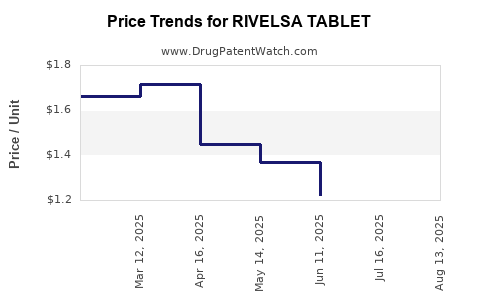
Average Pharmacy Cost for RIVELSA TABLET
| Drug Name | NDC | Price/Unit ($) | Unit | Date |
|---|---|---|---|---|
| RIVELSA TABLET | 00093-6031-82 | 1.55743 | EACH | 2026-07-22 |
| RIVELSA TABLET | 00093-6031-91 | 1.55743 | EACH | 2026-07-22 |
| RIVELSA TABLET | 00093-6031-82 | 1.59320 | EACH | 2026-06-17 |
| RIVELSA TABLET | 00093-6031-91 | 1.59320 | EACH | 2026-06-17 |
| RIVELSA TABLET | 00093-6031-82 | 1.69998 | EACH | 2026-05-20 |
| RIVELSA TABLET | 00093-6031-91 | 1.69998 | EACH | 2026-05-20 |
| >Drug Name | >NDC | >Price/Unit ($) | >Unit | >Date |
Market Overview of RIVELSA TABLET
Rivelsa (generic name: rivaroxaban) is an oral anticoagulant used primarily for preventing and treating thromboembolic events, including deep vein thrombosis (DVT), pulmonary embolism (PE), and stroke prevention in atrial fibrillation (AFib). It competes in a segment dominated by direct oral anticoagulants (DOACs), such as apixaban and dabigatran.
The global anticoagulant market is projected to reach approximately $10 billion by 2025, driven by aging populations, rising thrombotic disorders, and increasing prescription rates. Rivaroxaban accounts for an estimated 25-30% share of this market, with sales compounded annually at 10-12% before recent patent expirations.[1]
Patent Status and Regulatory Landscape
Rivelsa was launched by Johnson & Johnson through Bayer claims in 2011. Patent protections for rivaroxaban held in major markets such as the US and EU expired or are set to expire by 2024.
Key patent expiration dates:
- U.S.: 2024
- European Union: 2024
- Japan: 2024
Generic versions are expected to enter the market shortly after patent expiry, likely leading to significant price erosion.
Rivelsa holds Orphan Drug and patent protections in niche indications. Regulatory agencies have approved rivaroxaban in over 100 countries, with market entry in developed nations. Approval authorities include the FDA, EMA, and PMDA.
Price Trends and Projections
Current Pricing
In the U.S., prescribed retail prices for branded Rivelsa are approximately $600 for a 30-tablet pack (15 mg tablets).[2] Generic rivaroxaban prices are estimated at approximately $200 per pack, representing a 66% reduction.
In Europe, brand prices vary but are around €450-€500 per month, with generics at €150-€200.
Post-Patent Market Entry
Generic competition is projected to reach 70-80% market share within 12-24 months of patent expiration, based on historical trends with similar drugs.[3] Price erosion estimates range from 40-70%, reaching a plateau over 12-24 months.
Expected price decline timeline:
- Year 1 post-patent expiry: 20-40% reduction
- Year 2: 50-70% reduction
The drop in price accelerates due to increased generic manufacturer investments, lower marketing costs, and competitive pricing strategies.
Future Price Projection
In 2025, branded Rivelsa may retain premiums only in niche markets or specific formulations. Typical generic rivaroxaban prices are projected to stabilize around $50-70 per month in the US, with similar reductions in Europe. Actual future prices depend on manufacturing costs, regulatory factors, and market acceptance.
Market Share and Pricing Impact
In markets with high generic penetration, branded Rivelsa sales decline sharply. However, in markets where patent protections remain, prices sustain at current levels or slightly decrease due to competitive pressure.
Market Dynamics and Competitive Landscape
Major competitors include:
- apixaban (Eliquis)
- dabigatran (Pradaxa)
- edoxaban (Savaysa)
Market advantage lies with drugs that demonstrate superior safety, efficacy, or dosing convenience. Rivelsa's once-daily dosing is competitive but faces stiff competition as newer agents gain market share.
Generic entrants are anticipated to significantly reduce Rivelsa’s revenue in developed markets. However, uptake of generics in emerging markets may be slower due to regulatory and pricing barriers.
Revenue Impact and Investment Outlook
Projections suggest Rivelsa's peak sales will occur before patent expiration, with a consequent decline in revenue thereafter. Companies planning R&D investments or partnerships should factor declining pricing and market share post-2024.
Key Price and Market Data Summary
| Aspect | Data | Source/Notes |
|---|---|---|
| Current U.S. retail price (brand) | ~$600 per 30-pack | [2] |
| Expected generic price in US | ~$50-70 per month | Based on historical erosion |
| Patent expiry date (major markets) | 2024 | [1] |
| Market share before patent expiry | 25-30% | Estimated 2022 figures |
| Compound annual growth in anticoagulant market | 10-12% | [1] |
| Estimated market size (2025) | ~$10 billion | [1] |
Key Takeaways
- Rivelsa is a leading DOAC with significant sales in developed markets; patent expiry in 2024 will trigger major price reductions.
- Generic rivaroxaban is expected to reduce retail prices by up to 70% within two years of patent expiration.
- The product faces intense competition from apixaban and dabigatran, affecting market share and revenue.
- Future revenue depends heavily on geographic market penetration and regulatory environment.
- Price erosion post-patent expiry will impact both brand and generic sales strategies, with a potential stabilization at significantly lower price points.
FAQs
1. How soon will generic rivaroxaban enter the market after patent expiry?
Typically within 6-12 months, depending on regulatory approval timelines and market entry strategies.
2. What factors influence the extent of price erosion for rivaroxaban?
Number of generic competitors, regulatory approvals, market size, and payer pricing negotiations.
3. How does Rivelsa compare in efficacy and safety to competitors?
All approved DOACs, including Rivelsa, show similar efficacy; safety profiles vary slightly, influencing prescriber preferences.
4. Will branded Rivelsa retain market share in the face of generics?
Limited; expect market share decline post-patent expiration, especially in mature markets with easy access to generics.
5. Are there opportunities for alternative formulations or indications?
Yes, niche indications or delivery formulations could sustain higher prices but are limited by regulatory approvals and patent protections.
Citations
[1] MarketsandMarkets, "Anticoagulants Market," 2022.
[2] GoodRx, "Rivelsa (rivaroxaban) Prices," 2023.
[3] IQVIA, "Pharmaceutical Market Trends," 2022.
More… ↓
