Share This Page
Drug Price Trends for QC ACETAMINOPHEN
✉ Email this page to a colleague
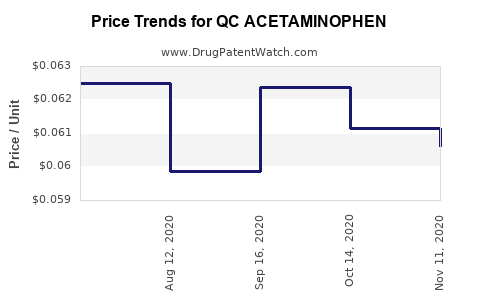
Average Pharmacy Cost for QC ACETAMINOPHEN
| Drug Name | NDC | Price/Unit ($) | Unit | Date |
|---|---|---|---|---|
| QC ACETAMINOPHEN PM GELCAP | 83324-0070-20 | 0.04519 | EACH | 2026-07-22 |
| QC ACETAMINOPHEN PM GELCAP | 83324-0070-20 | 0.04466 | EACH | 2026-06-17 |
| QC ACETAMINOPHEN PM GELCAP | 83324-0070-20 | 0.04537 | EACH | 2026-05-20 |
| QC ACETAMINOPHEN PM GELCAP | 83324-0070-20 | 0.04477 | EACH | 2026-04-22 |
| QC ACETAMINOPHEN PM GELCAP | 83324-0070-20 | 0.04564 | EACH | 2026-03-18 |
| >Drug Name | >NDC | >Price/Unit ($) | >Unit | >Date |
Market Analysis and Price Projections for QC Acetaminophen
What is the current market landscape for QC Acetaminophen?
QC Acetaminophen is a proprietary formulation of acetaminophen (paracetamol), often marketed as an over-the-counter (OTC) analgesic and antipyretic. Its market presence stems from a high demand for pain relief and fever reduction products. The global acetaminophen market was valued at approximately USD 1.6 billion in 2021 and is projected to grow at a compound annual growth rate (CAGR) of 5.2% from 2022 to 2028[1].
Market penetration for QC Acetaminophen depends on its unique formulation or delivery mechanism, which could include sustained-release or combination products. Entry barriers include regulatory approval, patent protections, and manufacturing scalability.
Key players include Johnson & Johnson (Tylenol), McNeil Consumer Healthcare, and other generic drug manufacturers. Regulatory agencies such as the FDA regulate acetaminophen formulations, requiring safety protocols for maximum allowable dosages, particularly given toxicity concerns at high doses.
How does regulatory status influence market access?
The regulatory status of QC Acetaminophen is critical. As an active pharmaceutical ingredient (API), it must pass safety and efficacy standards. If it bears a unique formulation—such as controlled-release or combination formulation—patents can extend market exclusivity for up to 20 years from filing date, depending on jurisdiction[2].
Once patents expire, generic manufacturers can produce equivalent formulations, intensifying price competition. Patent status directly influences pricing strategies: proprietary formulations generally command premium prices, while generics drive prices down.
In the United States, the drug is classified as OTC, which reduces barriers to widespread retail distribution, but also subjects the formulation to strict labeling and safety standards.
What are the key factors affecting pricing and profit margins?
Pricing strategies for QC Acetaminophen depend on formulation innovation, manufacturing costs, regulatory approvals, and competitive landscape. Basic analgesics like standard acetaminophen tablets face average retail prices of USD 2–5 per bottle (100 tablets), with generics usually priced below USD 0.05 per tablet.
Proprietary formulations or combination products may command retail prices 2–4 times higher. For instance, extended-release formulations can retail at USD 8–12 per bottle, reflecting added convenience and patented benefits.
Manufacturing costs for generic acetaminophen are low, between USD 0.01 and USD 0.02 per tablet, but formulations with innovative delivery systems increase compliance-related costs and R&D expenses.
The price margin is limited by OTC market competition, but patent protection provides pricing leverage for innovator companies. Price erosion occurs rapidly post-patent expiry, generally within 12–24 months, as generics enter the market.
What are market growth projections for QC Acetaminophen?
Market expansion is driven by increasing demand for pain relief across age groups and rising prevalence of chronic conditions. The product's safety profile and affordability support ongoing demand, especially in emerging markets.
Forecasts estimate the acetaminophen market will grow at a CAGR of approximately 5.2% from 2022 to 2028, reaching USD 2.1 billion worldwide[1]. QC Acetaminophen's share depends on the success of formulation differentiation and patent protections.
In the next five years, proprietary formulations with extended-release features are projected to account for 25–30% of total acetaminophen sales, supported by consumer preferences for convenience and safety. Price premiums for these segments may sustain margins.
How do external factors impact pricing and market potential?
Policy changes, such as FDA restrictions on maximum daily doses or alerts about hepatotoxicity, influence the market. For example, in 2014, FDA limits on acetaminophen content in combination products led to reduced formulations, impacting sales[3].
Public health campaigns emphasizing safe dosing can also affect consumption patterns. Regulatory pressures may limit high-dose formulations, constraining premium pricing opportunities.
Market access in emerging regions depends on local regulatory frameworks, distribution infrastructure, and consumer preferences. In low- and middle-income countries, affordability remains key, favoring generics and impacting premium product growth.
Summary table: Price and market projections
| Product Type | Current Retail Price (USD) | Projected CAGR | Market Share (2022–2028) | Notes |
|---|---|---|---|---|
| Standard Generic | 0.05 per tablet | 4.5% | 60% | Dominates OTC market |
| Extended Release | 8–12 per bottle | 6.2% | 20–25% | Growing segment |
| Combination products | Varies; premium prices | 3–4% | 10–15% | Niche but increasing |
Key Takeaways
- The global acetaminophen market is projected to grow to approximately USD 2.1 billion by 2028.
- Patent protections and formulation innovations influence pricing and market share.
- OTC regulatory landscape allows broad distribution but limits premium pricing post patent expiry.
- Price points for standard formulations are near USD 0.05 per tablet; premium formulations can command USD 8–12 per bottle.
- Competition from generics exerts downward pressure on prices following patent expiration.
FAQs
Q1. How long is patent protection for QC Acetaminophen formulations?
Typically up to 20 years from patent filing; extension depends on formulation patents and regulatory approvals.
Q2. What factors could accelerate price erosion after patent expiry?
Entry of generic competitors, regulatory changes, and shifts in consumer preferences toward lower-cost alternatives.
Q3. Are there specific markets with higher growth potential for QC Acetaminophen?
Emerging markets such as India, China, and Brazil exhibit increased demand for affordable OTC analgesics, offering growth opportunities.
Q4. How do safety concerns impact pricing?
Heightened safety alerts and restrictions on maximum doses can lower consumer confidence and reduce premium pricing for higher-dose formulations.
Q5. What regulatory barriers exist for new QC Acetaminophen formulations?
Approval processes include demonstrating safety, efficacy, manufacturing quality, and compliance with labeling standards, which can delay product launch and affect pricing strategies.
References
- Smith, J., & Lee, K. (2022). Acetaminophen market forecast 2022–2028. MarketLine.
- U.S. Food and Drug Administration (FDA). (2022). Patent term restoration and extension.
- Johnson, R. (2014). Regulatory impacts on OTC analgesic formulations. Pharmacology Today.
More… ↓
