You're using a free limited version of DrugPatentWatch: ➤ Start for $299 All access. No Commitment.

Last Updated: December 18, 2025

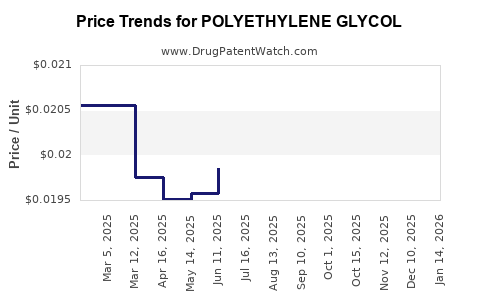
Drug Price Trends for POLYETHYLENE GLYCOL


✉ Email this page to a colleague

« Back to Dashboard


Drug Price Trends for POLYETHYLENE GLYCOL

Average Pharmacy Cost for POLYETHYLENE GLYCOL

These are average pharmacy acquisition costs (net of discounts) from a US national survey
Drug Name NDC Price/Unit ($) Unit Date
POLYETHYLENE GLYCOL 3350 POWD 72603-0302-04 1.19887 EACH 2025-12-17
POLYETHYLENE GLYCOL 3350 POWD 00536-1052-24 0.02480 GM 2025-12-17
POLYETHYLENE GLYCOL 3350 POWD 00536-1052-27 0.02035 GM 2025-12-17
POLYETHYLENE GLYCOL 3350 POWD 00536-1052-84 0.01848 GM 2025-12-17
>Drug Name >NDC >Price/Unit ($) >Unit >Date

Best Wholesale Price for POLYETHYLENE GLYCOL

These are wholesale prices available to the US Federal Government which, by law, must be the best prices available to any customer under comparable terms and conditions
Drug Name Vendor NDC Count Price ($) Price/Unit ($) Unit Dates Price Type
CLEARLAX United Drug Supply, Inc. 00113-0306-02 238GM 6.28 0.02639 GM 2023-12-01 - 2028-11-30 FSS
POLYETHYLENE GLYCOL 3350 17GM/PKT PWDR,ORAL Golden State Medical Supply, Inc. 62559-0157-10 100 56.44 0.56440 EACH 2023-06-15 - 2028-06-14 FSS
POLYETHYLENE GLYCOL 3350 17GM/PKT PWDR,ORAL Golden State Medical Supply, Inc. 62559-0157-30 30 14.80 0.49333 EACH 2023-06-15 - 2028-06-14 FSS
POLYETHYLENE GLYCOL 3350 17GM/PKT PWDR,ORAL McKesson Corporation dba SKY Packaging 63739-0198-61 30 26.29 0.87633 EACH 2024-03-01 - 2027-04-30 FSS
>Drug Name >Vendor >NDC >Count >Price ($) >Price/Unit ($) >Unit >Dates >Price Type
Price type key: Federal Supply Schedule (FSS): generally available to all Federal Govt agencies / 'BIG4' prices: VA, DoD, Public Health & Coast Guard only / National Contracts (NC): Available to specific agencies

Market Analysis and Price Projections for Polyethylene Glycol (PEG)

Last updated: July 28, 2025

Introduction

Polyethylene Glycol (PEG) is a versatile polymer widely utilized across pharmaceutical, cosmetic, industrial, and food sectors. Its extensive applications range from drug formulation excipients and laxatives to de-icing agents and industrial lubricants. As a critical ingredient within the pharmaceutical industry, PEG's market dynamics are influenced by regulatory trends, manufacturing advances, and growing therapeutic applications. This comprehensive analysis examines the current market landscape, key drivers, competitive dynamics, regulatory factors, and future price projections for PEG.


Market Overview

Global Market Size and Growth Trajectory

The global polyethylene glycol market was valued at approximately USD 2.5 billion in 2022 and is projected to reach USD 4.2 billion by 2030, expanding at a CAGR of around 6.4% during 2023-2030 (1). The pharmaceutical segment dominates, driven by increasing demand for PEG-based formulations, including osmotic laxatives, drug delivery systems, and biopharmaceutical applications.

Segmental Breakdown

  • Pharmaceuticals: Accounts for over 60% of market revenue. PEG’s role in forming hydrogels, conjugates, and as a drug excipient underpins demand.
  • Industrial: Applications in de-icing, lubricants, and sealants contribute to the industrial segment’s stability.
  • Cosmetics & Personal Care: Growing consumer preference for PEG-based moisturizers and cleansers spurs market expansion.
  • Food & Beverages: Limited but steady growth via PEG as a food additive and stabilizer.

Key Market Drivers

1. Expanding Pharmaceutical Applications

PEG’s biocompatibility, non-immunogenic nature, and flexibility in molecular weight customization bolster its use in bioconjugation, controlled drug release, and formulation enhancement. The surge in biopharmaceutical developments, especially monoclonal antibodies and mRNA vaccines, amplifies PEG’s importance (2).

2. Regulatory Support & Safety Profile

Regulatory agencies like the FDA and EMA recognize PEG’s safety in pharmaceutical and cosmetic applications when used within prescribed limits. This acceptance eases market entry for new PEG-based products and sustains demand.

3. Innovation in PEG Derivatives

Advancements in PEG chemistry — such as PEGylation techniques — extend its utility by improving drug stability, bioavailability, and half-life. Growing R&D investment by pharmaceutical firms accelerates the adoption of novel PEG derivatives.

4. Supply Chain Expansion & Manufacturing Advances

Major manufacturers are expanding production capacities, optimizing synthesis processes, and utilizing sustainable feedstocks, improving market supply stability and cost competitiveness.


Market Challenges

  • Regulatory Scrutiny: Increasing regulations on chemical safety and environmental impact of PEG and its derivatives could impose restrictions.
  • Environmental Concerns: PEG’s persistence in the environment raises sustainability issues, prompting calls for eco-friendly alternatives.
  • Price Volatility of Raw Materials: Fluctuations in base petrochemical feedstocks affect manufacturing costs and pricing.

Competitive Landscape

Major Players

Key industry participants include Dow Chemical Company, BASF, Ashland Inc., and Croda International. These firms focus on R&D, strategic partnerships, and capacity expansion to sustain competitive advantages.

Recent Developments

  • Dow Chemical’s launch of high-purity PEG grades tailored for biomedical applications.
  • BASF’s collaboration with biotech firms to develop PEGylated biopharmaceuticals.
  • Croda’s investments in sustainable PEG manufacturing processes.

Regulatory & Policy Environment

Global regulatory landscapes influence price trends and market accessibility. The FDA approves PEG use predominantly in prescription drugs and over-the-counter products. Environmental regulations targeting PEG’s biodegradability and eco-toxicity are evolving, potentially influencing future manufacturing practices and costs.


Price Analysis and Projections

Current Pricing Trends

As of 2023, PEG prices vary by molecular weight, purity, and application:

  • Low molecular weight PEGs (e.g., PEG 200, PEG 400): USD 2.50–USD 3.50 per kg.
  • High molecular weight PEGs (e.g., PEG 1000, PEG 3350): USD 4.00–USD 6.00 per kg.

Price stability is challenged by raw material costs, industrial demand, and evolving regulations.

Future Price Forecasts

Analysts project a moderate price increase through 2030, averaging 3-5% annually. Factors influencing this trajectory include:

  • Raw Material Costs: Petrochemical price fluctuations directly impact PEG manufacturing costs.
  • Supply-Demand Balance: Rising demand for PEG in biopharmaceuticals is expected to put upward pressure on prices.
  • Technological Advancements: Innovations reducing manufacturing costs could counterbalance price increases.
  • Environmental Regulations: Stricter standards may elevate production costs, influencing retail prices.

By 2030, average PEG prices are projected to reach USD 4.50–USD 7.00 per kg for common grades, contingent on molecular weight and application (3).


Implications for Stakeholders

  • Manufacturers: Capitalize on emerging applications, especially in biologics, and invest in sustainable production to mitigate regulatory risks and price volatility.
  • Investors: Monitor capacity expansion, R&D developments, and regulatory trends to anticipate supply shifts that could impact pricing.
  • End-Users: Plan procurement strategies considering potential cost increases and explore alternative formulations or sourcing options.

Key Market Opportunities

  • Development of eco-friendly PEG derivatives aligned with sustainability policies.
  • Expansion into emerging markets with increasing pharmaceutical R&D investment.
  • Innovation in PEG formulations for targeted drug delivery and bioconjugates.

Key Takeaways

  • The PEG market is poised for steady growth, driven predominantly by pharmaceutical applications.
  • Price stability faces challenges from raw material costs, environmental regulations, and demand dynamics.
  • Technological innovation and sustainable manufacturing will shape future pricing trends and market competitiveness.
  • Strategic investments in R&D and capacity expansion can capitalize on emerging therapeutic and industrial applications.

Conclusion

The polyethylene glycol market presents robust growth opportunities amid evolving therapeutic, industrial, and regulatory landscapes. While prices are expected to trend upward moderately through 2030, market players who focus on innovation, sustainability, and strategic capacity investments will be best positioned to navigate price fluctuations and capitalize on growth prospects.


FAQs

1. How does molecular weight influence PEG pricing?
Higher molecular weight PEGs generally cost more due to increased synthesis complexity and raw material requirements, with prices rising from around USD 2.50/kg for low molecular weight grades to over USD 6.00/kg for higher grades.

2. What are emerging applications driving PEG demand?
Bioconjugation in biologics, nanoparticle drug delivery, and PEGylated therapeutics are expanding PEG’s role in medicine, alongside newer industrial and cosmetic uses.

3. How might environmental regulations affect PEG prices?
Stricter environmental standards could escalate manufacturing costs due to the need for cleaner, sustainable processes, potentially increasing retail prices.

4. Which regions are experiencing the fastest PEG market growth?
Asia-Pacific regions, especially China and India, are experiencing rapid adoption fueled by expanding pharmaceutical R&D and manufacturing infrastructure.

5. Are there sustainable alternatives to PEG poised to disrupt the market?
Research into biodegradable and bio-based polymers continues, but PEG’s unique properties mean alternatives are still in developmental stages with limited immediate market impact.


References

  1. MarketsandMarkets. "Polyethylene Glycol Market by Molecular Weight, Application, and Region – Global Forecast to 2030." 2022.
  2. U.S. Food and Drug Administration. "Polymers Used in Drug Delivery." 2021.
  3. Industry Reports. "PEG Market Price Trends and Forecasts." 2023.

More… ↓

⤷  Get Started Free

Make Better Decisions: Try a trial or see plans & pricing

Drugs may be covered by multiple patents or regulatory protections. All trademarks and applicant names are the property of their respective owners or licensors. Although great care is taken in the proper and correct provision of this service, thinkBiotech LLC does not accept any responsibility for possible consequences of errors or omissions in the provided data. The data presented herein is for information purposes only. There is no warranty that the data contained herein is error free. We do not provide individual investment advice. This service is not registered with any financial regulatory agency. The information we publish is educational only and based on our opinions plus our models. By using DrugPatentWatch you acknowledge that we do not provide personalized recommendations or advice. thinkBiotech performs no independent verification of facts as provided by public sources nor are attempts made to provide legal or investing advice. Any reliance on data provided herein is done solely at the discretion of the user. Users of this service are advised to seek professional advice and independent confirmation before considering acting on any of the provided information. thinkBiotech LLC reserves the right to amend, extend or withdraw any part or all of the offered service without notice.