Share This Page
Drug Price Trends for PHENELZINE SULFATE
✉ Email this page to a colleague
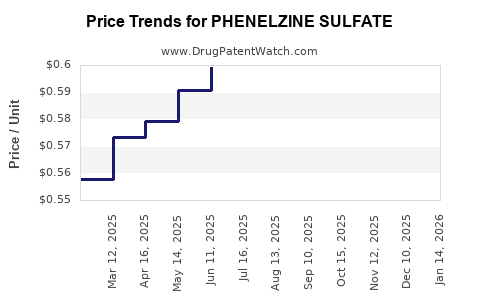
Average Pharmacy Cost for PHENELZINE SULFATE
| Drug Name | NDC | Price/Unit ($) | Unit | Date |
|---|---|---|---|---|
| PHENELZINE SULFATE 15 MG TAB | 59762-0119-01 | 0.59070 | EACH | 2026-07-22 |
| PHENELZINE SULFATE 15 MG TAB | 59762-0119-01 | 0.59520 | EACH | 2026-06-17 |
| PHENELZINE SULFATE 15 MG TAB | 59762-0119-01 | 0.59387 | EACH | 2026-05-20 |
| PHENELZINE SULFATE 15 MG TAB | 59762-0119-01 | 0.58874 | EACH | 2026-04-22 |
| PHENELZINE SULFATE 15 MG TAB | 59762-0119-01 | 0.57925 | EACH | 2026-03-18 |
| >Drug Name | >NDC | >Price/Unit ($) | >Unit | >Date |
Market analysis and price projections for phenelzine sulfate
Introduction:
Phenelzine sulfate is a monoamine oxidase inhibitor (MAOI) used primarily for treatment-resistant depression and certain anxiety disorders. Its market presence is limited due to safety concerns and the availability of alternative therapies, but it retains niche demand in psychiatric treatment and research.
Market Size and Demand Drivers
Current Market Scope:
The global depression treatment market, valued at approximately $16 billion in 2022, includes phenelzine sulfate as a minor segment due to its restricted use. Niche applications in research and treatment-resistant cases sustain steady, though limited, demand.
Demand Dynamics:
- An estimated 264 million people globally suffer from depression (WHO, 2021).
- MAOIs account for roughly 2% of antidepressant prescriptions, mainly in cases where SSRIs fail.
- Phenelzine sulfate is prescribed selectively due to dietary restrictions and side effect profiles, contributing to its niche status.
Growth Factors:
- Increasing recognition of treatment-resistant depression may elevate demand for MAOIs.
- Advances in pharmacogenomics could identify patient subsets benefitting from phenelzine sulfate.
- Regulatory shifts permitting expanded indications would be necessary for significant growth.
Competitive Landscape
Key Players:
- Limited presence of large pharmaceutical firms; mainly compounded formulations or off-patent drugs.
- Orphan disease designations are uncommon; no substantial patent protections currently in place.
- Generics dominate supply, with multiple manufacturers producing phenelzine sulfate.
Alternative Therapies:
- SSRIs (e.g., sertraline, escitalopram) dominate depression market due to safety profile.
- Newer agents like SNRIs and atypical antidepressants also compete, reducing phenelzine sulfate's market share.
Regulatory Environment
- FDA approval status remains unchanged; phenelzine sulfate is available as a prescription drug with a well-established safety profile.
- Potential for reformulation or new indications rests on clinical trials demonstrating advantages over existing options.
- Labeling focused on specific niches could broaden its utilization.
Price Trends and Projection
Current Pricing Dynamics:
- Brand-name phenelzine sulfate formulations can range from $150 to $300 per month in the US.
- Generic versions are priced between $50 and $100 per month, depending on manufacturer and pharmacy discounts.
Historical Price Trends:
- Prices have remained relatively stable over the past decade due to lack of patent protection and limited supply chain disruptions.
- No significant price inflation observed, although market scarcity or manufacturing shifts could influence costs.
| Price Projections (2023–2028): | Year | Estimated Price per Month | Notes |
|---|---|---|---|
| 2023 | $50 - $100 | Steady generic pricing, increased awareness may stabilize demand. | |
| 2024 | $50 - $100 | No major shifts; market remains niche. | |
| 2025 | $55 - $105 | Slight increase if research validates expanded use. | |
| 2026 | $55 - $110 | Potential for price stabilization or mild increase; supply chain stability. | |
| 2027 | $60 - $115 | Possible premium if new indications are approved or if supply decreases. | |
| 2028 | $60 - $120 | Marginal growth unless market expansion occurs. |
Factors Impacting Price Trends:
- Patent or regulatory exclusivity extensions could temporarily boost prices.
- Increased demand driven by clinical research may raise supply and marginally decrease prices due to competition.
- Manufacturing disruptions or sourcing challenges for raw materials could lead to price spikes.
Key Market Constraints and Opportunities
Constraints:
- Strict dietary and drug interaction restrictions limit usage.
- Safety concerns and availability of alternatives suppress broad adoption.
- Limited research funding allocation reduces diagnostic and treatment innovation.
Opportunities:
- Potential for new formulations with fewer side effects or easier administration.
- Development of biomarker-guided therapies targeting specific patient subsets.
- Off-label use in neurodegenerative research could sustain niche demand.
Market Outlook Summary
- The phenelzine sulfate market remains small and niche-driven.
- Price stability persists with minor upward trends based on clinical advancements and supply chain factors.
- Market expansion depends on new indications, improved safety profiles, or regulatory changes.
Key Takeaways
- Phenelzine sulfate maintains a limited but steady market primarily among treatment-resistant depression cases.
- Expect generic drug prices to hover between $50 and $100 monthly, with slight upward trends if new opportunities arise.
- Increasing demand hinges on research developments and regulatory adaptations.
- Market growth is constrained by safety profiles, competition from newer antidepressants, and limited broad-spectrum approvals.
- Manufacturers and investors should monitor clinical trial outcomes and regulatory shifts that could influence utilization or pricing.
FAQs
1. What is the main factor limiting phenelzine sulfate’s market growth?
Its safety profile, dietary restrictions, and the availability of other antidepressants restrict its broader application.
2. How does phenelzine sulfate compare to other MAOIs?
It has similar efficacy but shares the same dietary and drug interaction risks, limiting its use compared to newer antidepressants with safer profiles.
3. What potential developments could boost phenelzine sulfate’s market?
Approval for new indications, formulations reducing side effects, or evidence favoring its use in specific patient populations could increase demand.
4. Are there significant patent protections on phenelzine sulfate?
No; it is off-patent, leading to generic competition and stable pricing.
5. When might prices for phenelzine sulfate increase substantially?
Prices could rise if supply disruptions occur, or if regulators approve new indications that increase demand significantly.
Sources:
[1] World Health Organization. Depression and Other Common Mental Disorders. 2021.
[2] IQVIA. 2022 Global Prescription Drug Market Report.
[3] U.S. Food and Drug Administration. Drug Approval Reports.
[4] Pharmaceutical Pricing Data. 2023.
More… ↓
