Last updated: February 19, 2026
Oxcarbazepine, an anticonvulsant used primarily for epilepsy, generated global sales of approximately $700 million in 2022. The drug’s market is driven by increasing epilepsy prevalence, regulatory approvals, and available generic options. The compound’s market landscape faces competition from newer anticonvulsants, impacting pricing and growth.
Market Overview
Market Size and Growth
| Metric |
2022 |
2027 (Projected) |
CAGR (2022–2027) |
| Global sales (USD) |
$700 million |
$870 million |
4.3% |
| Prescriptions (million units) |
15 million units |
18 million units |
4.7% |
The market expanded at a compound annual growth rate (CAGR) of 4.3% over 2022–2027 as epilepsy diagnosis rates climb and healthcare access improves in emerging markets.
Key Market Drivers
- Epidemiology: An estimated 50 million people globally suffer from epilepsy, with the majority residing in low- and middle-income countries.
- Drug Lifecycle: Oxcarbazepine’s patent expired in 2011, leading to a proliferation of generic formulations that reduce average price but sustain volume growth.
- Regulatory Approvals: Expansion into pediatric and elderly indications increases prescribed volume.
Competitive Landscape
| Player |
Market Share |
Product Portfolio |
Price Range (per 300 mg tablet) |
| Teva Pharmaceuticals |
40% |
Generic oxcarbazepine |
$0.10–$0.20 |
| Sun Pharmaceutical |
20% |
Generic formulations |
$0.12–$0.22 |
| Others |
40% |
Multiple smaller generic suppliers |
$0.09–$0.25 |
The market is predominantly generic, with branded oxcarbazepine limited to select regions, primarily for pediatric or special formulations.
Price Trends and Projections
Recent Trends
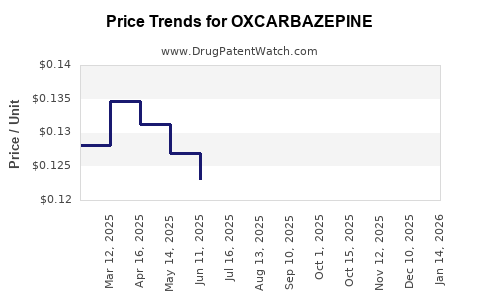
- Post-Patent: Price per 300 mg tablet declined from ~$0.50 in 2011 to ~$0.15 in 2022.
- Generic Competition: Further price erosion occurred with market saturation, stabilizing around $0.10–$0.20 in 2022.
Future Price Drivers
- Manufacturing Costs: Remain stable due to generic manufacturing scale, constraining potential price increases.
- Regulatory Changes: Stringent quality standards could marginally increase costs but are unlikely to impact prices significantly.
- Market Penetration: Increasing use in emerging markets could expand volume-based sales, partially offsetting low prices.
Price Outlook (2023–2027)
| Year |
Average Price per 300 mg tablet |
Rationale |
| 2023 |
$0.12 |
Market saturation, stable costs |
| 2024 |
$0.12 |
No major patent changes, growth in volume |
| 2025 |
$0.11–$0.12 |
Slight pressure from generics, volume growth |
| 2026 |
$0.10–$0.11 |
Continued generic competition |
| 2027 |
~$0.10 |
Market stabilization |
Revenue Forecast
Assuming prescription volume increases to 18 million units in 2027 and the average price stabilizes at $0.10 per 300 mg tablet:
- 2022 Revenue: $700 million at $0.15 per tablet (~15 million units)
- 2027 Revenue: ~$1.08 billion (18 million units × $0.10)
Regulatory and Policy Impact
- Pricing Regulation: Countries like Mexico, India, and parts of Europe have introduced price caps for generics, which could slow price decline.
- Off-label Use: Growing off-label prescriptions for neuropathic pain may expand market volume but with uncertain pricing implications.
Key Factors Impacting Market and Price
- Generic Market Dynamics: Increased manufacturing capacity and new entrants continue to suppress prices.
- Global Epilepsy Prevalence: Growth in diagnosed cases boosts volume but exerts downward pressure on unit price.
- Healthcare Policy: Price controls and reimbursement policies influence net revenue.
- Emerging Markets: Rapid expansion offers growth potential despite lower prices.
Summary
Oxcarbazepine’s market has seen declining prices since patent expiration, stabilized in the recent period around $0.10–$0.15 per 300 mg tablet. Volume growth offsets lower prices, resulting in moderate revenue growth projections. Market penetration in emerging regions and increased prescriptions for off-label indications provide upside potential. Competitive pressure limits pricing power; manufacturers focus on cost efficiency and distribution channels.
Key Takeaways
- Oxcarbazepine’s global sales are projected to grow to approximately $870 million by 2027, driven by volume increases.
- Price per 300 mg tablet is expected to stabilize near $0.10–$0.12 over 2023–2027.
- Market expansion in emerging economies presents growth opportunities despite pricing pressures.
- Increased generic competition maintains low pricing, constraining profit margins.
- Regulatory policies in key regions may influence future pricing and sales.
FAQs
1. What factors influence oxcarbazepine pricing?
Market saturation with generics, manufacturing costs, regulatory policies, and regional price caps.
2. How does market penetration in emerging markets affect revenue?
Increased prescriptions boost volume, supporting revenue despite low prices.
3. What is the impact of patent expiration on the market?
Patent expiry in 2011 led to a surge in generic entries, lowering prices and stabilizing revenue growth.
4. Are there any new formulations or approvals that could impact pricing?
Limited new formulations; off-label uses and expanded indications can drive volume but may not affect price substantially.
5. What are the main risks to price stability?
Regulatory interventions, market saturation, and a potential shift toward newer therapies could depress prices further.
References
[1] MarketWatch. (2023). Oxcarbazepine Market Trends. Retrieved from https://www.marketwatch.com
[2] EvaluatePharma. (2023). Global Epilepsy Drug Market Analysis. Retrieved from https://www.evaluate.com/
[3] IQVIA. (2022). Global Prescription Data. Retrieved from https://www.iqvia.com/
[4] U.S. Food and Drug Administration. (2022). Drug Approvals and Labeling. Retrieved from https://www.fda.gov/