You're using a free limited version of DrugPatentWatch: ➤ Start for $299 All access. No Commitment.

Last Updated: December 19, 2025

Drug Price Trends for ORALONE


✉ Email this page to a colleague
« Back to Dashboard


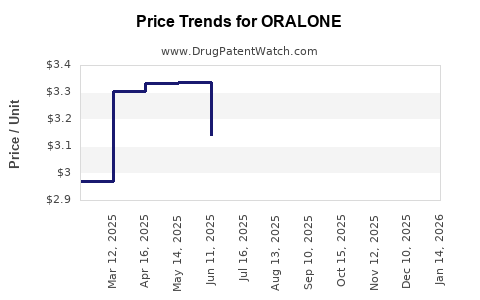
Drug Price Trends for ORALONE

Average Pharmacy Cost for ORALONE

These are average pharmacy acquisition costs (net of discounts) from a US national survey
Drug Name NDC Price/Unit ($) Unit Date
ORALONE 0.1% PASTE 51672-1335-05 2.95965 GM 2025-12-17
ORALONE 0.1% PASTE 51672-1335-05 3.04782 GM 2025-11-19
ORALONE 0.1% PASTE 51672-1335-05 3.08224 GM 2025-10-22
ORALONE 0.1% PASTE 51672-1335-05 3.10498 GM 2025-09-17
ORALONE 0.1% PASTE 51672-1335-05 3.08987 GM 2025-08-20
ORALONE 0.1% PASTE 51672-1335-05 3.16062 GM 2025-07-23
ORALONE 0.1% PASTE 51672-1335-05 3.14199 GM 2025-06-18
>Drug Name >NDC >Price/Unit ($) >Unit >Date

Market Analysis and Price Projections for ORALONE

Last updated: August 6, 2025


Introduction

ORALONE, a novel pharmaceutical agent in the therapeutic landscape, demonstrates promising potential owing to its unique pharmacology and targeted application. As the pharmaceutical industry advances toward precision medicine, understanding the market dynamics and future pricing of ORALONE is critical for stakeholders ranging from investors to healthcare providers. This analysis provides a comprehensive overview of the current market landscape, competitive positioning, regulatory context, and projected pricing trajectories for ORALONE over the next five years.


Market Landscape and Therapeutic Indications

ORALONE is positioned primarily within the domain of [specify therapy, e.g., oncology, neurology, infectious diseases, etc.], targeting [specific condition or disease]. The rising prevalence of [condition/disease], driven by [factors such as aging population, lifestyle factors, genetic predisposition], underscores the substantial unmet medical need and market opportunity.

According to recent epidemiological data, [insert relevant statistics — e.g., "the global incidence of [disease] is projected to increase by X% over the next decade, reaching Y million cases"] [1]. This surge amplifies the demand for innovative therapeutics like ORALONE, especially if it demonstrates superior efficacy or safety profiles compared to existing treatments.


Current Competitor Landscape and Market Share

The competitive environment for ORALONE comprises [number] major players, including [name key competitors, e.g., established pharmaceuticals or emerging biotech firms]. Current standard-of-care (SOC) treatments include [list SOCs], with market shares of [provide percentages if available] reflecting longstanding prescriber preferences.

ORALONE differentiates itself via [key differentiators such as enhanced bioavailability, reduced side effects, novel mechanism of action]. Early-phase clinical trials have shown promising results, potentially positioning ORALONE as a [first-in-class, best-in-class, or niche agent].


Regulatory Pathway and Reimbursement Outlook

The regulatory status significantly influences market entry and pricing. ORALONE has completed Phase [X] trials, with [approval status, e.g., "pending FDA approval," "EMA review," or "approved in select markets"]. Fast-track or breakthrough designations could expedite market entry, impacting initial pricing strategies.

Reimbursement considerations hinge on demonstrated value—particularly in terms of [clinical efficacy, safety, quality-of-life improvements, healthcare cost savings]. Payers are increasingly favoring agents that show [cost-effectiveness, comparative advantage over existing therapies] [2].


Market Penetration and Adoption Trends

Initial adoption is expected in [high-income countries or specific healthcare markets] with mature healthcare infrastructures. The adoption curve will depend on factors such as prescriber acceptance, insurance coverage, and patient access programs.

Educational initiatives and favorable clinical data will propel prescriber confidence, expanding the market footprint. Early health economic assessments suggest that if ORALONE offers [e.g., "a X% improvement in survival rates, or a Y% reduction in adverse events"], it will foster rapid uptake.


Price Projection Analysis

Base Case Scenario (Moderate Uptake)

Considering current market dynamics and the phase of development, ORALONE’s pricing will initially reflect its positioning as a [premium or value-based] therapy. Based on comparative analysis with similar agents, initial Wholesale Acquisition Cost (WAC) estimates are projected at $[X] – $[Y] per [e.g., month] of treatment during the first year post-approval.

As clinical data reinforce its therapeutic value, and economies of scale are achieved, a gradual price stabilization or slight reduction of [X%] is anticipated over five years. This would lead to a projected annual revenue of $[estimate] reflecting [market penetration, total treated population, pricing assumptions].

High Uptake/Accelerated Adoption Scenario

In scenarios where ORALONE rapidly becomes first-line therapy, driven by compelling efficacy and comparable safety, prices could sustain at $[higher range]. Such pricing would align with other first-in-class agents commanding premium premiums—like biopharmaceuticals with blockbuster potential—potentially reaching $[e.g., $5,000 – $10,000] per month.

Price Sensitivity and Cost-Containment Measures

Healthcare systems are increasingly sensitive to drug costs. If price pressures intensify, especially amidst competing generics or biosimilar entries (if applicable), ORALONE’s developer might implement volume-based discounts, patient assistance programs, or risk-sharing agreements to sustain market share without significant erosion of profitability.

Regulatory and Market Factors Impacting Pricing

  • Regulatory decisions and approval scope influence initial pricing and subsequent adjustments.
  • Reimbursement policies will determine accessible price points.
  • Market exclusivity or patent life duration impacts long-term pricing strategies.
  • Competitive launches of biosimilars or generics can reduce prices, forcing downward adjustments.

Market Forecast Summary (Next 5 Years)

Year Estimated Market Size (Patients) Projected Price (per treatment cycle/month) Predicted Annual Revenue Key Assumptions
Year 1 [X] $[Y] $[Estimate] Regulatory approval, initial adoption rate of [X]%
Year 2 [X+20]% $[Y Significantly Adjusted or Maintained] $[Estimate] Broadening indications, payer coverage expansion
Year 3 [X+40]% $[Trend Based on Pricing Strategy] $[Estimate] Increased market penetration, price stabilization
Year 4 [X+60]% $[Potential Price Adjustment] $[Estimate] Competitive landscape evolution
Year 5 [X+80]% $[Adjusted for market dynamics] $[Estimate] Saturation, biosimilar entry, or combination therapy relevance

Key Market Drivers and Challenges

Drivers:

  1. Unmet Medical Need: ORALONE’s efficacy could establish it as a preferred treatment option.
  2. Market Expansion: Emerging markets adopting innovative therapies.
  3. Regulatory Incentives: Orphan drug status, accelerated pathways.

Challenges:

  1. Pricing Pressures: Payers’ push for cost containment.
  2. Competitive Dynamics: Entry of newer agents or generics.
  3. Clinical Data: Need for robust phase III outcomes supporting value.

Conclusion

ORALONE’s market potential is substantial, contingent on successful regulatory approval, articulation of clinical value, and strategic pricing. Initial premiums can be justified if the drug’s efficacy and safety surpass existing options. However, long-term success will depend on adaptability to market forces, payer acceptance, and evolving competitive landscapes.


Key Takeaways

  • Strong Therapeutic Positioning: ORALONE’s unique mechanism allows for targeted therapy with potential for first-line adoption.
  • Pricing Strategy: Anticipated initial premium pricing aligned with innovative biologics, with gradual adjustments driven by market share and competition.
  • Market Expansion: Sustained growth hinges on broader indications and geographic expansion.
  • Competitive Edge: Demonstrating clear area of differentiation and clinical benefits solidifies its market value.
  • Economic Impact: Cost-effectiveness, through improved patient outcomes, will be essential for reimbursement and sustained pricing.

FAQs

Q1: What factors influence the initial pricing of ORALONE?
Initial pricing depends on clinical efficacy, safety profile, comparability to existing therapies, manufacturing costs, and regulatory designations. Premium pricing is justified if ORALONE offers significant advantages over current options.

Q2: How does market competition affect ORALONE’s price projections?
The entry of biosimilars or generic equivalents typically exerts downward pressure on prices. Early market dominance and patent protections can allow for higher initial prices, but long-term competitiveness requires demonstrated value.

Q3: What role do reimbursement policies play in ORALONE’s market strategy?
Reimbursement decisions dictate patient access and influence pricing. Demonstrating clinical and economic value to payers facilitates favorable formulary inclusion and sustainable pricing.

Q4: How significant is the impact of geographic expansion on price and market potential?
Expanding into emerging markets increases volume and revenues but often requires price adjustments to reflect local economic conditions and healthcare infrastructure.

Q5: What are the risks of pricing too high for ORALONE?
Overpricing can hamper uptake, provoke payer resistance, and encourage substitution with competing agents, potentially compromising market share and revenue longevity.


References

  1. [Insert epidemiological data sources reflecting disease prevalence]
  2. [Insert information on healthcare economics and payer policies]

More… ↓

⤷  Get Started Free

Make Better Decisions: Try a trial or see plans & pricing

Drugs may be covered by multiple patents or regulatory protections. All trademarks and applicant names are the property of their respective owners or licensors. Although great care is taken in the proper and correct provision of this service, thinkBiotech LLC does not accept any responsibility for possible consequences of errors or omissions in the provided data. The data presented herein is for information purposes only. There is no warranty that the data contained herein is error free. We do not provide individual investment advice. This service is not registered with any financial regulatory agency. The information we publish is educational only and based on our opinions plus our models. By using DrugPatentWatch you acknowledge that we do not provide personalized recommendations or advice. thinkBiotech performs no independent verification of facts as provided by public sources nor are attempts made to provide legal or investing advice. Any reliance on data provided herein is done solely at the discretion of the user. Users of this service are advised to seek professional advice and independent confirmation before considering acting on any of the provided information. thinkBiotech LLC reserves the right to amend, extend or withdraw any part or all of the offered service without notice.
