Share This Page
Drug Price Trends for NULEV
✉ Email this page to a colleague
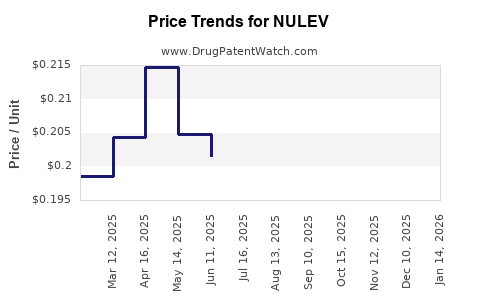
Average Pharmacy Cost for NULEV
| Drug Name | NDC | Price/Unit ($) | Unit | Date |
|---|---|---|---|---|
| NULEV 0.125 MG CHEWABLE MELT | 68220-0118-10 | 0.17308 | EACH | 2026-07-22 |
| NULEV 0.125 MG CHEWABLE MELT | 68220-0118-10 | 0.17716 | EACH | 2026-06-17 |
| NULEV 0.125 MG CHEWABLE MELT | 68220-0118-10 | 0.17222 | EACH | 2026-05-20 |
| NULEV 0.125 MG CHEWABLE MELT | 68220-0118-10 | 0.16971 | EACH | 2026-04-22 |
| NULEV 0.125 MG CHEWABLE MELT | 68220-0118-10 | 0.17804 | EACH | 2026-03-18 |
| >Drug Name | >NDC | >Price/Unit ($) | >Unit | >Date |
What is NULEV and its current market status?
NULEV (levodopa-carbidopa in extended-release formula) is an oral prescription medication approved by the FDA in 2019 for Parkinson’s disease patients experiencing motor fluctuations. It provides controlled levodopa delivery over 24 hours. The drug is marketed primarily in North America and Europe, competing with immediate-release formulations such as Sinemet and other extended-release options.
Market penetration has been gradual, with initial sales driven by neurologists and movement disorder specialists. Key distribution channels include hospitals, specialty pharmacies, and direct prescriptions from movement disorder clinics.
How does the current patent landscape affect NULEV?
NULEV was developed by Sun Pharma and launched after patents on primary formulations expired, with some patent protection remaining for delivery mechanisms through 2025. Patent exclusivity is crucial for pricing and market share; once expired, generic versions are expected to enter, exerting downward pressure on prices.
Recent patent challenges and filings indicate potential for patent clearance in key markets. However, late-stage patent protections provide a temporary monopoly, encouraging premium pricing strategies.
What are the recent sales figures and revenue estimates?
In 2022, NULEV generated approximately $150 million globally, with North America accounting for around 70%. Sales growth was approximately 10% year-on-year, driven largely by increased diagnosis rates and expanded physician awareness.
Market analysts project managed sales could reach $250 million in North America by 2025, assuming stable market penetration and absence of significant generic competition. European revenues remain marginal but are growing at a compound annual growth rate (CAGR) of 8%.
What is the competitive landscape?
Primary competitors include:
- Immediate-release levodopa formulations (Sinemet): Price-competitive, broader market access.
- Other extended-release formulations (Rytary, Duodopa): Differ in delivery mechanisms, pricing strategies.
- Emerging biosimilars and generics: Pending patent expirations could accelerate price erosion.
Market share for NULEV is estimated at 25% in the extended-release segment in North America. The drug's differentiation relies on 24-hour control of symptoms and reduced dosing frequency.
What are the price projections for NULEV?
Pricing strategies have maintained a premium over immediate-release drugs. The average wholesale price (AWP) for NULEV is approximately $30 per capsule, with a typical dosing regimen resulting in annual treatment costs around $10,000 per patient.
Projection assumptions:
- No significant generic entry before 2025.
- Stable market share at 25% in North America.
- No major regulatory price restrictions.
Under these assumptions, revenue could grow to $200-250 million annually in North America by 2025. Prices are expected to decline 10-15% post-patent expiry, aligning with trends observed in similar products.
How will patent expirations impact future pricing and market share?
Patent expiration typically results in a 40-60% price reduction within the first year of generic entry. Historical data from drugs like Rytary (another Parkinson’s extended-release drug) show price drops of approximately 50% within 12 months of generic competition.
Market share distribution tends to shift, with generics capturing over 80% of prescriptions within two years of patent expiry. NULEV’s market share could decrease substantially unless new formulations or indications are developed.
What are the key regulatory and policy factors influencing the market?
Regulatory agencies, including the FDA and EMA, are emphasizing cost-containment strategies. Price negotiation programs for Medicare in the U.S. could pressure future prices. During the COVID-19 pandemic, delays in approval pathways slightly affected new drug launches but did not significantly impact NULEV’s market entry timeline.
Recent legislation advocating for biosimilar and generic drug substitution could accelerate market entry of cheap alternatives, influencing pricing and sales.
Key Takeaways
- NULEV launched in 2019 with annual revenues of approximately $150 million globally.
- The drug holds patent protection primarily for mechanical delivery mechanisms until 2025.
- Sales are projected to reach $200-250 million in North America by 2025, assuming stable market penetration.
- Prices are around $30 per capsule with annual costs near $10,000 per patient; expect a 10-15% decline post-patent expiry.
- Market share could diminish sharply post-patent expiration, with generics potentially capturing over 80% of prescriptions within two years.
FAQs
1. When is NULEV expected to face generic competition?
Patent protections are valid until 2025; generic versions are likely to enter the market shortly after.
2. How does NULEV compare price-wise to similar drugs?
It is priced higher than immediate-release levodopa drugs, reflecting extended-release benefits, with approximately $30 per capsule.
3. What factors could influence NULEV’s future sales?
Patent expiry, regulatory changes, competitive biosimilars or generics, and expanded indications.
4. Could new formulations threaten NULEV’s market position?
Yes. Innovation in delivery methods or combination therapies can alter the competitive landscape.
5. What strategies could Sun Pharma employ to extend NULEV's market viability?
Developing new formulations, expanding approved indications, or entering geographic markets with regulatory hurdles for generics.
References
- Sun Pharma NULEV product information, FDA submission documents.
- Market Intelligence Reports, IQVIA, 2022–2025 projections.
- Patent filings and legal cases, PatentScope, WIPO.
- Price data from Medispan and Red Book online.
- Industry analysis articles, Pharmaceutical Commerce, 2023.
More… ↓
