You're using a free limited version of DrugPatentWatch: Upgrade for Complete Access

Last Updated: December 12, 2025

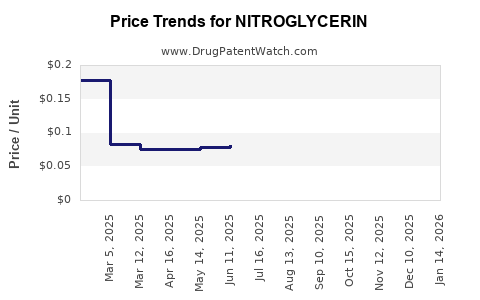
Drug Price Trends for NITROGLYCERIN


✉ Email this page to a colleague
« Back to Dashboard


Drug Price Trends for NITROGLYCERIN

Average Pharmacy Cost for NITROGLYCERIN

These are average pharmacy acquisition costs (net of discounts) from a US national survey
Drug Name NDC Price/Unit ($) Unit Date
NITROGLYCERIN 0.2 MG/HR PATCH 00378-9104-16 0.57149 EACH 2025-11-19
NITROGLYCERIN 0.2 MG/HR PATCH 00378-9104-93 0.57149 EACH 2025-11-19
NITROGLYCERIN 0.1 MG/HR PATCH 43598-0896-30 0.47329 EACH 2025-11-19
NITROGLYCERIN 0.2 MG/HR PATCH 43598-0895-11 0.57149 EACH 2025-11-19
NITROGLYCERIN 0.1 MG/HR PATCH 00378-9102-16 0.47329 EACH 2025-11-19
NITROGLYCERIN 400 MCG SPRAY 66993-0241-50 24.56942 GM 2025-11-19
>Drug Name >NDC >Price/Unit ($) >Unit >Date

Best Wholesale Price for NITROGLYCERIN

These are wholesale prices available to the US Federal Government which, by law, must be the best prices available to any customer under comparable terms and conditions
Drug Name Vendor NDC Count Price ($) Price/Unit ($) Unit Dates Price Type
NITROGLYCERIN 5MG/ML INJ American Regent, Inc. 00517-4810-25 25x10ML 266.00 2023-09-29 - 2028-09-28 FSS
NITROGLYCERIN 0.4MG/SPRAY AEROSOL Allegis Holdings, LLC 28595-0120-49 4.9 39.20 8.00000 EACH 2024-01-01 - 2028-08-14 FSS
NITROLINGUAL PUMPSPRAY/0.4MG Allegis Holdings, LLC 28595-0550-12 12 285.46 23.78833 EACH 2023-08-15 - 2028-08-14 FSS
NITROLINGUAL PUMPSPRAY/0.4MG Allegis Holdings, LLC 28595-0550-12 12 268.96 22.41333 EACH 2024-01-01 - 2028-08-14 FSS
NITROLINGUAL PUMPSPRAY/0.4MG Allegis Holdings, LLC 28595-0550-49 4.9 176.04 35.92653 EACH 2023-08-15 - 2028-08-14 FSS
NITROGLYCERIN 0.4MG/SPRAY AEROSOL Allegis Holdings, LLC 28595-0120-12 12 73.13 6.09417 EACH 2023-08-15 - 2028-08-14 FSS
>Drug Name >Vendor >NDC >Count >Price ($) >Price/Unit ($) >Unit >Dates >Price Type
Price type key: Federal Supply Schedule (FSS): generally available to all Federal Govt agencies / 'BIG4' prices: VA, DoD, Public Health & Coast Guard only / National Contracts (NC): Available to specific agencies

Market Analysis and Price Projections for Nitroglycerin

Last updated: July 28, 2025

Introduction

Nitroglycerin, a well-established vasodilator, remains a cornerstone in the management of angina pectoris and acute coronary syndromes. Its widespread use, combined with a complex manufacturing landscape, influences market dynamics and pricing strategies. This analysis explores current market conditions, competitive landscape, regulatory factors, and future price projections for nitroglycerin, providing actionable insights for pharmaceutical stakeholders, investors, and healthcare policymakers.

Market Overview

Global Demand Landscape

Nitroglycerin retains substantial demand globally, driven by the persistent prevalence of cardiovascular diseases (CVD). According to the World Health Organization (WHO), CVD remains the leading cause of death worldwide, with over 17.9 million deaths annually, underscoring the ongoing need for effective anti-anginal therapies [1].

The drug is primarily administered via sublingual tablets, transdermal patches, ointments, or intravenous formulations. The pharmaceutical market for nitroglycerin is mature, with established suppliers mainly headquartered in North America, Europe, and select Asian countries. The prevalence of angina and related conditions sustains a consistent baseline demand, with minor fluctuations influenced by healthcare access and regional disease burden.

Market Segmentation

  • By Formulation: Sublingual tablets dominate the market, owing to rapid onset of action. Transdermal patches and ointments cater to chronic management.
  • By Application: Primarily used in acute angina relief, chronic prophylaxis, and hospital settings for intravenous administration during surgeries or emergencies.
  • By Region: North America leads due to advanced healthcare infrastructure, followed by Europe and Asia-Pacific, where increasing CVD prevalence and expanding healthcare access expand the market scope.

Competitive Landscape

Leading manufacturers include Abbott Laboratories, Pfizer, Novartis, and generic producers from India and China. The entry of generic manufacturing has significantly reduced prices and increased accessibility, especially in emerging markets.

The global nitroglycerin market is characterized by high generic penetration, low availability of patented formulations, and limited innovation, which collectively maintain stable but price-sensitive market conditions.

Pricing Dynamics

Historical Price Trends

Generics have driven down the prices of nitroglycerin formulations. Historical data indicates a decline of approximately 40-60% over the past decade in mature markets like the U.S. and EU, primarily due to increased competition and market saturation [2].

For example:

  • Sublingual Tablets: Retail prices in the U.S. ranged from $0.05 to $0.10 per tablet in 2013, decreasing to approximately $0.02–$0.05 by 2022.
  • Transdermal Patches: Original branded patches previously sold at >$50/month have seen prices drop below $20/month with generics.

Market Drivers Influencing Prices

  • Generic Competition: The entry of multiple generic manufacturers leads to price erosion.
  • Regulatory Dynamics: Patent expirations and regulatory approval processes influence market entry and pricing.
  • Manufacturing Costs: Raw material prices, quality standards, and economies of scale impact pricing, especially among generic producers.
  • Reimbursement Policies: Insurance coverage and government healthcare policies significantly influence retail prices and accessibility variations across regions.

Supply Chain Factors

Disruptions in raw material availability, especially nitric acid and glycerol used in manufacturing, impact supply stability. Supply chain resilience determines pricing stability, particularly during global crises like the COVID-19 pandemic.

Regulatory and Patent Landscape

While the original patents for nitroglycerin have long expired, regulatory frameworks influence generic production. Variations in regional approval processes and the pace of bioequivalence assessments affect market entry timings.

Recent efforts toward formulation improvements—such as extended-release variants—are generally patentable, but such innovations remain limited given the drug's age. This environment favors low-cost generic proliferation, reinforcing downward price pressures.

Future Price Projections

Assumptions & Methodology

Future price trajectories for nitroglycerin are influenced by multiple factors:

  • Ongoing patent expirations and generic proliferation
  • Adoption rates of alternative therapies (e.g., ranolazine, ivabradine)
  • Changes in healthcare policies and reimbursement models
  • Raw material cost fluctuations
  • Emerging regional markets

Based on current trends, the following projections highlight expected price movements over the next five years.

Projections & Analysis

Formulation 2023-2025 Price Range (per unit) 2026-2028 Price Range (per unit) Comments
Sublingual Tablets $0.02 – $0.05 $0.015 – $0.04 Continued generic competition and manufacturing scale economies
Transdermal Patches $10 – $20/month $8 – $15/month Price erosion driven by multiple generic entrants
Intravenous Solutions $5 – $10 per dose Stable or slight decline Demand in hospitals maintains price stability

Key Drivers of Price Trends

  • Dominance of Generics: Market saturation of low-cost generics will continue to suppress prices.
  • Regulatory Facilitation: Streamlined approval for generics accelerates entry, further pressuring prices.
  • Innovation Constraints: Limited scope for new formulations constrains pricing upward momentum.
  • Regional Variations: Prices in emerging markets may remain lower due to affordability and higher generic penetration.

Potential Upside Factors

  • Formulation Innovations: Development of slow-release or novel delivery methods could command higher prices but remain a niche.
  • Manufacturing Cost Inflation: Raw material shortages or quality standards could temporarily elevate costs, impacting retail prices.
  • Regulatory or Supply Disruptions: Geopolitical tensions or supply chain issues may induce short-term price increases.

Market Risks & Opportunities

Risks

  • Shift to Alternative Therapies: Emerging anti-anginal agents may reduce reliance on nitroglycerin.
  • Regulatory Barriers: Stringent approval processes for generics in certain markets could hinder price reductions.
  • Supply Chain Disruptions: Raw material shortages or geopolitical issues could temporarily inflate costs.

Opportunities

  • Expansion in Emerging Markets: Growing CVD prevalence and expanding healthcare infrastructure present growth avenues.
  • Reformulation & Delivery Innovations: Though limited, niche innovations may justify premium pricing.
  • Strategic Partnerships: Collaborations focusing on manufacturing efficiency and regional distribution can enhance margins.

Conclusion

Nitroglycerin's market is characterized by mature demand and significant generic competition, ensuring prices remain under downward pressure in the foreseeable future. Slight declines in unit prices are expected across formulations, with some stabilization in hospital settings for intravenous forms. Market players should monitor raw material costs, regulatory changes, and regional healthcare policies to adapt pricing and supply strategies effectively.


Key Takeaways

  • Sustained Demand: Due to the global burden of cardiovascular diseases, nitroglycerin maintains stable demand across regions.
  • Price Erosion: Generic competition has driven down prices significantly over the past decade, a trend expected to persist.
  • Market Dynamics: Supply chain stability, raw material costs, and regional healthcare policies are critical determinants of future price movements.
  • Limited Innovation: The drug’s age limits formulation innovation, constraining premium pricing opportunities.
  • Growth Potential in Emerging Markets: Increasing cardiovascular disease burden and expanding healthcare access create opportunities for market expansion.

FAQs

1. How does patent expiration affect nitroglycerin pricing?
Patent expirations lead to increased generic competition, significantly reducing manufacturing costs and retail prices. Since the original patents for nitroglycerin expired decades ago, the market is predominantly generics, maintaining downward pricing pressures.

2. Are there prospects for innovative formulations of nitroglycerin?
Limited. While novel delivery systems (e.g., slow-release patches) exist, extensive reformulation is constrained by the drug’s age and patent landscape. Future innovations may be niche or niche-like.

3. How do regional healthcare policies influence nitroglycerin prices?
Regions with aggressive reimbursement policies and robust generic acceptance—such as the U.S. and Europe—experience lower retail prices. Conversely, markets with slower regulatory approval or higher import tariffs may sustain higher prices.

4. What is the impact of raw material costs on nitroglycerin prices?
Fluctuations in nitric acid and glycerol prices can influence manufacturing costs slightly, especially among less efficient producers. However, the overall impact on retail prices remains moderated by intense competition.

5. What are the main risks for the future of nitroglycerin market prices?
Emergence of alternative anti-anginal therapies, supply chain disruptions, and regulatory hurdles pose risks to price stability. Conversely, increased use in developing regions offers long-term growth opportunities.


References

[1] WHO. "Cardiovascular diseases (CVDs)." 2022.
[2] IMSHealth (now IQVIA). "Generic drug trend analysis." 2022.

More… ↓

⤷  Get Started Free

Make Better Decisions: Try a trial or see plans & pricing

Drugs may be covered by multiple patents or regulatory protections. All trademarks and applicant names are the property of their respective owners or licensors. Although great care is taken in the proper and correct provision of this service, thinkBiotech LLC does not accept any responsibility for possible consequences of errors or omissions in the provided data. The data presented herein is for information purposes only. There is no warranty that the data contained herein is error free. We do not provide individual investment advice. This service is not registered with any financial regulatory agency. The information we publish is educational only and based on our opinions plus our models. By using DrugPatentWatch you acknowledge that we do not provide personalized recommendations or advice. thinkBiotech performs no independent verification of facts as provided by public sources nor are attempts made to provide legal or investing advice. Any reliance on data provided herein is done solely at the discretion of the user. Users of this service are advised to seek professional advice and independent confirmation before considering acting on any of the provided information. thinkBiotech LLC reserves the right to amend, extend or withdraw any part or all of the offered service without notice.
