Share This Page
Drug Price Trends for NICOTINE
✉ Email this page to a colleague
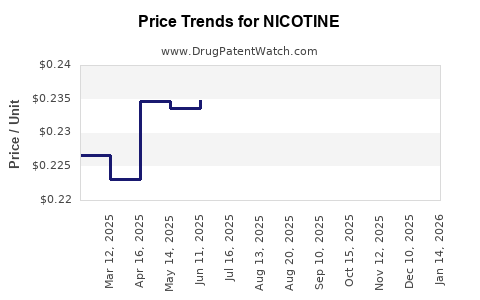
Average Pharmacy Cost for NICOTINE
| Drug Name | NDC | Price/Unit ($) | Unit | Date |
|---|---|---|---|---|
| NICOTINE 14 MG/24HR PATCH | 00536-1107-88 | 1.80173 | EACH | 2026-07-22 |
| NICOTINE 14 MG/24HR PATCH | 00536-5895-53 | 1.80173 | EACH | 2026-07-22 |
| NICOTINE 14 MG/24HR PATCH | 00536-5895-71 | 1.80173 | EACH | 2026-07-22 |
| NICOTINE 14 MG/24HR PATCH | 00536-5895-88 | 1.80173 | EACH | 2026-07-22 |
| NICOTINE TRANSDERMAL SYSTEM | 43598-0445-56 | 1.41684 | EACH | 2026-07-22 |
| NICOTINE 14 MG/24HR PATCH | 43598-0447-70 | 1.80173 | EACH | 2026-07-22 |
| NICOTINE 14 MG/24HR PATCH | 43598-0447-71 | 1.80173 | EACH | 2026-07-22 |
| >Drug Name | >NDC | >Price/Unit ($) | >Unit | >Date |
Best Wholesale Price for NICOTINE
| Drug Name | Vendor | NDC | Count | Price ($) | Price/Unit ($) | Unit | Dates | Price Type |
|---|---|---|---|---|---|---|---|---|
| GOODSENSE NICOTINE POLACRILEX 4MG MINT GUM | United Drug Supply, Inc. | 00113-0532-60 | 20 | 5.16 | 0.25800 | EACH | 2023-12-01 - 2028-11-30 | FSS |
| NICOTINE 21MG/24HRS PATCH | Golden State Medical Supply, Inc. | 60505-7090-00 | 14 | 20.43 | 1.45929 | EACH | 2023-06-16 - 2028-06-14 | FSS |
| NICOTINE 7MG/24HRS PATCH | Golden State Medical Supply, Inc. | 60505-7088-00 | 14 | 20.43 | 1.45929 | EACH | 2023-06-16 - 2028-06-14 | FSS |
| NICOTINE 14MG/24HRS PATCH | Golden State Medical Supply, Inc. | 60505-7089-00 | 14 | 20.43 | 1.45929 | EACH | 2023-06-16 - 2028-06-14 | FSS |
| NICOTINE POLACRILEX 4MG TAB,CHEWG GUM FRUIT | McKesson Corporation dba SKY Packaging | 63739-0368-10 | 10X10 | 22.56 | 2022-05-01 - 2027-04-30 | FSS | ||
| NICOTINE POLACRILEX 4MG TAB,CHEW GUM CINNAMON | McKesson Corporation dba SKY Packaging | 63739-0369-10 | 10X10 | 16.79 | 2022-05-01 - 2027-04-30 | FSS | ||
| NICOTINE POLACRILEX 2MG TAB,CHEW GUM CINNAMON | McKesson Corporation dba SKY Packaging | 63739-0370-10 | 10X10 | 18.97 | 2022-05-01 - 2027-04-30 | FSS | ||
| >Drug Name | >Vendor | >NDC | >Count | >Price ($) | >Price/Unit ($) | >Unit | >Dates | >Price Type |
Nicotine: Market Analysis and Price Projections
Nicotine, a naturally occurring alkaloid, is undergoing a significant market evolution driven by shifting regulatory landscapes and growing consumer demand for harm-reduction alternatives to traditional combustible cigarettes. This analysis projects market growth and price trends for nicotine products, focusing on the pharmaceutical and consumer health sectors.
What is the Current Global Market Size for Nicotine Products?
The global nicotine market is substantial, encompassing a range of products from nicotine replacement therapies (NRTs) to next-generation products like e-cigarettes and heated tobacco. The market is fragmented, with significant regional variations in product availability and consumer preference.
- Nicotine Replacement Therapy (NRT) Market: The NRT market, primarily comprising patches, gums, lozenges, and inhalers, is a mature segment. In 2023, the global NRT market was valued at approximately $2.8 billion and is projected to grow at a compound annual growth rate (CAGR) of 4.5% through 2030. [1] This growth is supported by increasing awareness of smoking cessation benefits and broader insurance coverage in developed economies.
- Next-Generation Nicotine Products (NGPs): This segment, including e-cigarettes (vaping devices) and heated tobacco products (HTPs), represents the fastest-growing area of the nicotine market. The global e-cigarette market was estimated at $18.3 billion in 2023 and is forecast to reach $58.5 billion by 2030, with a CAGR of 18.2%. [2] The HTP market, though smaller, is also experiencing robust growth, projected to expand from $7.5 billion in 2023 to $35.2 billion by 2030 at a CAGR of 24.5%. [3] These NGPs are increasingly positioned as less harmful alternatives to traditional cigarettes, driving their adoption.
What Factors Are Driving Nicotine Market Growth?
Several key drivers are propelling the expansion of the nicotine market:
- Harm Reduction Initiatives: A primary driver is the global shift towards harm reduction strategies for adult smokers. Regulatory bodies and public health organizations are increasingly acknowledging that while nicotine is addictive, the combustion process in traditional cigarettes is the main source of harmful chemicals. This has fostered an environment conducive to the development and adoption of less harmful nicotine delivery systems. [4]
- Increasing Consumer Awareness and Demand for Alternatives: Consumers, particularly adult smokers, are actively seeking alternatives to combustible cigarettes due to concerns about health risks and social restrictions. The availability of a diverse range of NGP products, offering various nicotine strengths, flavors, and user experiences, caters to this demand.
- Technological Advancements and Product Innovation: Continuous innovation in product design, battery technology, and e-liquid formulations for e-cigarettes, as well as advancements in heating technology for HTPs, are enhancing user satisfaction and driving market penetration. Devices are becoming more sophisticated, offering better flavor delivery and longer battery life.
- Growing Market Penetration in Emerging Economies: While NRTs have a strong presence in developed markets, NGPs are witnessing rapid adoption in emerging economies in Asia and Latin America, where smoking rates are higher and regulatory frameworks are still evolving.
- Government Policies and Regulatory Frameworks: While regulations vary significantly, some governments are implementing policies that support harm reduction by distinguishing between combustible products and less harmful alternatives. This includes differential taxation and marketing regulations, which can influence market dynamics and product pricing. However, stringent regulations on flavors and marketing in some key markets, such as the United States, can also act as a constraint. [5]
What are the Key Product Segments within the Nicotine Market?
The nicotine market can be broadly segmented into pharmaceutical-grade nicotine products and consumer-grade nicotine products.
Nicotine Replacement Therapies (NRTs)
These are regulated pharmaceutical products designed for smoking cessation.
- Forms:
- Nicotine Patches: Provide a slow, steady release of nicotine.
- Nicotine Gum: Offers a faster release than patches, allowing for on-demand use.
- Nicotine Lozenges: Similar to gum, dissolving in the mouth for nicotine absorption.
- Nicotine Inhalers and Nasal Sprays: Mimic the hand-to-mouth action of smoking and provide rapid nicotine delivery.
- Market Dynamics: Dominated by established pharmaceutical companies. Sales are driven by clinical efficacy, physician recommendations, and insurance reimbursement.
- Pricing: Prices are generally stable, influenced by manufacturing costs, R&D investment, and regulatory compliance. A typical 28-day supply of nicotine patches can range from $40 to $70, while a pack of nicotine gum (10-20 pieces) might cost $15 to $30. [6]
Next-Generation Nicotine Products (NGPs)
These are consumer products intended as alternatives to combustible cigarettes.
- E-cigarettes (Vaping Devices):
- Device Types:
- Disposable Vapes: Pre-filled and pre-charged, designed for single use. Market share is growing rapidly due to convenience and lower upfront cost.
- Pod Systems: Feature a rechargeable battery and replaceable pre-filled or refillable pods.
- Mods: More advanced devices with customizable settings, larger batteries, and refillable tanks.
- E-liquids: Contain nicotine, propylene glycol, vegetable glycerin, and flavorings. Nicotine concentrations typically range from 0 mg/mL to 50 mg/mL (or higher in some markets).
- Market Dynamics: Highly competitive, with rapid product cycles. Driven by flavor innovation, device design, and marketing. Regulatory scrutiny regarding flavors and marketing is a significant factor.
- Device Types:
- Heated Tobacco Products (HTPs):
- Mechanism: Heat tobacco sticks to release nicotine and flavor without combustion.
- Leading Products: IQOS (Philip Morris International), glo (British American Tobacco).
- Market Dynamics: Require dedicated heating devices and proprietary tobacco sticks. Market growth is tied to the adoption of specific device ecosystems.
- Nicotine Pouches:
- Description: Smokeless, tobacco-free pouches containing nicotine, flavorings, and plant-based fillers. Designed for oral use, placed between the lip and gum.
- Market Dynamics: Rapidly emerging segment, appealing to consumers seeking discreet nicotine use without vapor or smoke. Brands like Zyn (Swedish Match) have seen significant growth.
What are the Projected Price Trends for Nicotine Products?
Price projections vary significantly across different nicotine product segments.
- NRTs: Prices are expected to remain relatively stable, with modest annual increases (1-3%) driven by inflation, manufacturing costs, and ongoing R&D for improved formulations. The mature nature of the NRT market limits significant price volatility.
- E-cigarettes:
- Disposable Vapes: Current trends suggest continued price competition among manufacturers, particularly for mid-range and budget options. Prices for a single disposable device (e.g., 5,000 puffs) typically range from $20 to $40. [7] However, increasing regulatory interventions, such as flavor bans or excise taxes, could lead to price increases or a shift in product offerings. Emerging markets may see lower price points to drive adoption.
- Pod Systems and Mods: The initial cost of rechargeable devices can range from $30 to $100 or more, with ongoing costs for replacement pods or e-liquid cartridges. E-liquid prices are generally stable, ranging from $15 to $30 for a 30mL bottle, depending on nicotine strength and brand. [7] Future price trends will be influenced by technological upgrades, brand competition, and regulatory compliance costs.
- Heated Tobacco Products (HTPs): Device costs are a significant upfront investment, ranging from $50 to $150 for the heating unit. [3] The recurring cost is for proprietary tobacco sticks, which are often priced comparably to or slightly higher than a pack of traditional cigarettes, typically $5 to $8 per pack of 20 sticks. [3] Pricing is likely to remain aligned with premium cigarette prices, with potential for increases as market penetration grows and manufacturers recoup R&D expenses.
- Nicotine Pouches: This segment has seen significant price growth, driven by high demand and brand loyalty. Prices for a can of 20 pouches can range from $4 to $7. [8] Growth in this segment is robust, and pricing power is expected to remain strong, particularly for established brands, unless significant regulatory interventions occur.
Factors Influencing Price Trends:
- Regulatory Landscape: Taxation, flavor bans, marketing restrictions, and product standards directly impact manufacturing costs and market access, leading to price adjustments. For instance, excise taxes on e-liquids or HTP tobacco sticks can add 10-50% to the retail price.
- Raw Material Costs: The cost of nicotine itself, as well as other components like batteries, plastics, and flavorings, influences manufacturing expenses.
- Competition and Market Saturation: Intense competition, particularly in the e-cigarette and nicotine pouch markets, can drive prices down. However, brand loyalty and product differentiation can allow for premium pricing.
- Technological Innovation: Adoption of new technologies can initially increase prices but may lead to cost reductions through economies of scale over time.
- Consumer Demand and Perceived Value: The perceived health benefits of NGPs and the desire for alternatives to smoking support premium pricing, especially for products offering convenience and satisfaction.
What is the Competitive Landscape for Nicotine Products?
The competitive landscape is dynamic and highly segmented.
- NRTs: Dominated by established pharmaceutical companies like Johnson & Johnson (Nicorette), GlaxoSmithKline (Nicoderm CQ), and Perrigo. Market share is relatively stable.
- E-cigarettes:
- Device Manufacturers: Includes companies like Juul Labs (though facing significant regulatory challenges), Vuse (British American Tobacco), Blu (Imperial Brands), and a vast array of smaller and emerging players. The disposable vape segment is particularly fragmented with numerous brands.
- E-liquid Manufacturers: A diverse market with both large tobacco companies and independent manufacturers.
- Heated Tobacco Products (HTPs): Primarily dominated by two major players:
- Philip Morris International (PMI) with its IQOS brand.
- British American Tobacco (BAT) with its glo brand. These companies have invested heavily in R&D and market rollout for their respective HTP systems.
- Nicotine Pouches: A rapidly consolidating market. Key players include:
- Swedish Match (now part of PMI) with its Zyn brand, which holds a dominant market share in the US.
- Altria Group (On! brand).
- Imperial Brands (White Cloud, others).
- BAT has also entered this market with its Velo brand.
Key Competitive Dynamics:
- Tobacco Company Transition: Major tobacco companies are actively transitioning their portfolios towards NGPs and HTPs to offset declining traditional cigarette sales. This involves significant investment in product development, marketing, and distribution.
- Regulatory Arbitrage: Companies often seek markets with more favorable regulatory environments to launch and expand their product lines, especially concerning flavors and marketing.
- Product Differentiation: Competition centers on device design, battery life, flavor variety, nicotine delivery efficiency, and brand appeal.
- Mergers and Acquisitions: Consolidation is evident, particularly in the nicotine pouch segment, as larger players seek to acquire market share and established brands.
What are the Regulatory Challenges and Opportunities?
The regulatory landscape is the most significant variable impacting the nicotine market.
- Challenges:
- Flavor Bans: Restrictions on flavored e-liquids and potentially other nicotine products in various jurisdictions (e.g., US states, EU countries) aim to curb youth initiation but restrict adult consumer choice and impact market growth. [5]
- Marketing Restrictions: Limitations on advertising, promotion, and sponsorship for NGPs.
- Product Standards: Regulations on nicotine content, device safety, and ingredient disclosure.
- Taxation: Imposition of excise taxes on e-cigarettes, HTPs, and nicotine pouches, increasing consumer prices and potentially driving consumers back to traditional cigarettes or the illicit market.
- Youth Prevention: A primary regulatory focus is preventing underage access and use of nicotine products, leading to stricter age verification and sales controls.
- Opportunities:
- Harm Reduction Frameworks: Clearer regulatory pathways for approving and marketing less harmful nicotine products can provide opportunities for innovation and market expansion.
- Product Categorization: Differentiating between combustible cigarettes and NGPs through taxation and regulation can incentivize the transition to safer alternatives.
- Global Harmonization (Limited): While unlikely, some degree of international alignment on harm reduction principles and product standards could simplify market entry for global players.
- Pharmaceutical Approvals: The process for seeking marketing authorization for nicotine products as medical devices for smoking cessation (e.g., by the FDA) presents an opportunity for NRTs and potentially innovative NGP-based cessation tools.
What is the Outlook for Nicotine Demand?
The outlook for nicotine demand is complex, influenced by substitution effects and public health policy.
- Substitution from Combustibles: The primary driver of growth in the nicotine market is the displacement of traditional combustible cigarettes. As adult smokers perceive NGPs as less harmful and more satisfying than quitting entirely, demand for these alternatives is expected to increase.
- Dual Use: A significant portion of the market consists of dual users who consume both traditional cigarettes and NGPs. The goal of harm reduction strategies is to convert these dual users to exclusive use of NGPs.
- Youth and Non-Smoker Use: The concern of attracting new users, particularly youth, to nicotine through appealing flavors and marketing remains a major public health challenge and a key focus for regulators. This poses a constraint on market expansion in certain segments.
- Decline in Traditional Cigarettes: The long-term secular decline in traditional cigarette consumption in developed markets will continue, creating a vacuum that NGPs are positioned to fill.
- Market Bifurcation: The market is likely to bifurcate into distinct categories: NRTs for cessation, and NGPs for adult smokers seeking alternatives, with distinct regulatory and pricing dynamics for each.
Key Takeaways
- The nicotine market is projected for robust growth, driven by the shift towards harm reduction alternatives to traditional cigarettes.
- Next-generation nicotine products (NGPs), including e-cigarettes and heated tobacco products, are expected to lead this growth, significantly outpacing the mature NRT segment.
- Price trends will vary, with NRTs showing stability, e-cigarettes facing potential fluctuations due to regulation and competition, and HTPs and nicotine pouches likely commanding premium pricing.
- Regulatory actions, particularly concerning flavors, taxation, and marketing, represent the most critical variable influencing market dynamics and price projections.
- Major tobacco companies are key players, actively investing in and transitioning towards NGP and HTP portfolios.
Frequently Asked Questions
1. How will potential federal flavor bans in the United States impact nicotine pouch pricing?
Federal flavor bans in the US are primarily targeting e-cigarettes. Nicotine pouches, which are tobacco-free and not typically vaporized, are less likely to be directly affected by e-cigarette flavor bans. However, increased regulatory scrutiny on all nicotine products could lead to future taxation or restrictions that indirectly influence pouch pricing. Current market trends indicate strong demand and pricing power for nicotine pouches, which may persist in the absence of direct regulatory intervention specific to pouches.
2. What is the expected impact of the EU's potential ban on menthol cigarettes on the demand for menthol-flavored nicotine products?
The EU's ban on menthol cigarettes, effective from May 20, 2020, has likely increased demand for menthol-flavored alternatives, including e-liquids and nicotine pouches, among former menthol smokers. While some jurisdictions are also considering or implementing flavor restrictions on these alternatives, the absence of menthol in combustible cigarettes may continue to drive consumers towards menthol-flavored NGPs, assuming they remain legal and accessible. Price increases for menthol-flavored NGPs could occur due to higher demand and potential regulatory compliance costs.
3. How does the cost of raw nicotine compare across different product types?
The cost of raw nicotine as a percentage of the final product price varies significantly. For NRTs, which are pharmaceutical-grade and undergo stringent purification, the cost of raw nicotine is a component of a higher overall manufacturing cost. In contrast, for e-liquids and nicotine pouches, the nicotine concentration can be a more direct driver of cost per unit. While the base price of pharmaceutical-grade nicotine is higher due to purity standards, the volume used and the retail pricing strategy of the final product dictate the ultimate cost impact. Nicotine itself is a commodity, but its price is influenced by agricultural supply and demand for tobacco, as well as the development of synthetic nicotine.
4. What is the long-term market outlook for heated tobacco products (HTPs) versus e-cigarettes?
The long-term outlook for HTPs and e-cigarettes is competitive. HTPs offer a product that resembles traditional smoking more closely, which may appeal to a segment of adult smokers unwilling to switch to vaping. E-cigarettes, particularly pod systems and disposable devices, offer greater product variety and a wider range of flavors, appealing to a broader consumer base and potentially a younger demographic entering the nicotine market. Market share will likely depend on evolving consumer preferences, regulatory treatment of flavors, and the success of respective marketing and product development strategies by major manufacturers like PMI and BAT.
5. Will advancements in synthetic nicotine impact the pricing of nicotine products?
Advancements in synthetic nicotine offer an alternative to naturally derived nicotine. The production of synthetic nicotine can potentially stabilize supply and decouple pricing from agricultural factors. If synthetic nicotine production scales efficiently, it could lead to more predictable and potentially lower raw material costs for manufacturers, which may translate to more stable or even slightly reduced pricing for end products, particularly in the highly competitive e-cigarette and nicotine pouch markets. However, regulatory recognition and acceptance of synthetic nicotine may also influence its adoption and cost-effectiveness.
Citations
[1] Grand View Research. (2024). Nicotine Replacement Therapy Market Size, Share & Trends Analysis Report By Product (Patches, Gums, Lozenges, Inhalers, Sprays), By Distribution Channel, By Region, And Segment Forecasts, 2023 - 2030.
[2] Mordor Intelligence. (2024). E-cigarettes Market - Growth, Trends, COVID-19 Impact, and Forecasts (2023 - 2028).
[3] Statista. (2024). Heated tobacco market worldwide.
[4] World Health Organization. (2020). WHO report on the global tobacco epidemic 2019.
[5] U.S. Food & Drug Administration. (2022). FDA's Regulatory Actions on Flavored Electronic Nicotine Delivery System (ENDS) Products.
[6] GoodRx. (2024). Nicotine Patch Prices, Coupons & Savings.
[7] Vaping360. (2024). Disposable Vapes: The Best Disposable Vape Pens of 2024.
[8] Nicokick. (2024). Nicotine Pouches Product Information.
More… ↓
