Last updated: February 13, 2026
What is the Current Market for Milk of Magnesia Suspension?
Milk of Magnesia Suspension (magnesium hydroxide) is an over-the-counter laxative mainly used to treat constipation and acid indigestion. It is a well-established product with a broad consumer base. The global market is driven by the increasing prevalence of digestive disorders, over-the-counter drug usage, and demand for low-cost remedies.
Market Size and Growth
- The global laxative market was valued at approximately USD 4.6 billion in 2022 and is expected to grow at a Compound Annual Growth Rate (CAGR) of 5.2% from 2023 to 2028 ([1]).
- Milk of magnesia forms a significant segment within this market, with sales concentrated in North America, Europe, and Asia-Pacific.
- The global antacid and laxative segment, including magnesium hydroxide products, is projected to reach USD 5.8 billion by 2028.
Key Players
- Prestige Brands Holdings Inc.
- Bausch Health Companies Inc.
- Perrigo Company
- Dr. Reddy’s Laboratories ([2])
- Local and generic brands dominate retail channels.
What Are the Leading Factors Influencing Market Dynamics?
Demand Drivers
- Aging populations increase the incidence of chronic constipation.
- Rising awareness and accessibility of over-the-counter medications.
- Preference for low-cost, effective remedies for digestive issues.
Supply Factors
- Availability of raw magnesium hydroxide.
- Manufacturing capacity expansions in emerging markets.
- Regulatory environment facilitating OTC sales.
Regulatory Landscape
- In most jurisdictions, milk of magnesia is classified as over-the-counter (OTC) medicine with minimal regulatory hurdles.
- Different formulations and labeling requirements exist across countries, influencing product differentiation.
Challenges
- Competition from alternative laxatives (stimulant, osmotic, fiber-based).
- Potential restrictions on OTC advertising.
- Consumer shift towards natural remedies.
What Are the Current Pricing Trends?
Pricing Overview
- In the United States, a 4 oz (118 ml) bottle ranges from USD 3.50 to USD 5.50.
- Larger bottles (8 oz or 16 oz) cost proportionally less per ounce, typically USD 7.00–USD 12.00.
- Generic and store brands price similar or slightly lower than branded options.
Factors Impacting Price
- Brand recognition: Established brands tend to command higher prices.
- Packaging size: Larger bottles reduce cost per unit.
- Retail channel: Prices are lower in supermarkets and online outlets compared to pharmacy chains.
Price Variability
| Region |
Typical Price Range (USD) for 4 oz |
Key Influences |
| US |
3.50 – 5.50 |
Brand, retailer, formulation |
| EU |
EUR 4.00 – EUR 6.50 |
Regulation, availability |
| Asia-Pacific |
USD 2.50 – USD 4.00 |
Market competition, imports |
Price Trends
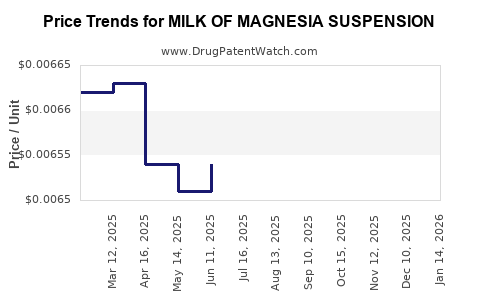
- Prices have remained stable over recent years, with slight increases reflecting inflation and manufacturing costs.
- Generics continue to challenge branded products by offering lower prices.
What Price Projections Are Expected?
Short-Term (Next 2-3 Years)
- Prices are expected to remain stable with minor fluctuations, barring supply chain disruptions.
- Retail prices could increase by 1-2%, driven by inflation and raw material costs.
Long-Term (Next 5-10 Years)
- Price growth could match or slightly exceed inflation rates, approximately 2-3% annually.
- Increased competition and market saturation might pressure prices downward unless product innovation or branding strategy shifts.
Influencing Factors
- Raw material prices, notably magnesium hydroxide.
- Regulatory changes affecting packaging or labeling.
- Trends toward natural or organic laxatives potentially affecting demand and pricing.
Key Takeaways
- The global market for milk of magnesia suspension is expanding steadily, with growth driven by demographic shifts and OTC demand.
- The product remains competitively priced, especially in generic markets, with stable retail prices expected in the near term.
- Price increases are likely to be modest, aligned with inflation, but long-term trends could be influenced by supply chain dynamics, regulation, and market competition.
- The market's future depends on innovations, regulatory adaptations, and evolving consumer preferences.
FAQs
1. How does milk of magnesia compete with other laxatives?
It competes primarily on cost-effectiveness, ease of use, and established efficacy, but faces competition from stimulant, fiber-based, and newer natural remedies.
2. Are there regulatory hurdles affecting the pricing or availability?
Regulations primarily govern labeling and marketing. OTC status minimizes entry barriers, but different international standards influence market access and pricing.
3. What factors could cause prices to fluctuate significantly?
Raw material shortages, regulatory restrictions, supply chain shocks, or sudden shifts in consumer preferences toward natural remedies.
4. How does online sales impact pricing?
Online channels typically offer lower prices, with reduced overhead and increased competition, affecting brick-and-mortar retail pricing strategies.
5. What potential developments could influence the market in the next decade?
Product formulation innovations, increased natural or organic offerings, and regulatory developments, especially relating to OTC drug classifications, could influence future market conditions.
References
[1] Research and Markets, "Laxatives Market Report," 2022.
[2] Independent market research reports on OTC laxatives, 2022-2023.