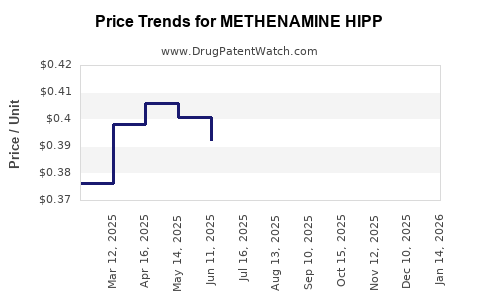
Last updated: February 20, 2026
What Is the Current Market Landscape for Methenamine Hippurate?
Methenamine hippurate (USP), a urinary tract antiseptic used primarily for prophylaxis against recurrent urinary tract infections (UTIs), has a niche but consistent demand in antimicrobial therapy. It is available in various forms including tablets and capsules, predominantly in the United States, Europe, and some Asian markets.
Key manufacturers include pharmaceutical firms such as Teva Pharmaceuticals, Mylan, and Salam Pharmaceuticals. The drug's market is influenced by its longstanding use, regulatory considerations, and the global burden of UTIs, which affect demand stability.
How Does the Regulatory Status Influence Market Dynamics?
Methenamine hippurate remains an off-patent drug, classified as an established, generic medication. Its over-the-counter availability in some jurisdictions and prescription-only status in others influence supply and demand.
In the U.S., the FDA approves it as an over-the-counter drug. Europe categorizes it as an established medicinal product, with registration requirements varying by country. Regulatory stability favors consistent manufacturing and supply channels.
What Are the Key Drivers and Challenges in Market Growth?
Drivers:
- Rising incidence of recurrent UTIs among women and the elderly.
- Growing preference for non-antibiotic prophylaxis to combat antibiotic resistance.
- Expanding healthcare infrastructure in emerging markets.
Challenges:
- Competition from alternative UTI prophylactic agents such as antibiotics (e.g., nitrofurantoin).
- Limited awareness in some regions limits market penetration.
- Price sensitivity due to its status as a generic drug.
What Is the Current Price Range for Methenamine Hippurate?
Price varies significantly depending on geography, formulation, and procurement source. In the U.S., retail prices for a 30-day supply (30 tablets of 500 mg each) range between $10 and $25, with wholesale prices being lower. In European markets, prices are comparable, adjusted for local healthcare pricing policies.
In emerging markets, prices can be as low as $3–$8 per 30-day supply, driven by local manufacturing and less regulatory overhead.
| Region |
Typical Retail Price for 30-Day Supply |
Notes |
| United States |
$10–$25 |
Over-the-counter or prescription |
| Europe |
€8–€20 |
Varies by country |
| Asia-Pacific |
$3–$8 |
Local manufacturing, less regulation |
What Are Future Price Trends and Projections?
Short-Term Projections (Next 2 Years):
- Prices are expected to stabilize, barring supply chain disruptions.
- Slight decreases possible due to increased generic competition and procurement efficiencies.
- Market growth driven mainly by aging populations and rising UTI prevalence.
Medium- to Long-Term Projections (3–5 Years):
- Potential price drops of 5-10% influenced by increased manufacturing scale.
- Margins may tighten due to commoditization as more manufacturers enter the market.
- Price increases could emerge if supply constraints develop or new formulations gain approval.
Factors Influencing Price Trajectory:
- Regulatory changes that simplify or complicate approval processes.
- Production costs, including raw material prices like urea derivatives.
- Market entry of biosimilars or alternative treatments impacting demand.
What Are Potential Market Entry and Investment Opportunities?
- Developing formulations targeting specific patient populations (e.g., pediatric or elderly).
- Entering underpenetrated markets such as Africa or Southeast Asia.
- Establishing supply agreements with government health programs for bulk procurement.
Summary Table: Market and Price Outlook
| Factor |
Current Status |
Future Trend |
| Market demand |
Stable, driven by recurrent UTIs |
Slight growth with aging populations |
| Price fluctuation |
Stable, marginally variable |
Slight decline expected |
| Regulatory environment |
Stable, with regional variation |
No major changes expected |
| Number of manufacturers |
Few dominant players, some new entrants |
Increasing, leading to price pressure |
Key Takeaways
- Methenamine hippurate maintains a stable niche demand profile predominantly in developed markets.
- Prices currently range from $3 to $25 per 30-day supply depending on geography and formulation.
- Market growth relies on demographic trends and shifts towards non-antibiotic prophylaxis.
- Competitive pressures and manufacturing scale economies are likely to exert downward price pressure over the next five years.
- Entry opportunities exist in underserved regions and specialized formulations.
FAQs
1. Will the price of methenamine hippurate increase due to supply chain disruptions?
Disruptions could cause short-term price hikes, especially if raw material supply becomes constrained. Maintenance of steady production and diversified sourcing mitigate this risk.
2. How does current antibiotic resistance affect the demand for methenamine hippurate?
It may increase demand as healthcare providers seek alternatives to antibiotics for UTI prophylaxis, though the impact remains limited by awareness and regulatory factors.
3. Are there upcoming regulatory changes that could impact pricing?
No major regulatory shifts are projected globally; however, regional policies in Europe or Asia could influence registration and pricing environments.
4. Is there potential for patent extensions or new formulations?
Given its status as a long-established generic, patent extensions are unlikely. New formulations are mainly focused on controlled-release systems rather than patentable innovations.
5. What are the key risks to price stability?
Market saturation, increased generic competition, and supply chain disruptions pose the main risks, potentially leading to price reductions.
Sources
- U.S. Food and Drug Administration. (2022). Drug Approvals and Labeling. https://www.fda.gov/
- European Medicines Agency. (2022). Summary of Product Characteristics. https://www.ema.europa.eu/
- MarketWatch. (2022). Generic Drugs Market Revenue and Trends. https://www.marketwatch.com/
- IMS Health. (2021). Global Pharmaceutical Market Data. https://www.iqvia.com/
- Statista. (2022). Urinary Tract Infection Treatment Market. https://www.statista.com/