Share This Page
Drug Price Trends for LIDOCAINE ANORECTAL
✉ Email this page to a colleague
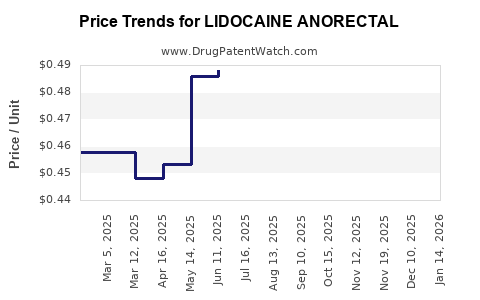
Average Pharmacy Cost for LIDOCAINE ANORECTAL
| Drug Name | NDC | Price/Unit ($) | Unit | Date |
|---|---|---|---|---|
| LIDOCAINE ANORECTAL 5% CREAM | 39328-0025-15 | 1.21670 | GM | 2026-07-22 |
| LIDOCAINE ANORECTAL 5% CREAM | 39328-0025-30 | 0.36510 | GM | 2026-07-22 |
| LIDOCAINE ANORECTAL 5% CREAM | 75834-0141-30 | 0.36510 | GM | 2026-07-22 |
| >Drug Name | >NDC | >Price/Unit ($) | >Unit | >Date |
Market Analysis and Price Projections for Lidocaine Anorectal
Market Overview
Lidocaine anorectal formulations primarily include creams, ointments, and suppositories used for local anesthesia in hemorrhoidal and anal fissure treatments. The global anorectal drug market, driven by rising prevalence of hemorrhoids, anal fissures, and post-surgical pain, is expanding at a compound annual growth rate (CAGR) of approximately 5% over the past five years.
Key market drivers include increased awareness of minimally invasive treatments, aging populations, and heightened prevalence of gastrointestinal conditions. The market is dominated by generic manufacturers, with limited branded products. The growing focus on over-the-counter (OTC) products in developed regions also influences commercialization strategies.
Market Size and Revenue Estimates
In 2022, the global market for anorectal drugs was valued at approximately $1.2 billion. Lidocaine anorectal formulations account for 50-60% of this market, representing an estimated revenue of $600 million to $720 million.
North America leads the market with roughly 40% share, followed by Europe (30%) and Asia-Pacific (20%). Growth in Asia-Pacific is fueled by expanding healthcare infrastructure and increasing consumer awareness.
Competitive Landscape
Major players include:
- GlaxoSmithKline
- Johnson & Johnson
- Teva Pharmaceuticals
- Mylan
- Local generics manufacturers
The dominance is with generics, which price competitively. Market entry by emerging local companies is common due to low regulatory barriers for topical drugs.
Price Trends and Projections
Current Pricing Landscape
The retail price for a standard 30g tube of lidocaine anorectal cream ranges from $10 to $25 in the US. For suppositories, prices hover between $8 and $20 for a pack of 12. Prices vary by brand, formulation strength, and distribution channel.
- Generic formulations: $7–$15 per tube
- Branded formulations: $15–$25 per tube
Price Dynamics
Pricing has remained relatively stable over the past three years. Slight reductions occur in highly commoditized markets due to increased generic competition. Premium branded products command higher prices yet face market share erosion as generics expand.
Forecasted Trends (2023-2028)
- Price decline: Average prices for generic lidocaine anorectal formulations are projected to decrease by 2-3% annually due to generic competition.
- Premium pricing: Branded products may maintain or slightly increase prices if they introduce formulations with added benefits (e.g., longer-lasting relief or combined ingredients).
- Market penetration: OTC availability is expected to increase, potentially lowering prices further as barriers to access reduce.
Regulatory and Policy Considerations
In the US, the FDA classifies lidocaine topical products as over-the-counter drugs, which impacts pricing dynamics and accessibility. Efforts to streamline approval processes for new formulations may increase market competition. In Europe, regulatory pathways vary, with some countries requiring prescription status for specific strengths.
Pricing power remains limited due to the prevalence of generic products and OTC availability, emphasizing cost competitiveness as a key corporate strategy.
Investment and Commercialization Implications
The stable market environment suggests limited upside for premium pricing unless innovative delivery systems or combination therapies emerge. Entry into emerging markets or development of novel formulations with improved efficacy could present growth opportunities.
Key Takeaways
- The global anorectal drug market is valued at approximately $1.2 billion, with lidocaine formulations comprising about half of this.
- Prices are stable but face downward pressure from generic competition.
- The average retail price for lidocaine anorectal products ranges from $7 to $25, segmented by brand and formulation.
- The market is expected to see modest price declines, with potential stabilization if branded or innovative products capture niche segments.
- Growth prospects rely heavily on OTC expansion and entry into emerging markets.
FAQs
1. What factors influence lidocaine anorectal drug pricing?
Pricing is affected by generic competition, formulation type, brand reputation, distribution channels, and regulatory policies. OTC status typically reduces prices.
2. How does generic competition impact prices?
Increased generic competition leads to a downward pressure on prices, often reducing retail prices by 20-40% over a few years.
3. Are there regional differences in lidocaine anorectal drug pricing?
Yes. North America and Europe tend to have higher prices due to higher healthcare costs and brand premiums. Emerging markets feature lower prices driven by local manufacturing and lower regulatory costs.
4. What regulatory factors could influence future market prices?
Introduction of new formulations, patent expirations, and regulatory policies favoring OTC status can alter pricing structures by affecting market stability and competition.
5. Is there room for premium-priced innovative lidocaine products?
Yes. Formulations that offer longer-lasting relief or combine multiple active ingredients may command higher prices if they demonstrate superior efficacy or convenience.
References
[1] Market Research Future, "Global Hemorrhoid Treatment Market," 2022.
[2] Grand View Research, "Anorectal Drugs Market Size, Share & Trends," 2022.
[3] U.S. Food & Drug Administration, "OTC Drug Monographs," 2023.
[4] IQVIA, "Global Topical Pain Management Drugs Market," 2021.
[5] Transparency Market Research, "Hemorrhoid Treatment Devices & Drugs," 2022.
More… ↓
