Share This Page
Drug Price Trends for KLOR-CON
✉ Email this page to a colleague
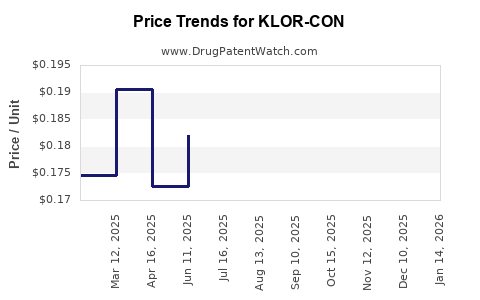
Average Pharmacy Cost for KLOR-CON
| Drug Name | NDC | Price/Unit ($) | Unit | Date |
|---|---|---|---|---|
| KLOR-CON 10 MEQ TABLET | 00245-0836-01 | 0.12348 | EACH | 2026-07-22 |
| KLOR-CON 10 MEQ TABLET | 00245-0836-11 | 0.12348 | EACH | 2026-07-22 |
| KLOR-CON 10 MEQ TABLET | 00245-0836-15 | 0.12348 | EACH | 2026-07-22 |
| KLOR-CON 10 MEQ TABLET | 00245-0836-89 | 0.12348 | EACH | 2026-07-22 |
| KLOR-CON 10 MEQ TABLET | 00245-5316-01 | 0.12348 | EACH | 2026-07-22 |
| KLOR-CON 10 MEQ TABLET | 00245-5316-11 | 0.12348 | EACH | 2026-07-22 |
| KLOR-CON 10 MEQ TABLET | 00245-5316-15 | 0.12348 | EACH | 2026-07-22 |
| >Drug Name | >NDC | >Price/Unit ($) | >Unit | >Date |
KLOR-CON Market Analysis and Price Projections
What is KLOR-CON?
KLOR-CON is an orally administered potassium supplement formulated for the treatment and prevention of hypokalemia. It is available in extended-release tablets. The active pharmaceutical ingredient is potassium chloride.
What are the approved indications for KLOR-CON?
KLOR-CON is indicated for the treatment and prevention of potassium deficiency, commonly referred to as hypokalemia. This condition arises when blood potassium levels fall below the normal range, which can impair nerve and muscle function, including the heart.
What is the current market landscape for potassium chloride supplements?
The market for potassium chloride supplements is mature and highly competitive. Numerous generic and branded products are available, offering various dosages and formulations. Major players include generic manufacturers and established pharmaceutical companies. The market is characterized by price sensitivity due to the over-the-counter availability of many potassium supplements and the presence of generic alternatives to prescription-grade products.
What factors influence KLOR-CON's market performance?
Several factors influence KLOR-CON's market performance:
- Prescription volume: The primary driver is physician prescribing habits. Prescriptions are driven by the prevalence of hypokalemia and the clinical perception of KLOR-CON's efficacy and safety profile.
- Generic competition: The availability of lower-cost generic potassium chloride tablets and capsules significantly impacts pricing and market share.
- Insurance formulary placement: Inclusion on insurance formularies and preferred drug lists can influence physician prescribing and patient out-of-pocket costs, affecting demand.
- Pricing strategies: Manufacturers' pricing strategies, including wholesale acquisition costs and patient assistance programs, play a crucial role in market penetration and affordability.
- Regulatory landscape: Compliance with FDA regulations regarding manufacturing, labeling, and marketing is essential.
- Prevalence of conditions leading to hypokalemia: Conditions such as diuretic use, gastrointestinal losses (vomiting, diarrhea), and certain endocrine disorders contribute to the incidence of hypokalemia, thereby influencing demand for potassium supplements.
- Availability of alternative treatments: While potassium chloride is the standard, the availability and perceived benefits of other potassium salt formulations or alternative therapies can influence market dynamics.
What is KLOR-CON's patent status and its implications?
KLOR-CON is marketed by Upsher-Smith Laboratories. As of current data, the primary patents associated with the extended-release formulation of potassium chloride, including those that may cover KLOR-CON, have expired. For instance, U.S. Patent No. 4,980,177, which claimed a process for producing potassium chloride particles for extended-release formulations, expired in 2010. [1]
The expiration of key formulation patents allows for generic competition. This typically leads to a significant decline in the market share and revenue of the branded product as generic versions enter the market at lower price points.
What is the estimated current market size for KLOR-CON?
Precise, publicly disclosed market size data specifically for KLOR-CON is not readily available. However, the broader prescription potassium chloride market is estimated to be in the hundreds of millions of dollars annually. Given that KLOR-CON is a branded product facing significant generic competition, its individual market share and revenue are likely a fraction of this total market.
What are the projected price trends for KLOR-CON?
The price trend for KLOR-CON is expected to be downward, driven by ongoing generic competition.
- Wholesale Acquisition Cost (WAC): The WAC for branded KLOR-CON has historically been higher than generic alternatives. Post-patent expiration, the WAC has likely already seen significant reductions to remain competitive. Further minor reductions may occur due to market pressures, but substantial declines are unlikely without new market entrants significantly undercutting existing pricing.
- Average Selling Price (ASP): The ASP, which reflects net revenue after discounts and rebates, will continue to be influenced by the pricing of generics. As more generic versions gain market share, payers and pharmacy benefit managers (PBMs) will exert further downward pressure on pricing.
- Patient Out-of-Pocket Costs: For patients with commercial insurance, out-of-pocket costs will depend on formulary placement and co-payment structures, which are increasingly tiered to favor generics. For patients without insurance or with high-deductible plans, the cost will be directly influenced by the prevailing WAC and any available discount programs.
Projected Price Trajectory (Next 3-5 Years):
| Metric | Current Trend | Projected Trend (3-5 Years) |
|---|---|---|
| Wholesale Acquisition Cost | Stable to marginal decline | Stable to marginal decline; potential for minor competitive reductions |
| Average Selling Price | Declining due to generic penetration | Continued decline, driven by generic price erosion |
| Patient Out-of-Pocket | Variable (insurance dependent), higher for brand | Likely to increase for brand if generics are preferred by payers |
What are the key competitive products and companies?
The competitive landscape for prescription potassium chloride is dominated by generic manufacturers.
Key Generic Competitors:
- Various Generic Manufacturers: Companies such as Teva Pharmaceuticals, Sandoz (a Novartis division), Hikma Pharmaceuticals, and numerous others produce generic potassium chloride extended-release tablets.
- Potassium Chloride ER Tablets (20 mEq/10 mEq): These are the direct competitors to KLOR-CON.
Branded Products (Historically or Currently):
- K-Tab (Potassium Chloride Extended-Release Tablets): Formerly a significant competitor, also facing generic pressure.
- Klor-Con 10 (Potassium Chloride Extended-Release Tablets): A specific dosage strength offered by Upsher-Smith.
The primary competitive dynamic is the price differential between branded KLOR-CON and its generic equivalents.
What are the potential future market developments?
- Continued Generic Erosion: The market share of branded KLOR-CON will likely continue to decline as generic penetration increases. Upsher-Smith may focus on maintaining a smaller, niche market share or explore other product opportunities.
- Pricing Adjustments by Upsher-Smith: To remain competitive, Upsher-Smith may implement further pricing adjustments or enhance patient assistance programs, although the effectiveness of such measures is limited in a highly commoditized market.
- Innovation in Potassium Supplementation: While unlikely to disrupt the immediate market for simple potassium chloride deficiency, future developments could involve novel delivery systems or formulations that offer improved absorption, reduced gastrointestinal side effects, or combination therapies for more complex electrolyte imbalances. However, for straightforward hypokalemia, the cost-effectiveness of generics makes significant innovation challenging to monetize.
- Payer Policies: Increased emphasis on value-based purchasing and formulary restrictions favoring generics by payers and PBMs will continue to shape prescribing patterns and market access.
Key Takeaways
KLOR-CON operates within a mature and price-sensitive market for potassium chloride supplements. The expiration of its primary formulation patents has opened the door for extensive generic competition, a trend that is expected to continue. This competitive pressure is the primary driver for projected downward price trends for both wholesale acquisition costs and average selling prices. Upsher-Smith Laboratories, the marketer of KLOR-CON, faces challenges in maintaining market share and revenue against lower-cost generic alternatives. Future market developments will likely be characterized by further generic erosion, ongoing price adjustments, and continued influence from payer policies favoring cost-effective generic options.
Frequently Asked Questions
-
Will the price of KLOR-CON increase significantly in the next five years? No, significant price increases for KLOR-CON are unlikely. The market is dominated by generic competition, which exerts consistent downward pressure on pricing. Minor fluctuations may occur due to manufacturing costs or strategic decisions, but a substantial upward trend is not anticipated.
-
Are there any new patents expected to protect KLOR-CON's formulation? Given the age of the core formulation patents, it is improbable that new patents offering significant market exclusivity for the current KLOR-CON formulation will be granted or will be substantial enough to deter generic entry. Focus would likely shift to incremental improvements or new product lines if pursued.
-
What is the typical market share difference between branded KLOR-CON and its generic equivalents? Branded products typically hold a minority market share in a market with widespread generic availability. For potassium chloride extended-release tablets, generic versions likely account for over 80% of the prescription volume.
-
How do insurance companies influence the demand for KLOR-CON versus generics? Insurance companies, through their formulary design and tiered co-payment structures, strongly influence demand. They typically place generic potassium chloride at lower cost-sharing tiers, making them more attractive to patients and physicians, thereby reducing demand for branded KLOR-CON.
-
What are the primary risks to KLOR-CON's continued market presence? The primary risks are intensified generic competition, further aggressive pricing by generic manufacturers, and stricter formulary management by payers that may limit or remove branded KLOR-CON from preferred drug lists, making it less accessible to patients.
Citations
[1] U.S. Patent No. 4,980,177. (1990). Process for producing potassium chloride particles for extended release formulations. Retrieved from USPTO Patent Database.
More… ↓
