You're using a free limited version of DrugPatentWatch: Upgrade for Complete Access

Last Updated: December 12, 2025

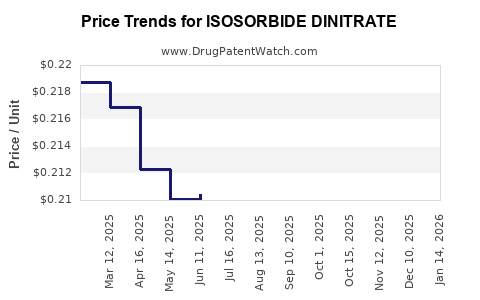
Drug Price Trends for ISOSORBIDE DINITRATE


✉ Email this page to a colleague

« Back to Dashboard


Drug Price Trends for ISOSORBIDE DINITRATE

Average Pharmacy Cost for ISOSORBIDE DINITRATE

These are average pharmacy acquisition costs (net of discounts) from a US national survey
Drug Name NDC Price/Unit ($) Unit Date
ISOSORBIDE DINITRATE 10 MG TAB 00143-1771-10 0.20275 EACH 2025-11-19
ISOSORBIDE DINITRATE 10 MG TAB 00781-1556-10 0.20275 EACH 2025-11-19
ISOSORBIDE DINITRATE 10 MG TAB 00904-6619-61 0.20275 EACH 2025-11-19
ISOSORBIDE DINITRATE 10 MG TAB 00781-1556-01 0.20275 EACH 2025-11-19
ISOSORBIDE DINITRATE 5 MG TAB 72888-0081-01 0.19380 EACH 2025-11-19
>Drug Name >NDC >Price/Unit ($) >Unit >Date

Best Wholesale Price for ISOSORBIDE DINITRATE

These are wholesale prices available to the US Federal Government which, by law, must be the best prices available to any customer under comparable terms and conditions
Drug Name Vendor NDC Count Price ($) Price/Unit ($) Unit Dates Price Type
ISOSORBIDE DINITRATE 20MG TAB,ORAL Golden State Medical Supply, Inc. 49884-0022-01 100 28.05 0.28050 EACH 2023-06-15 - 2028-06-14 FSS
ISOSORBIDE DINITRATE 30MG TAB,ORAL Golden State Medical Supply, Inc. 49884-0009-10 1000 718.65 0.71865 EACH 2023-06-15 - 2028-06-14 FSS
ISOSORBIDE DINITRATE 20MG TAB,ORAL Golden State Medical Supply, Inc. 49884-0022-10 1000 273.90 0.27390 EACH 2023-06-15 - 2028-06-14 FSS
ISOSORBIDE DINITRATE 30MG TAB,ORAL Golden State Medical Supply, Inc. 49884-0009-10 1000 765.36 0.76536 EACH 2023-06-23 - 2028-06-14 FSS
ISOSORBIDE DINITRATE 5MG TAB,ORAL Golden State Medical Supply, Inc. 49884-0020-01 100 14.85 0.14850 EACH 2023-06-15 - 2028-06-14 FSS
>Drug Name >Vendor >NDC >Count >Price ($) >Price/Unit ($) >Unit >Dates >Price Type
Price type key: Federal Supply Schedule (FSS): generally available to all Federal Govt agencies / 'BIG4' prices: VA, DoD, Public Health & Coast Guard only / National Contracts (NC): Available to specific agencies

Market Analysis and Price Projections for ISOSORBIDE DINITRATE

Last updated: July 27, 2025


Introduction

Isosorbide dinitrate (ISDN) is a nitrate vasodilator primarily used to manage angina pectoris and chronic heart failure. Known for its vasodilatory properties, it reduces myocardial oxygen demand by dilating veins and arteries, improving blood flow. The drug’s longstanding clinical utility, combined with ongoing cardiovascular disease (CVD) prevalence, sustains consistent demand. This analysis explores market trends, key drivers, competitive landscape, regulatory environment, and projected pricing trajectories for ISDN over the coming years.


Global Market Overview

The global cardiovascular disease burden remains high, with projected growth driven by aging populations, sedentary lifestyles, and rising prevalence of hypertension and hyperlipidemia—risk factors for angina and heart failure. Consequently, the demand for vasodilators, including ISDN, is anticipated to strengthen.

The market for nitrates like ISDN is concentrated in North America, Europe, and Asia-Pacific. North America leads due to high cardiovascular disease prevalence, advanced healthcare infrastructure, and established generic markets. The Asia-Pacific region shows significant growth potential due to expanding healthcare access and increasing CVD awareness, despite price sensitivities.

Market Size Estimates:
Preliminary assessments, as of 2022, place the global market for nitrates, including ISDN, in the vicinity of USD 500 million, with an anticipated compound annual growth rate (CAGR) of approximately 3-4% over the next five years. The sustained demand for generic formulations, especially in developing markets, underscores market stabilization with potential for incremental expansion.


Key Market Drivers

  1. Rising CVD Incidence:
    The global surge in CVD cases directly correlates with increased usage of vasodilators such as ISDN for symptom management and prophylaxis.

  2. Established Generic Market:
    Patent expirations of branded ISDN formulations have led to a proliferation of generics, reducing prices but expanding accessibility, particularly in cost-sensitive markets.

  3. Increased Off-Label Uses:
    Research exploring ISDN for conditions like pulmonary hypertension and certain neurological disorders could open new markets, although these are not yet mainstream indications.

  4. Healthcare Infrastructure Expansion:
    Improved healthcare delivery and medication adherence initiatives support continued demand for affordable nitrate therapies.


Competitive Landscape

The ISDN market is highly competitive, characterized predominantly by generic manufacturers. Major players include Teva Pharmaceuticals, Mylan (now part of Viatris), Dr. Reddy’s Laboratories, and pharmaceutical companies in India and China, which supply both export markets and domestic needs.

Branded formulations, such as Isordil (Pfizer), now lack market dominance due to patent expiry, leaving generics to capture most of the market share. Pricing strategies often focus on cost leadership to penetrate emerging markets.

Market Challenges:

  • Price Sensitivity: Particularly in low- and middle-income countries, constraining revenues of higher-cost formulations.
  • Regulatory Barriers: Stringent approval processes may delay launches of new formulations or formulations with improved bioavailability.
  • Supply Chain Disruptions: Especially for raw materials sourced from regions with geopolitical concerns or manufacturing challenges.

Regulatory Environment

Regulatory bodies like the U.S. FDA and EMA classify ISDN as a generic drug, with approvals contingent on bioequivalence and manufacturing standards. Regulatory trends favor streamlined approval pathways for generics, bolstering market entry.

In regions with evolving pharmacovigilance requirements, manufacturers must maintain rigorous quality controls to sustain compliance. The future may see incentives for formulations with extended-release capabilities or novel delivery systems, encouraging innovation within regulatory frameworks.


Price Projections (2023–2028)

Current Pricing Landscape:
Generic ISDN formulations, typically 30 mg to 120 mg tablets, are priced variably across markets. In developed countries like the U.S., a typical monthly supply of generic ISDN costs between USD 10–30, depending on formulation and insurance coverage. In developing nations, prices can be substantially lower, aligning with healthcare budget constraints.

Projected Price Trends:

  • Price Stability or Slight Decline: Given the mature nature of the market and high generic competition, prices are unlikely to increase significantly.
  • Potential for Price Compression: Introduction of new extended-release formulations or bioequivalent products may induce further price reductions to gain market share.

Forecast:

  • In North America and Europe, the average market price for a standard dose of ISDN is expected to decline modestly (~1-2% annually) through 2028.
  • In emerging markets, prices will stabilize or slightly decrease due to increased competition and procurement efforts by government health programs.
  • The proliferation of low-cost manufacturing, especially from Asian producers, will exert downward pressure on prices globally.

Future Market Opportunities

While ISDN remains a cornerstone in angina management, innovation in formulation—such as transdermal patches and extended-release tablets—can enhance adherence and therapeutic efficacy. Such developments may command premium pricing, balancing the overall market’s downward pressure.

Moreover, expanding indications, including potential off-label uses or adjunct therapy in heart failure, could marginally buoy revenues. However, these markets remain relatively niche compared to core angina therapy.


Key Market Risks

  • Patent and Regulatory Challenges: Although patent expiry favors generics, future patent protections for new formulations could temporarily disrupt pricing trajectories.
  • Market Saturation: High generic penetration limits significant price increases; growth is primarily tied to increased volume rather than price hikes.
  • Health System Constraints: Budget caps and reimbursement policies in several countries can suppress drug prices and limit market growth.

Conclusion

The ISDN market exhibits mature characteristics, dominated by generic manufacturers with limited room for substantial price increases. The overarching trend remains a gradual decline in prices, driven by fierce competition and manufacturing efficiencies, especially in low-cost regions. Despite this, steady demand persists fueled by the high prevalence of cardiovascular diseases.

Expect continued moderate growth in global demand, aligning with rising CVD demographics, with price projections indicating sustained downward or stable trajectories through 2028. Strategic emphasis on formulation innovation and expanding indications may offer avenues for premium pricing and market differentiation.


Key Takeaways

  • Market size for ISDN remains steady, with estimates around USD 500 million globally, growing at 3-4% CAGR driven by CVD prevalence.
  • Generic competition dominates, leading to modest or declining prices, particularly in developed markets.
  • Regulatory pathways favor generics, reducing barriers to entry but limiting pricing power.
  • Innovation in formulations (e.g., extended-release patches) offers potential for premium products, though expected to complement rather than replace existing generics.
  • Emerging markets present growth opportunities due to expanding healthcare infrastructure but pose pricing challenges from high competition.

FAQs

1. How does patent expiration influence the ISDN market?
Patent expiration allows generic manufacturers to introduce bioequivalent products, significantly increasing supply and driving down prices. This fosters broader access but limits profit margins for original branded formulations.

2. What are emerging trends in ISDN formulation technology?
Developments include extended-release formulations, transdermal patches, and combination therapies to improve adherence and efficacy. Such innovations may command higher prices and serve niche markets.

3. How does regional regulation impact ISDN pricing?
Regulatory bodies’ requirements for bioequivalence and manufacturing quality influence entry costs and timelines, indirectly affecting prices. Regions with streamlined approval pathways tend to see more rapid market entry and price competition.

4. What is the forecast for ISDN demand in Asia-Pacific?
Demand is projected to grow steadily owing to increasing CVD prevalence, expanding healthcare coverage, and government initiatives. Price pressures may be higher due to aggressive local manufacturing.

5. Are there any significant barriers to market entry for new manufacturers?
While regulatory hurdles exist, the primary barrier is the high level of existing generic saturation. Entry requires substantial investment with limited scope for premium pricing unless new formulations or indications are introduced.


References

  1. WHO Global status report on noncommunicable diseases 2014.
  2. MarketWatch Reports on Cardio-vascular Drugs, 2022.
  3. IMS Health Data, 2022.
  4. FDA Drug Approvals and Bioequivalence Guidelines, 2022.
  5. Deloitte Pharmaceutical Industry Outlook, 2022.

More… ↓

⤷  Get Started Free

Make Better Decisions: Try a trial or see plans & pricing

Drugs may be covered by multiple patents or regulatory protections. All trademarks and applicant names are the property of their respective owners or licensors. Although great care is taken in the proper and correct provision of this service, thinkBiotech LLC does not accept any responsibility for possible consequences of errors or omissions in the provided data. The data presented herein is for information purposes only. There is no warranty that the data contained herein is error free. We do not provide individual investment advice. This service is not registered with any financial regulatory agency. The information we publish is educational only and based on our opinions plus our models. By using DrugPatentWatch you acknowledge that we do not provide personalized recommendations or advice. thinkBiotech performs no independent verification of facts as provided by public sources nor are attempts made to provide legal or investing advice. Any reliance on data provided herein is done solely at the discretion of the user. Users of this service are advised to seek professional advice and independent confirmation before considering acting on any of the provided information. thinkBiotech LLC reserves the right to amend, extend or withdraw any part or all of the offered service without notice.