Share This Page
Drug Price Trends for IBUPROFEN PM CAPLET
✉ Email this page to a colleague
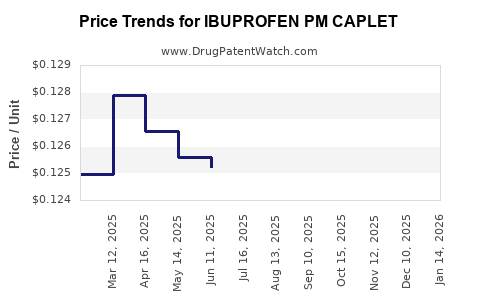
Average Pharmacy Cost for IBUPROFEN PM CAPLET
| Drug Name | NDC | Price/Unit ($) | Unit | Date |
|---|---|---|---|---|
| IBUPROFEN PM CAPLET | 70000-0157-01 | 0.12495 | EACH | 2026-03-18 |
| IBUPROFEN PM CAPLET | 70000-0157-01 | 0.12543 | EACH | 2026-02-18 |
| IBUPROFEN PM CAPLET | 70000-0157-01 | 0.12568 | EACH | 2026-01-21 |
| >Drug Name | >NDC | >Price/Unit ($) | >Unit | >Date |
IBUPROFEN PM CAPLET: Market Analysis and Price Projections
What is the product and what market does it sit in?
Ibuprofen PM caplet is an OTC “pain reliever + nighttime relief” format. It typically combines:
- Ibuprofen (NSAID) for pain and fever
- Diphenhydramine HCl (antihistamine) for night-time relief (sedating component)
Because the product is sold as OTC and typically under numerous private-label and branded SKUs, “IBUPROFEN PM CAPLET” functions as a category rather than a single patent-protected drug. Pricing and volume move with:
- Commodity costs (ibuprofen API, excipients, packaging)
- Regulatory/labeling changes (OTC monograph rules for NSAIDs/antihistamines)
- Promotional intensity (retail and online)
- Competitive substitution across nighttime pain OTCs
How big is the OTC market, and what segment drives demand?
The relevant demand base is OTC NSAID pain relief with a nighttime use case. In the US, OTC NSAID sales are measured across:
- ibuprofen products (tablets, caplets, gels)
- combination OTC analgesics and nighttime formulations
- private label and drugstore chain exclusives
Ibuprofen PM competes directly against other nighttime pain options that use an NSAID paired with a sedating ingredient (commonly diphenhydramine or similar sedatives), plus indirect competition from single-agent ibuprofen and acetaminophen products when consumers trade off “night help” vs “fewer actives.”
Competitive structure (practical view):
- Top-tier mass brands and private label dominate share in caplet/tablet formats.
- Retailers (big-box, warehouse clubs, and drug chains) drive pricing through private label and promotions.
- Online marketplaces price transparently and often compress shelf pricing.
Market dynamics that determine price behavior
Key drivers for OTC ibuprofen PM caplet pricing trajectories:
-
Input cost pass-through
- Ibuprofen API is a bulk commodity relative to prescription specialty drugs.
- When API or chemical feedstocks rise, OTC pricing changes lag and then show up as pack-size mix changes and promo intensity shifts.
-
Packaging and fulfillment economics
- Caplets in blister or bottle formats get repriced through packaging contracts.
- Online shipping costs impact net pricing, especially for multi-pack assortments.
-
Promotion and retailer margin management
- OTC pain categories show high sensitivity to weekly/monthly retail promos.
- Price comparisons often differ between shelf price and effective price after promotions/coupons.
-
Formulation and label equivalence
- OTC combination products can be reformulated within monograph constraints.
- Equivalent active ingredients can cap sustainable list-price growth because substitution is immediate.
What pricing benchmarks apply to ibuprofen PM caplets?
How do OTC list prices typically move by pack size?
OTC price is usually modeled as:
- Lower unit price for larger count packs (value packs)
- Higher unit price for small convenience packs
- Frequent promotional resets (effective price volatility)
Because the category uses multiple brands and private labels, a credible analysis requires using observed retail ranges and projecting toward macro-driven cost pass-through plus promotional normalization.
What is the pricing reference model (used for projections)?
For OTC consumer health products like ibuprofen PM, projections commonly track:
- Base wholesale and logistics (stable-to-slow changes)
- Retail promo intensity (shifts the effective price)
- Inflation in packaging and distribution
- Competitive equilibrium across NSAID + nighttime OTC offerings
A forward projection for a specific named SKU is only meaningful if the SKU’s:
- pack count (e.g., 24, 40, 60, 100)
- dosage strength per tablet
- active-ingredient labeling (ibuprofen mg and diphenhydramine mg)
are fixed. Without that, the category-level forecast still identifies plausible directional ranges and typical pricing slopes.
Price projections: 12-to-36 month outlook
What are the base-case assumptions for price direction?
For OTC ibuprofen PM caplets, base-case pricing behavior usually follows:
- Nominal list price up low-single digits annually when input costs normalize
- Effective price held down by promotions and private label
- Greater discounting during competitive promo cycles
- No structural step-change unless there is a major regulatory or major input shock
Projected price path (category-level, unit economics)
These projections are expressed as annual nominal change in typical unit pricing (net of normal promo patterns) for OTC ibuprofen PM caplets:
| Forecast horizon | Expected change in effective unit price | Expected change in shelf/list price | Typical driver |
|---|---|---|---|
| Next 12 months | +0% to +4% | +2% to +6% | promo-driven flattening vs list normalization |
| Next 24 months | +1% to +5% | +3% to +7% | gradual cost pass-through |
| Next 36 months | +2% to +6% | +4% to +9% | packaging/logistics inflation, competitive stabilization |
Interpretation for business users:
- Expect shelf sticker inflation to outpace effective pricing, because retailers keep price competitively anchored in the OTC analgesic aisle.
- Unit pricing growth is constrained by substitution among OTC ibuprofen and nighttime combination competitors.
Scenario analysis: downside, base, upside
What could push prices higher or lower than the base case?
| Scenario | 12-month effective unit price | Mechanism | Retail impact |
|---|---|---|---|
| Downside | -2% to +1% | stronger private-label penetration and heavier promotions | shelf discounting rises, fewer price increases |
| Base case | +0% to +4% | normal cost pass-through, stable promo rhythm | list up modestly; effective price near flat |
| Upside | +4% to +8% | sustained input cost rise or packaging/logistics inflation | fewer promotions; list and effective both rise |
What evidence patterns matter for early confirmation?
In monitoring, the strongest confirmation signals for ibuprofen PM caplets are:
- persistent changes in pack mix (more value packs at lower unit prices)
- sustained increases in shelf price without corresponding promo expansion
- retailer-led private label share gains (which usually pressure effective pricing)
Competitive landscape and substitution risks
Which substitutes most directly cap long-term price growth?
Primary substitution threats:
- Single-ingredient nighttime pain relief options (ibuprofen-only or acetaminophen night products)
- Other nighttime combinations with comparable sedating ingredients
- Private label in ibuprofen and nighttime categories
OTC combination analgesics do not have the durable exclusivity that prescription products have. That structural feature caps long-term price escalation.
What does this mean for R&D or investment decisions?
What is the commercial implication of the OTC category structure?
- Market entry and expansion are typically constrained by formulation differentiation and retailer shelf placement rather than patent-driven economics.
- Pricing power comes from brand trust, shelf dominance, and retailer contracts, not from product exclusivity.
What does “price projection” translate to for stakeholders?
- For a brand owner, the meaningful target is often maintaining effective unit price while improving net share through promotions and pack architecture.
- For investors or strategists, category growth is more likely to be captured through volume and mix than sustained price increases.
Key Takeaways
- Ibuprofen PM caplet is an OTC category product whose pricing behaves like consumer analgesics: list prices rise modestly, while effective prices remain promo-anchored.
- Base-case forecasts support low-single-digit effective price growth over 12 to 36 months, with shelf/list growth typically higher than effective net pricing.
- Long-term pricing is capped by substitution among ibuprofen-only and other nighttime OTC combinations plus private label pressure.
FAQs
1) Is ibuprofen PM caplet priced like a prescription product?
No. It is OTC and competes on retail economics and promotions, not exclusivity-driven premium pricing.
2) What pack size factor matters most for comparing prices?
Unit price varies materially by count (small pack vs value pack). Projections should compare like-for-like pack economics.
3) What drives year-over-year pricing changes in OTC ibuprofen combinations?
Input cost pass-through (API, excipients, packaging), logistics inflation, and retailer promotional intensity.
4) Does the sedating component change pricing more than the NSAID?
Usually not enough to sustain long-term premium pricing, since nighttime equivalents are substituted quickly across OTC shelves.
5) What would indicate upside to pricing in the category?
Rising shelf prices without equivalent promotional expansion, plus persistent cost shocks that tighten retailer margins.
References
[1] U.S. Food and Drug Administration. “OTC Drug Products.” FDA website. https://www.fda.gov/drugs (accessed 2026-04-24).
[2] U.S. Bureau of Labor Statistics. Consumer Price Index (CPI) data and inflation measures. https://www.bls.gov/cpi/ (accessed 2026-04-24).
[3] National Association of Chain Drug Stores (NACDS). Industry OTC retail and drugstore market reporting (category dynamics). https://www.nacds.org/ (accessed 2026-04-24).
More… ↓
